Collectives in the Spanish Revolution by Leval Gaston; García-Guirao Pedro; Richards Vernon
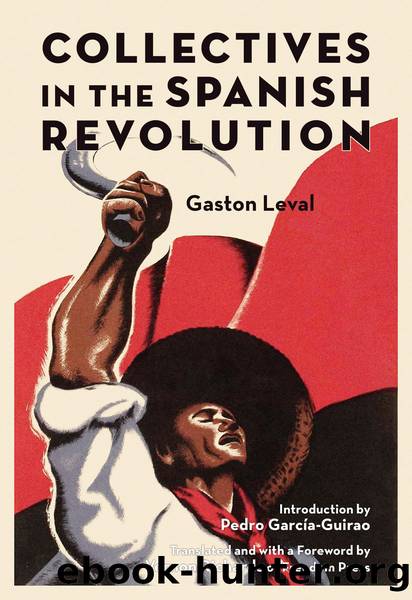
Author:Leval, Gaston; García-Guirao, Pedro; Richards, Vernon
Language: eng
Format: epub
Publisher: PM Press
Published: 2018-11-15T00:00:00+00:00
From the economic point of view, the Collectives in Castile did not always have the same organic structure that one finds, for instance, in those of Aragon. Often they could only develop in the vast estates which the socialising peasants took possession of. On the other hand, and as in Andalusia, some estates were so large that with the personnel settled on them they literally constituted socio-economic units, so that an isolated Collective could nevertheless be a very important one. But it was also the case that within the jurisdiction of some villages many scattered Collectives were linked together by a coordinating local Comité. In other cases practically the whole village was collectivised, or the part of it that was constituted a homogeneous and integrated unity in the multiplicity of the general activities.
For whatever may have been the significance of those realisations, all of them, from the beginning, tended to unify and even, to use a verb dear to Bakunin, to âsolidariserâ* their action. It explains why each Collective belonging to the cantonal Federation, after covering its expenses (payment of wages or transfersâthe word âwagesâ was repugnant to most peopleâpurchase of fertilisers, seed, machines, school outgoings, sanitation, etc.) would send any cash surplus to the âCantonal Equalisation Fundâ. This Fund, the administrators of which were nominated by a general assembly of delegates from the Collectives and responsible to them, had as its main function the distribution of moneys, supplied by the more favoured Collectives, among the less favoured ones.
Thus, as in Aragon, the libertarian communist principle was applied not only within each Collective, but between all the Collectives. No village ravaged by a hailstorm, or drought, or frost and receiving compensation for the damage sustained, was expected to reimburse a penny of what it had received.
But the federal Equalisation Fund had also other functions. It was not enough to help the village or isolated Collective which was through no fault of its own constantly in the red. With the help of the specialists from the Comité of the federation of the Centre it looked into ways and means for remedying the difficulties by improving yields in agriculture and by organising auxiliary industries.
As in the case of other regions in Spain, all the cantonal funds in the Central region were federated. The headquarters were in Madrid. The region thus constituted a unity the parts of which freely settled local problems, but also, generally speaking, common problems such as those concerned with production. In a year the Madrid Comité distributed a million pesetas worth of fertilisers and machines to the poorest Collectives.7 It had obtained that money from the sale of the surpluses of the wealthiest Collectives. So the general and federal mechanism was well set up. Nothing was left to chance. And the general regional organisation did not limit itself to the functions we have so far enumerated. It gave advice, full time guidance as to the best techniques to adopt, and the most suitable methods of production. Already in November
Download
This site does not store any files on its server. We only index and link to content provided by other sites. Please contact the content providers to delete copyright contents if any and email us, we'll remove relevant links or contents immediately.
| Africa | Americas |
| Arctic & Antarctica | Asia |
| Australia & Oceania | Europe |
| Middle East | Russia |
| United States | World |
| Ancient Civilizations | Military |
| Historical Study & Educational Resources |
The Dawn of Everything by David Graeber & David Wengrow(1691)
The Bomber Mafia by Malcolm Gladwell(1620)
Facing the Mountain by Daniel James Brown(1546)
Submerged Prehistory by Benjamin Jonathan; & Clive Bonsall & Catriona Pickard & Anders Fischer(1452)
Wandering in Strange Lands by Morgan Jerkins(1419)
Tip Top by Bill James(1409)
Driving While Brown: Sheriff Joe Arpaio Versus the Latino Resistance by Terry Greene Sterling & Jude Joffe-Block(1368)
Red Roulette : An Insider's Story of Wealth, Power, Corruption, and Vengeance in Today's China (9781982156176) by Shum Desmond(1350)
Evil Geniuses: The Unmaking of America: A Recent History by Kurt Andersen(1346)
The Way of Fire and Ice: The Living Tradition of Norse Paganism by Ryan Smith(1324)
American Kompromat by Craig Unger(1307)
It Was All a Lie by Stuart Stevens;(1295)
F*cking History by The Captain(1289)
American Dreams by Unknown(1277)
Treasure Islands: Tax Havens and the Men who Stole the World by Nicholas Shaxson(1266)
Evil Geniuses by Kurt Andersen(1249)
White House Inc. by Dan Alexander(1207)
The First Conspiracy by Brad Meltzer & Josh Mensch(1167)
The Fifteen Biggest Lies about the Economy: And Everything Else the Right Doesn't Want You to Know about Taxes, Jobs, and Corporate America by Joshua Holland(1115)
