Cataphracts by Erich B Anderson
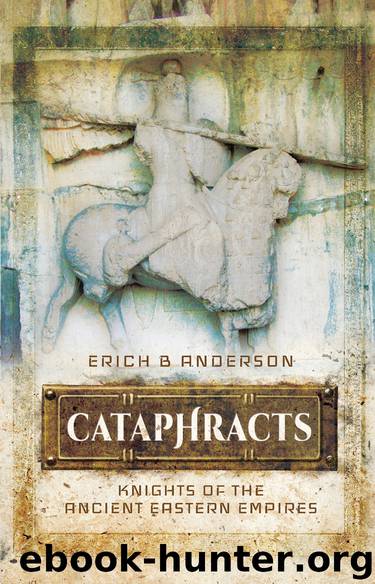
Author:Erich B Anderson
Language: eng
Format: epub
Publisher: Pen & Sword Books
Published: 2016-03-14T16:00:00+00:00
CHAPTER SIX
IMPERIAL ROMAN CATAPHRACTI, CATAPHRACTARII AND CLIBANARII
The Roman Empire
By the end of the reign of Emperor Trajan in 117, the territory of the Roman Empire had increased to its greatest extent. But as we have seen (see Chapter 3), land was not the only major addition made to the empire at that time. After numerous violent encounters with the deadly Parthian cataphracts, as well as the Sarmatian armoured lancers, the Romans finally decided to create their own unit of cataphracts, known as ala I Gallorum et Pannoniorum catafractata.1 This first known Roman cataphract unit was most likely introduced during the reign of Emperor Hadrian in the second quarter of the second century AD and was stationed in Moesia Inferior. Early evidence of this unit is from the funeral stela of the prefect M. Maenius Agrippa, although it is possible that cataphracts may have been a part of the Roman army before the creation of ala I Gallorum et Pannoniorum catafractata, perhaps in the reign of Hadrian’s predecessor, Trajan, or even earlier than that.2 When the ancient historian Flavius Josephus witnessed the Roman siege of Jotapata in 68, his account contained a particularly interesting moment:
[Vespasian] made the most courageous of the horsemen get off their horses, and placed them in three ranks over against those ruins of the wall, but covered with armour on every side, and with kontoi [heavy lances] in their hands.3
Completely armoured like cataphracts, the dismounted heavy cavalrymen of the Roman army charged at the breached walls, while the defenders poured extremely hot olive oil down on them from above. Some of the hot oil managed to get under the armour of the unluckiest attackers, burning through their skin as if it was on fire itself, but the improvised infantrymen were sufficiently well protected to storm the fortifications. However, it is possible that these heavily armoured warriors were not Roman soldiers at all, but rather mounted troops provided by allied rulers who simply fought in the Roman army.4
Another heavy cavalry unit created around the same time as the first Roman cataphracts, specifically during the reign of Emperor Trajan in the early second century, were also armed with the contus (kontos in Greek) like the cataphracts and Vespasian’s armoured dismounted horsemen. The new unit was known as ala Ulpia contariorum milliara civia Romanorum, with the word ‘contariorum’ meaning the cavalrymen fought with the contus (heavy lance). In general, mounted warriors in the Roman army who wielded the contus were known as a contarius (pl. contarii), or ‘contus-bearer’. The main difference between the Roman contarii and cataphracts was that the latter heavy cavalrymen were much more armoured than the former. While the contarii did wear armour, they were much more like the majority of the Sarmatian mounted lancers who were too poor to provide their steeds with expensive barding, while the cataphracts were armoured like the wealthiest aristocratic warriors, with both riders and horses covered with extensive protection. With heavier armour, the cataphracts could be even more deadly at shock
Download
This site does not store any files on its server. We only index and link to content provided by other sites. Please contact the content providers to delete copyright contents if any and email us, we'll remove relevant links or contents immediately.
| Africa | Americas |
| Arctic & Antarctica | Asia |
| Australia & Oceania | Europe |
| Middle East | Russia |
| United States | World |
| Ancient Civilizations | Military |
| Historical Study & Educational Resources |
The Radium Girls by Kate Moore(12035)
100 Deadly Skills by Clint Emerson(4931)
Rise and Kill First by Ronen Bergman(4797)
The Templars by Dan Jones(4695)
The Doomsday Machine by Daniel Ellsberg(4493)
The Rape of Nanking by Iris Chang(4224)
Killing England by Bill O'Reilly(4008)
Stalin by Stephen Kotkin(3973)
Hitler in Los Angeles by Steven J. Ross(3949)
12 Strong by Doug Stanton(3554)
Hitler's Monsters by Eric Kurlander(3348)
Blood and Sand by Alex Von Tunzelmann(3207)
The Code Book by Simon Singh(3197)
Darkest Hour by Anthony McCarten(3135)
The Art of War Visualized by Jessica Hagy(3014)
Hitler's Flying Saucers: A Guide to German Flying Discs of the Second World War by Stevens Henry(2759)
Babylon's Ark by Lawrence Anthony(2685)
The Second World Wars by Victor Davis Hanson(2529)
Tobruk by Peter Fitzsimons(2521)
