Can We All Be Feminists? by June Eric-Udorie
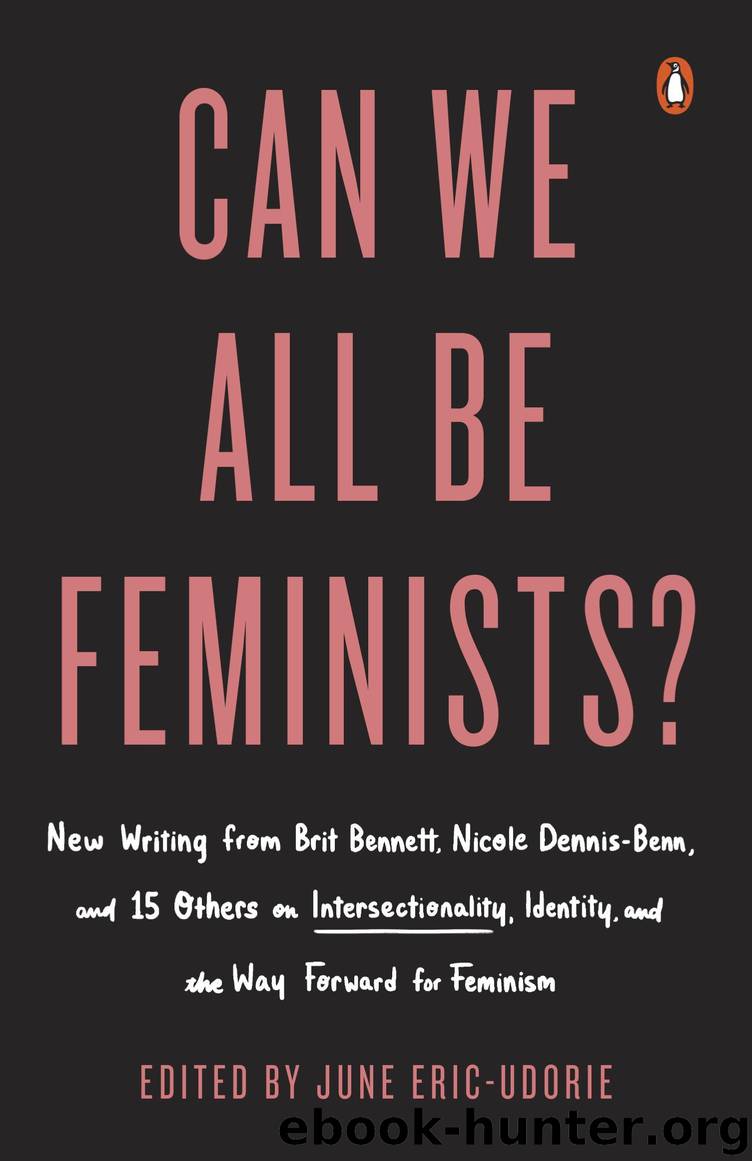
Author:June Eric-Udorie
Language: eng
Format: azw3, epub
Publisher: Penguin Publishing Group
Published: 2018-09-25T00:00:00+00:00
AFRO-DIASPORIC FEMINISM AND A FREEDOM IN FLUIDITY
Zoé Samudzi
MY FIRST REAL understanding of my apparent poor grasp of my own culture—at least, beyond the painful self-consciousness of not being able to speak my mother tongue—came when a diaspora auntie made a joke about my poor etiquette, commenting that my parents had not taught me the proper way of engaging elders, and other everyday things like traditional ways of greeting. “What did your parents teach you?” I remember her asking me incredulously.
But my parents, even as immigrants to the United States and despite having been socialized into Zimbabwean traditions before they emigrated, are not the picture of upstanding cultural torchbearers. My father recently told me a story about what happened when he explained my parents’ division of domestic labor to his family shortly after they were married in the mid-1980s. When he told them that he would wash dishes when my mother cooked and they would both take care of household chores, people in his house laughed, contemptuously referring to his willingness to share such responsibilities as “those feminist things.” Their laughter confused him: He wasn’t trying to embody a feminist politics; he simply rejected the idea that household work should be gendered. To him, it made sense that all of the household labor should be equally divided, rather than what was considered the “women’s work”—responsibility for cooking and cleaning and childcare—falling solely on my mother.
Members of my extended family, some of whom were those very same conservative family members who scoffed at my father, have over the years commented in horror at my facial piercings, tattoos, and (sometimes) brightly colored hair. But my self-presentation is no longer a symptom of a “rebellious phase”; I’m an adult, and this is how I choose to express myself. My ability to do so is, at least in some part, the result of my parents instilling in me the importance of autonomy and a refusal to self-police to please others—a sense of freedom invaluable to Black women whose identities and fates are constantly defined by everyone and everything but themselves. Rather than teaching me to perform on-demand deference to elders, they taught me the things they felt were most important: independence and autonomy. There were contradictions, of course, as with all parents.
As immigrants often do—for unfortunate reasons, some of which are admittedly pragmatic—my parents tended toward assimilation. They pushed me to aspire to be just like everybody else (i.e. my white middle-class peers), which was their metric of success. We spoke only English at home, the rationale being there was no real reason for my brother and me to speak or understand Shona, our mother tongue. But despite this push for assimilation, my parents were not always so outwardly accepting of my desire to be “typically American.” There was a strange dissonance in this: I was raised to reject certain parts of my culture and identity that they believed would potentially prevent me from becoming “fully” American, and yet it was made painfully clear that I was not American.
Download
This site does not store any files on its server. We only index and link to content provided by other sites. Please contact the content providers to delete copyright contents if any and email us, we'll remove relevant links or contents immediately.
| Anthropology | Archaeology |
| Philosophy | Politics & Government |
| Social Sciences | Sociology |
| Women's Studies |
The Rules Do Not Apply by Ariel Levy(4974)
On the Front Line with the Women Who Fight Back by Stacey Dooley(4875)
The Lonely City by Olivia Laing(4805)
Bluets by Maggie Nelson(4563)
The Confidence Code by Katty Kay(4267)
Three Women by Lisa Taddeo(3437)
Not a Diet Book by James Smith(3433)
Inferior by Angela Saini(3317)
Confessions of a Video Vixen by Karrine Steffans(3313)
A Woman Makes a Plan by Maye Musk(3255)
Pledged by Alexandra Robbins(3181)
Wild Words from Wild Women by Stephens Autumn(3157)
Nice Girls Don't Get the Corner Office by Lois P. Frankel(3051)
Brave by Rose McGowan(2827)
Women & Power by Mary Beard(2769)
Why I Am Not a Feminist by Jessa Crispin(2764)
The Clitoral Truth: The Secret World at Your Fingertips by Rebecca Chalker(2725)
The Girl in the Spider's Web: A Lisbeth Salander novel, continuing Stieg Larsson's Millennium Series by Lagercrantz David(2724)
I Who Have Never Known Men by Jacqueline Harpman(2677)
