Cambodia, 1975-1978 by Jackson Karl D.; Jackson Karl D ;
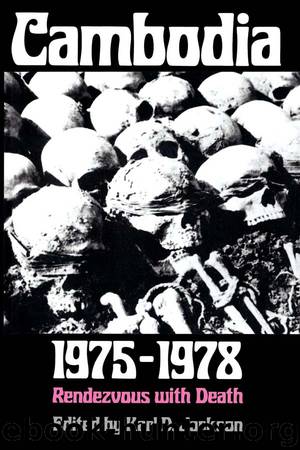
Author:Jackson, Karl D.; Jackson, Karl D ;
Language: eng
Format: epub
Publisher: Princeton University Press
Published: 2014-12-09T16:00:00+00:00
* * *
1 As Willmott and Forest aptly demonstrated, the relationship between Khmer and Chinese was rarely fraught with tension, but came to be founded on a certain pattern of division of labor within Cambodian society (Willmot 1967; Forest 1980). Nevertheless, onto this ethnic differentiation that hitherto had survived free of violent conflict, the revolutionaries superimposed a Marxist analysis of class antagonism. For the first time, a foreign observer on April 18, 1975, could hear from the mouth of a cadre, “It’s the Chinese who is an enemy of the Khmer people,” an expression that heretofore had been directed only at the Vietnamese. Under the Khmer Rouge regime, however, the Chinese do not appear to have been subjected to any particular discrimination due to their race but, rather, like other citizens, only out of considerations for their status in society.
As for the conflictual ties between Khmers and Vietnamese, they were a constant throughout all regimes: such reflex responses of a defeated people directed at their subjugators is a legacy of three centuries of incessant struggle. Khmers of all social backgrounds and political stripe make frequent use of such sayings as “Kom poup tè Ong,” “don’t knock over the gentleman’s tea,” recalling the cruelties that the satraps of Ming Mang inflicted on the Khmers, burying them alive and allowing only their heads to show to be used as a stand for their braziers. It is not accidental that the most venomous ant is referred to as a “Vietnamese ant.” “The Vietnamese never forsake their deceitful ways,” and so on. All these expressions and idioms are manifestations of a collective unconscious, generating violence. This latent antagonism can easily degenerate into racial violence, as occurred—among other instances—during the anti-Vietnamese pogroms instituted by Lon Nol in March-April 1970 in which more than four thousand Vietnamese were murdered. Beyond informing the political analyses in terms of which the Khmer revolutionaries gauged the vulnerability of their people in the face of a looming and conquering Vietnam, these atavisms played a role in the various purges of pro-Vietnamese Khmer cadres that took place in 1971 and 1973, as well as in the explusion of the Vietnamese minority in 1973 and again in 1975. In 1978, Cambodians who had Vietnamese features, or who simply were too pale, became as much the victims of this racist hatred as of the political will to eliminate a fifth column.
2 Of course, the Khmer Rouge also manifested profound disdain for many traditional values. Sequence in time, however, is important to understanding the delegitimization of a ruling elite. The Phnom Penh elite’s disdain for traditional values created mass alienation, the very social clay the Khmer Rouge remolded, at first somewhat gently in the period 1970 to early 1973 and then much more drastically from early 1973 to 1979. Finally, the mass social alienation that gave rise to the Khmer Rouge was remolded in revolutionary form by pairing the rejection of tradition with an egalitarian ideology backed by a powerful coercive apparatus. (On the changing tactics of the Khmer Rouge during the 1970–1975 period, see Quinn 1976.
Download
This site does not store any files on its server. We only index and link to content provided by other sites. Please contact the content providers to delete copyright contents if any and email us, we'll remove relevant links or contents immediately.
| Africa | Americas |
| Arctic & Antarctica | Asia |
| Australia & Oceania | Europe |
| Middle East | Russia |
| United States | World |
| Ancient Civilizations | Military |
| Historical Study & Educational Resources |
The Radium Girls by Kate Moore(12208)
100 Deadly Skills by Clint Emerson(5035)
Rise and Kill First by Ronen Bergman(4914)
The Templars by Dan Jones(4810)
The Doomsday Machine by Daniel Ellsberg(4633)
The Rape of Nanking by Iris Chang(4340)
Killing England by Bill O'Reilly(4118)
Stalin by Stephen Kotkin(4080)
Hitler in Los Angeles by Steven J. Ross(4018)
12 Strong by Doug Stanton(3635)
Hitler's Monsters by Eric Kurlander(3480)
The Code Book by Simon Singh(3329)
Blood and Sand by Alex Von Tunzelmann(3316)
Darkest Hour by Anthony McCarten(3237)
The Art of War Visualized by Jessica Hagy(3115)
Hitler's Flying Saucers: A Guide to German Flying Discs of the Second World War by Stevens Henry(2816)
Babylon's Ark by Lawrence Anthony(2801)
Tobruk by Peter Fitzsimons(2625)
The Second World Wars by Victor Davis Hanson(2594)
