Cabinet's Finest Hour by Owen David;
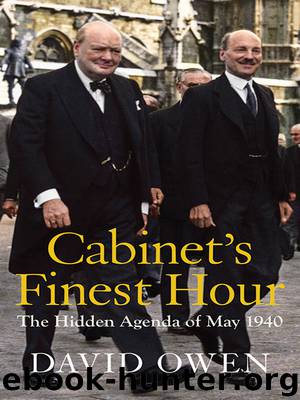
Author:Owen, David;
Language: eng
Format: epub
Publisher: Haus Publishing
4
The Hidden Agenda
Minutes of the War Cabinet
“Future generations may deem it noteworthy that the supreme question of whether we should fight on alone never found a place on the War Cabinet agenda. It was taken for granted and as a matter of course by these men of all parties in the state, and we were much too busy to waste time on such unreal, academic issues.”
Winston Churchill, The Second World War, Vol. 2: Their Finest Hour
(London, 1949)
That categorical assertion at the start of Chapter Nine of Their Finest Hour is described by professor David Reynolds “… strictly correct yet seriously misleading. There are no items of the Cabinet minutes headed ‘Surrender’ or ‘Negotiated Peace’.”1 But when Churchill wrote that chapter he was writing the most significant cover-up in the book. In 1949 he was Leader of the Opposition and a general election was due after the five-year limit for a parliament had almost been reached. Prime Minister Attlee held a massive majority and Churchill knew that the 1950 election would be very difficult to win. He made the decision to exclude the details of the Cabinet meetings as a politician, not an historian. It suited his election strategy for he cast himself as the indomitable figure, resolute, uncompromising for victory whatever the cost. He was being censored by Whitehall to conceal secrets – for example, he was not allowed to describe ‘Enigma’ or the work of the Bletchley Park code breakers – and he censored his comments on people like de Gaulle, Eisenhower and Tito whom he expected to meet again when back in government, so a little censorship concerning his own image was not so reprehensible. As someone commented, Churchill fought the war twice over, first as Prime Minister and then as its premier historian. We can understand why he distorted history, but we must not forget that he did distort it. This record of nine highly secret ministerial meetings, from 26 to 28 May 1940 reveals the truth. Churchill was the leader of a War Cabinet in which his voice was powerful, but not all-powerful.
As Churchill wrote, “Those of us who were responsible at the summit in London understood the physical structure of our island strength and were sure of the spirit of the nation. The confidence with which we faced the immediate future was not founded, as was commonly supposed abroad, upon audacious bluff or rhetorical appeal, but upon a sober consciousness and calculation of practical facts.” It was in no sense “academic”. Here are the facts, and here are the sober calculations for you, the reader, to make your own assessment.
The following Chapter has been arranged so that on the left hand side, on even page numbers, you can read a continuous account of seven confidential ministerial War Cabinet meetings. On the opposite right hand side, on odd page numbers, you can read the actual documents the ministers had before them at the time.
This pattern is followed for the majority of the chapter, until page 156,
Download
This site does not store any files on its server. We only index and link to content provided by other sites. Please contact the content providers to delete copyright contents if any and email us, we'll remove relevant links or contents immediately.
| Africa | Americas |
| Arctic & Antarctica | Asia |
| Australia & Oceania | Europe |
| Middle East | Russia |
| United States | World |
| Ancient Civilizations | Military |
| Historical Study & Educational Resources |
The Radium Girls by Kate Moore(12035)
100 Deadly Skills by Clint Emerson(4930)
Rise and Kill First by Ronen Bergman(4796)
The Templars by Dan Jones(4691)
The Doomsday Machine by Daniel Ellsberg(4493)
The Rape of Nanking by Iris Chang(4218)
Killing England by Bill O'Reilly(4007)
Stalin by Stephen Kotkin(3971)
Hitler in Los Angeles by Steven J. Ross(3947)
12 Strong by Doug Stanton(3553)
Hitler's Monsters by Eric Kurlander(3346)
Blood and Sand by Alex Von Tunzelmann(3206)
The Code Book by Simon Singh(3197)
Darkest Hour by Anthony McCarten(3134)
The Art of War Visualized by Jessica Hagy(3012)
Hitler's Flying Saucers: A Guide to German Flying Discs of the Second World War by Stevens Henry(2757)
Babylon's Ark by Lawrence Anthony(2684)
The Second World Wars by Victor Davis Hanson(2528)
Tobruk by Peter Fitzsimons(2520)
