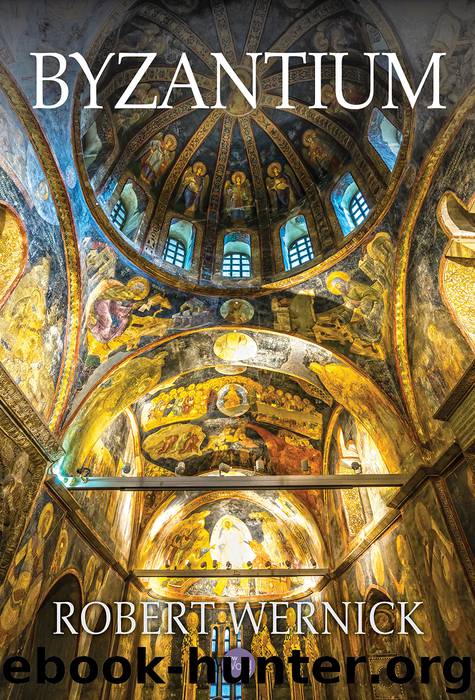
Byzantium by Robert Wernick
Author:Robert Wernick [Robert Wernick]
Language: eng
Format: epub
Tags: History/Ancient/General
ISBN: 9781612309903
Publisher: New Word City, Inc.
Published: 2016-10-03T16:00:00+00:00
Evidence of the lives led by the men and women of Byzantium remains in unexpected corners of the Greek world - in monastery courtyards on Mount Athos, in the ruins of the hillside town of Mystras, in the Taygetus Mountains near the theater of ancient Sparta, in the caïques of remote Aegean fishing ports.
Here we can glean some of the details of the daily lives of the Byzantines and the social and commercial structure of their society.
The life of the Byzantines was filled with opportunities for self-expression and independence. Even if the Byzantines were informed by their religious beliefs that people were doomed to endless tribulation and suffering and that they could expect little peace or stability, this did not prevent them from celebrating life in a festive manner. They appreciated beauty, which gave their lives the texture of a self-conscious work of art.
Despite their preoccupation with religion and fate, the Byzantines found it easy to relax. Most of their social activities took place outdoors, strolling in the streets and socializing in the spacious open forums. Refreshments were available in cafes and restaurants, where men and women played games similar to dominoes and checkers. Those seeking to escape the congestion of Constantinople could amble through gardens near the water’s edge and explore pristine forests and fields just outside the city’s gates. Hunting was popular, and the rich played a form of polo.
For those who preferred city life, entertainment could be found in nearby theaters, featuring ballets and musical revues, strolling musicians, and itinerant jugglers. Circuses and carnivals were popular, as were the public baths.
The favorite sport of the Byzantine masses was chariot racing, held at the Hippodrome. At these races, contingents of important citizens formed factions, each of which supported its own entries. While these factions had existed in Roman times, at Byzantium they evolved into powerful organizations structured on the lines of local militia. Originally, there were four factions - the Greens, Blues, Reds and Whites; the Greens and Blues later absorbed the other two.
Each of the surviving factions had its own leader, or demarch, who was served by a host of dignitaries and employees: treasurers, notaries, archivists, heralds, poets, musicians, organists, painters and sculptors, charioteers, circus performers, stable hands, and officials assigned to keep order.
In addition to staging the chariot races in the Hippodrome, the factions acted as the emperor’s escort in cavalcades and processions and read the official acclamations prepared for state functions. They wore special clothes - cloaks and shoes of the barbarian Huns, tunics with billowing sleeves fastened at the wrist - and wore their hair cropped close in front, with long locks hanging down their backs. These factions provided an outlet for the Byzantines to express their opinions on a variety of subjects, be it cheaper oil, fewer taxes, or the conduct of an unjust official.
On a racing day, the city came alive amid the bustle and commotion as crowds swarmed into the tiers of the Hippodrome’s stone seats. In the seats closest to
Download
This site does not store any files on its server. We only index and link to content provided by other sites. Please contact the content providers to delete copyright contents if any and email us, we'll remove relevant links or contents immediately.
| Africa | Americas |
| Arctic & Antarctica | Asia |
| Australia & Oceania | Europe |
| Middle East | Russia |
| United States | World |
| Ancient Civilizations | Military |
| Historical Study & Educational Resources |
The Radium Girls by Kate Moore(12098)
100 Deadly Skills by Clint Emerson(4975)
Rise and Kill First by Ronen Bergman(4842)
The Templars by Dan Jones(4742)
The Doomsday Machine by Daniel Ellsberg(4559)
The Rape of Nanking by Iris Chang(4269)
Killing England by Bill O'Reilly(4047)
Stalin by Stephen Kotkin(4013)
Hitler in Los Angeles by Steven J. Ross(3984)
12 Strong by Doug Stanton(3585)
Hitler's Monsters by Eric Kurlander(3396)
The Code Book by Simon Singh(3257)
Blood and Sand by Alex Von Tunzelmann(3247)
Darkest Hour by Anthony McCarten(3171)
The Art of War Visualized by Jessica Hagy(3051)
Hitler's Flying Saucers: A Guide to German Flying Discs of the Second World War by Stevens Henry(2780)
Babylon's Ark by Lawrence Anthony(2739)
Tobruk by Peter Fitzsimons(2567)
The Second World Wars by Victor Davis Hanson(2556)
