Business as Usual after Marikana by Becker Britta; Grimm Maren; Krameritsch Jakob & Jakob Krameritsch & Britta Becker (Eds.)
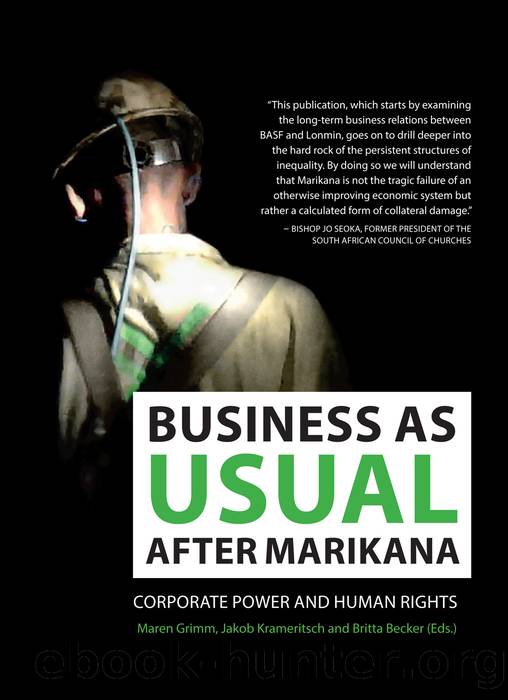
Author:Becker, Britta; Grimm, Maren; Krameritsch, Jakob & Jakob Krameritsch & Britta Becker (Eds.)
Language: eng
Format: epub
ISBN: 5622232
Publisher: Jacana Media
Published: 2018-08-14T16:00:00+00:00
Submissions by the Centre for Applied Legal Studies
The submissions by CALS proposed that a gendered lens and poverty be added to both the process for the development of the binding instrument and the content of the binding instrument. They further called for poverty to be considered by the working group in both the process and the content of the binding instrument. In summary, the CALS submissions called on the working group to use the treaty process as an opportunity to address the multifaceted and intersectional human rights impacts of corporate activities (CALS, 2015).
Submissions by the South African Institute for Advanced Constitutional Public, Human Rights and International Law
The submissions of the director of SAFAIC, David Bilchitz, focused on possible approaches that a treaty on business and human rights could adopt in apportioning obligations to promote or protect individuals against the violation of their rights by third parties such as corporations. Bilchitz considered both the direct and indirect model approach to be adopted for purposes of such a treaty. The indirect model, which focuses on the obligation of the state to protect individuals against the violation of their rights by third parties, would place an international legal obligation on the state to ensure that corporations do not violate the human rights of individuals. Corporations would, however, have no direct obligations flowing from international human rights law. The direct model, in contrast, imposes direct obligations on corporations by international human rights law or provides for their creation by states (SAFAIC, 2015).
Bilchitz advocates a direct approach. This would start with a beneficiary- or victim-orientated evaluation of whether particular actions or omissions of corporations have an effect on the interests protected by fundamental rights. This would then be followed by a consideration of reasons to limit the obligations of corporations in such circumstances, either for reasons relating to their nature or for reasons relating to the nature of the normative considerations underlying any potential limitation.
Conclusion
In the current circumstances, South Africa and Ecuador face a mammoth task. Both countries will have to find more efficient methods of advocacy and lobbying to nurture and capitalise on the support of the powerful countries which sponsored the resolution. It is crucial to ensure that African states, whose people are among the most severely affected by TNCs, stand firmly behind the initiative.
While the UN Guiding Principles are deficient, their proponents are well resourced and have made advances in terms of popularisation and public awareness. South Africa must proceed with caution given that this process could drag on indefinitely, proceeding along a well-trodden path from which past sojourners have returned empty-handed. DIRCO’s concern with globalisation and divestment and its lack of contact with communities on the ground might do more to undermine the South African initiative than the UN Guiding Principles. Having come so far and expended a lot of energy and limited resources, it would be regrettable if, as Professor Ruggie cautioned, a successful treaty ended up as a largely symbolic gesture, of little practical use to affected communities on the ground.
Download
This site does not store any files on its server. We only index and link to content provided by other sites. Please contact the content providers to delete copyright contents if any and email us, we'll remove relevant links or contents immediately.
International Integration of the Brazilian Economy by Elias C. Grivoyannis(111078)
The Radium Girls by Kate Moore(12036)
Turbulence by E. J. Noyes(8057)
Nudge - Improving Decisions about Health, Wealth, and Happiness by Thaler Sunstein(7712)
The Black Swan by Nassim Nicholas Taleb(7137)
Rich Dad Poor Dad by Robert T. Kiyosaki(6646)
Pioneering Portfolio Management by David F. Swensen(6305)
Man-made Catastrophes and Risk Information Concealment by Dmitry Chernov & Didier Sornette(6029)
Zero to One by Peter Thiel(5808)
Secrecy World by Jake Bernstein(4756)
Millionaire: The Philanderer, Gambler, and Duelist Who Invented Modern Finance by Janet Gleeson(4483)
The Age of Surveillance Capitalism by Shoshana Zuboff(4310)
Skin in the Game by Nassim Nicholas Taleb(4257)
The Money Culture by Michael Lewis(4212)
Bullshit Jobs by David Graeber(4197)
Skin in the Game: Hidden Asymmetries in Daily Life by Nassim Nicholas Taleb(4012)
The Dhandho Investor by Mohnish Pabrai(3776)
The Wisdom of Finance by Mihir Desai(3754)
Blockchain Basics by Daniel Drescher(3586)
