Atlantic Nightmare: The longest military campaign in World War II by Freeman Richard
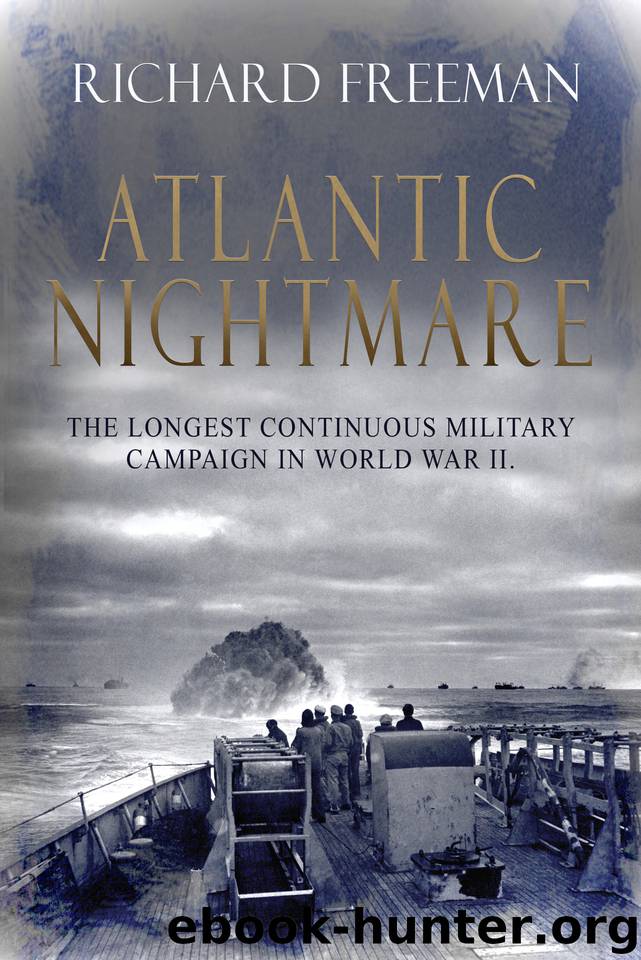
Author:Freeman, Richard [Freeman, Richard]
Language: eng
Format: epub, pdf
Publisher: Endeavour Media
Published: 2019-01-30T16:00:00+00:00
22
Dönitz triumphant
May to December 1942
Return to the Atlantic
At 1 May 1942 Dönitz had a total of 292 U-boats, of which 124 were frontline – the others were on trials or being used for training. Eighty-five of his operational boats were Atlantic-based. These figures were a huge increase on his 57 boats in September 1939, but even so, the daily average of boats at sea was only 48.8; and only 9.87 were in operational areas. The reality of operating U-boats was that for most of the time they were in harbour, or in transit to and from their operational areas.
As the Second Happy Time drew to an end in spring 1942, Dönitz reassessed his boat distribution. He knew from signal intercepts that the Allies were now routing Atlantic convoys along a great circle in the north. (This being the shortest route, it exposed them to the minimum possible period of attack.) Noting that his 16-20 boats in the Norway area had sunk only 40,000 tons in March and April, Dönitz concluded that his Atlantic boats could quadruple that tonnage. The move to the North Atlantic quickly followed. It was to yield spectacular successes and bring despair to the Allied escorts.
One of Dönitz’s earliest forays proved amply rewarding, while also exposing the feeble response of the Allied escorts. Convoy ON-92 was outbound from Liverpool for North America. It had departed on 6 May and on the next day had met its Mid-Ocean Escort Force led by Commander J B Heffernan in USS Gleaves . The escort was handicapped from the moment that it met the convoy since none of its ships was fitted with either HF/DF or 10cm radar. Only the rescue ship, HMS Bury , carried HF/DF and only the Canadian corvette HMCS Bittersweet was fitted with Type 271 radar.
On 11 May, HMS Bury ’s HF/DF found three U-boats circling the convoy. Her commander reported the sightings to Derby House, which passed them on to Heffernan in Gleaves . British practice at this point was to execute a sharp course change followed by zigzagging. Instead, Heffernan chose to follow United States Navy practice by taking Gleaves and the cutter USCGC Spencer on a sweep ahead of the convoy. They found one U-boat and dropped depth charges without any success.
While Gleaves and Spencer were away from the convoy, U-124 had manoeuvred into a striking position. Its commander, Commander Johann Mohr, had already sunk 18 ships. He took two more in minutes as his torpedoes first hit the 7000-ton Empire Dell and then the 5000-ton Llanover at around 2.00 am. All but two men from the two ships were picked up by Bury and the corvette HMCS Shediac .
Gleaves and Spencer were still away from the convoy when U-94 arrived and sank the Panamanian 5500-ton Cocle . Kapitänleutnant Otto Ites, who had been in U-boats since 1938, had now sunk his tenth ship. His attack was followed by the return of U-124 , which sank the Greek steamer Mount Parnes , laden with Welsh coal.
Download
Atlantic Nightmare: The longest military campaign in World War II by Freeman Richard.pdf
This site does not store any files on its server. We only index and link to content provided by other sites. Please contact the content providers to delete copyright contents if any and email us, we'll remove relevant links or contents immediately.
| Africa | Americas |
| Arctic & Antarctica | Asia |
| Australia & Oceania | Europe |
| Middle East | Russia |
| United States | World |
| Ancient Civilizations | Military |
| Historical Study & Educational Resources |
The Radium Girls by Kate Moore(12035)
100 Deadly Skills by Clint Emerson(4931)
Rise and Kill First by Ronen Bergman(4797)
The Templars by Dan Jones(4692)
The Doomsday Machine by Daniel Ellsberg(4493)
The Rape of Nanking by Iris Chang(4222)
Killing England by Bill O'Reilly(4008)
Stalin by Stephen Kotkin(3973)
Hitler in Los Angeles by Steven J. Ross(3949)
12 Strong by Doug Stanton(3554)
Hitler's Monsters by Eric Kurlander(3347)
Blood and Sand by Alex Von Tunzelmann(3207)
The Code Book by Simon Singh(3197)
Darkest Hour by Anthony McCarten(3135)
The Art of War Visualized by Jessica Hagy(3013)
Hitler's Flying Saucers: A Guide to German Flying Discs of the Second World War by Stevens Henry(2758)
Babylon's Ark by Lawrence Anthony(2685)
The Second World Wars by Victor Davis Hanson(2529)
Tobruk by Peter Fitzsimons(2521)
