Assyrian Empire: A History from Beginning to End (Mesopotamia History Book 3) by Hourly History
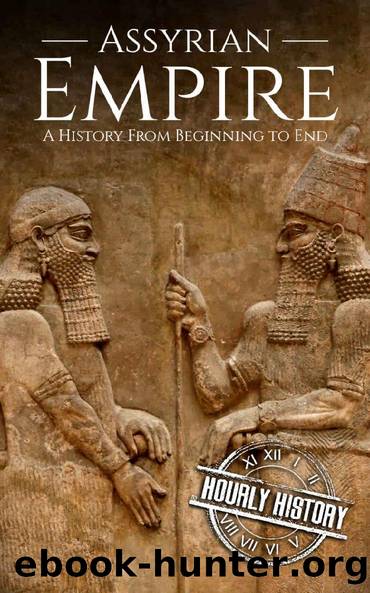
Author:Hourly History [History, Hourly]
Language: eng
Format: epub
Published: 2019-10-13T00:00:00+00:00
Chapter Five
The Warrior Society
âTell me your friends, and Iâll tell you who you are.â
âMesopotamian proverb
Before moving on to examine the next phase of the history of the Assyrian Empire, it is worth pausing for a moment to consider the importance of the army in this history. In the previous chapters, you have read how Assyrian forces conquered almost every enemy they encounteredâin fact, there are very few accounts of the defeat of Assyrian forces in the empireâs early history. Why was this? What was it about Assyrian military forces that made them so successful and so feared?
There are several strands to this answer. One is equipmentâAssyrian artisans and metalworkers were amongst the best and most advanced in the ancient world. The iron weapons and armor provided to Assyrian forces were simply better than those used by their adversaries. They were also cheaper and easier to produce. In many battles, the Assyrians faced opponents in whose armies only the aristocratic leaders had sophisticated weapons and armor. In the Assyrian army, every infantry and cavalry soldier was equipped with iron weapons and armor. Assyrian armies were also the first to incorporate a corps of engineers who were adept at producing rams, scaling ladders, towers, and other equipment that could be used to assault the walled cities of their enemies. These factors would give any military force an advantage, but they donât completely explain the string of virtually uninterrupted Assyrian victories.
Another factor was conscription. Every male Assyrian citizen, regardless of rank or religion, was required to serve for a fixed period in the army. This meant that, in time of war, large numbers of trained reservists could be called up to bolster the size of the army. The fact that its soldiers were trained also gave the Assyrians a distinct advantage on the battlefield. Most ancient armies would simply fling themselves en masse at the enemy; the Assyrians were able to use formations and tactics considerably more sophisticated than this.
The army was a powerful factor in Assyrian society. Warriors were respected. Kings were expected to lead their armies and to display physical strength and courage, and many state offices were controlled by the military. However, having a largely conscript army also had its disadvantages. Most of the men serving in the army were farmers. Calling up large numbers of farmers during the planting or harvesting season would have caused food shortages, so early Assyrian campaigns were generally conducted only in the summer, after the crops had been planted and before they were due to be harvested. There were essentially no wars during the winter.
King Tiglath-Pileser III was one of the first Assyrian leaders to recognize that having a fulltime, professional army capable of campaigning all year round would give a distinct military advantage. Under his reign during the Neo-Assyrian Empire, the Assyrian army was completely reorganized as a professional force which gave it an even greater advantage on the battlefield.
There was another weapon that the Assyrians used with great success: fear. All Assyrian
Download
This site does not store any files on its server. We only index and link to content provided by other sites. Please contact the content providers to delete copyright contents if any and email us, we'll remove relevant links or contents immediately.
| Africa | Americas |
| Arctic & Antarctica | Asia |
| Australia & Oceania | Europe |
| Middle East | Russia |
| United States | World |
| Ancient Civilizations | Military |
| Historical Study & Educational Resources |
The Dawn of Everything by David Graeber & David Wengrow(1691)
The Bomber Mafia by Malcolm Gladwell(1620)
Facing the Mountain by Daniel James Brown(1545)
Submerged Prehistory by Benjamin Jonathan; & Clive Bonsall & Catriona Pickard & Anders Fischer(1452)
Wandering in Strange Lands by Morgan Jerkins(1419)
Tip Top by Bill James(1409)
Driving While Brown: Sheriff Joe Arpaio Versus the Latino Resistance by Terry Greene Sterling & Jude Joffe-Block(1364)
Red Roulette : An Insider's Story of Wealth, Power, Corruption, and Vengeance in Today's China (9781982156176) by Shum Desmond(1350)
Evil Geniuses: The Unmaking of America: A Recent History by Kurt Andersen(1345)
The Way of Fire and Ice: The Living Tradition of Norse Paganism by Ryan Smith(1324)
American Kompromat by Craig Unger(1307)
It Was All a Lie by Stuart Stevens;(1294)
F*cking History by The Captain(1289)
American Dreams by Unknown(1277)
Treasure Islands: Tax Havens and the Men who Stole the World by Nicholas Shaxson(1253)
Evil Geniuses by Kurt Andersen(1249)
White House Inc. by Dan Alexander(1206)
The First Conspiracy by Brad Meltzer & Josh Mensch(1167)
The Fifteen Biggest Lies about the Economy: And Everything Else the Right Doesn't Want You to Know about Taxes, Jobs, and Corporate America by Joshua Holland(1115)
