An Islandwide Struggle for Freedom by Nessler Graham T.;
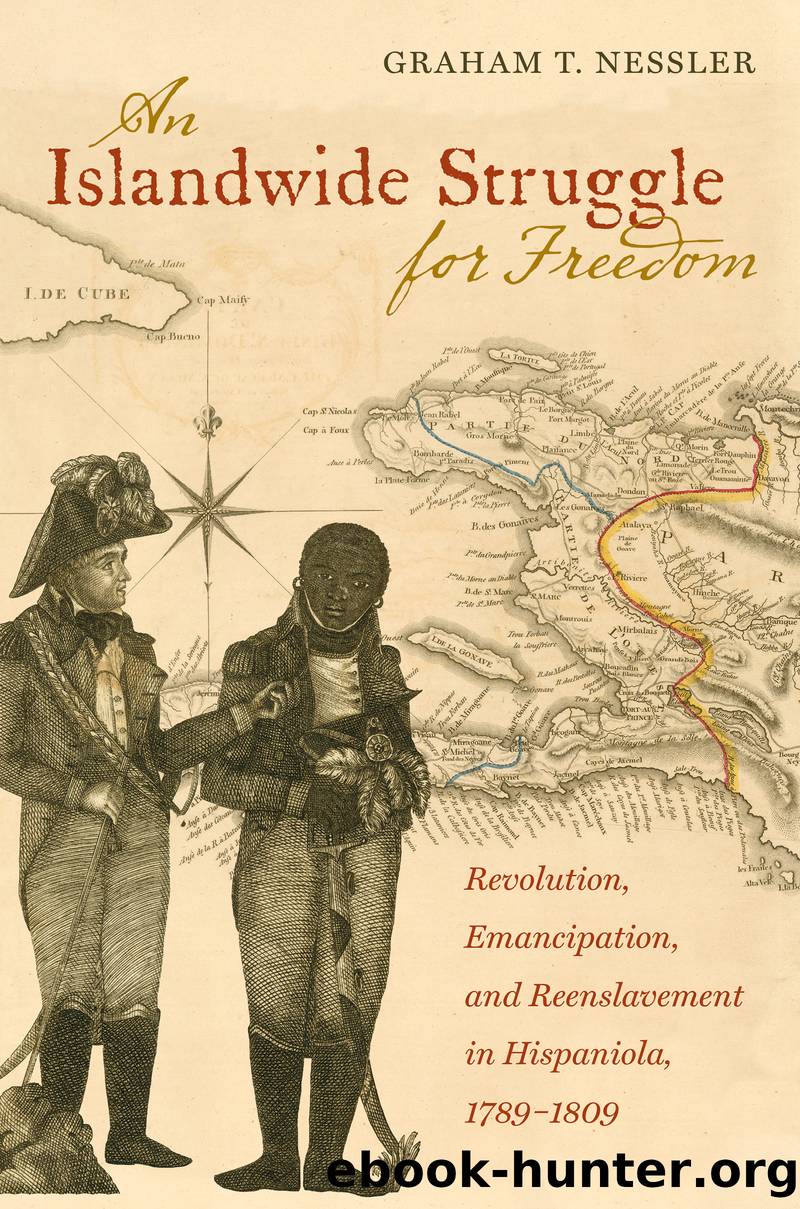
Author:Nessler, Graham T.;
Language: eng
Format: epub
Publisher: University of North Carolina Press
Legal and Political Conflicts over Enslavement and Citizenship Rights
In a correspondence to Napoleon written on 5 February 1805, a group of Dominguan refugees in Santiago de Cuba denounced the âcowardiceâ of Franceâs âenemiesâ who had âbetrayed, evacuated, and delivered Saint-Domingue to a miserable handful of freed people and rebel slaves, who only have the energy and courage of a blind and cowardly ferocity.â87 During a time of substantial regression to the legal racism of the prerevolutionary era in the French world, French migrant enclaves in places such as Santiago de Cuba and Santo Domingo became hotbeds of such vitriol, even as many in the Francophone sphere resisted the destruction of the more egalitarian order of the 1790s.88 In spite of such resistance, the fact of slave revolution in nearby Haiti, as well as Dessalinesâs killing of many French whites who remained there after 1803, shaped the decisions that the leaders of the French occupation of Santo Domingo made in their efforts to fashion a new slaveholding society. In this respect, the close proximity of Haiti reinforced the resurgence of racism in French law and colonial policy.
Though ideologies of racial inferiority had emerged in close connection with plantation slavery in the French Caribbean and beyond, antislavery and antiracism had often diverged in the writings of many eighteenth-century French abolitionists and in the discourses of numerous individuals in the revolutionary era, as support for one did not necessarily imply acceptance of the other.89 Nonetheless, the years 1790 to 1802 in the French world can be conceptualized as an arc across which struggles against legalized racism and slavery yielded landmark legislative triumphs, peaking in 1795, only to reverse direction after that year. The subsequent erosion of these gains again drew racism and slavery closely together.
After 1802, Napoleon coupled his repudiation of the 1794 emancipation decree with an array of racist laws that left the hard-won gains of the early 1790s in tatters. These included the reinstatement of assorted ancien régime regulations that had aimed to closely monitor the activities of persons of African extraction in France, the reinstitution of the requirement that blacks carry identity cards while in the metropole, prohibitions on mixed-race personsâ entry into France, and a ban on interracial marriage.90
In line with the actions of their leader, authorities in various French territories passed laws that similarly targeted the rights of those of African ancestry and that sought to limit the means by which those claimed as slaves could gain their freedom.91 Ferrand for his part enforced a distinction between âFrenchâ blacks, whom he associated with Haiti and considered especially subversive, and âSpanishâ blacks, deemed somewhat less dangerous.92 The line separating âFrenchâ and âSpanishâ blacks ran through the ancien régime to the revolutionary era and into the post-1804 period.93 Ferrandâs actions in this respect closely resembled those of his counterparts in other parts of the Americas, as Cuban officials generally sought to bar the settlement on that island of free and freed men of African descent from Saint-Domingue, while North American
Download
This site does not store any files on its server. We only index and link to content provided by other sites. Please contact the content providers to delete copyright contents if any and email us, we'll remove relevant links or contents immediately.
| Africa | Americas |
| Arctic & Antarctica | Asia |
| Australia & Oceania | Europe |
| Middle East | Russia |
| United States | World |
| Ancient Civilizations | Military |
| Historical Study & Educational Resources |
The Dawn of Everything by David Graeber & David Wengrow(1707)
The Bomber Mafia by Malcolm Gladwell(1625)
Facing the Mountain by Daniel James Brown(1553)
Submerged Prehistory by Benjamin Jonathan; & Clive Bonsall & Catriona Pickard & Anders Fischer(1455)
Wandering in Strange Lands by Morgan Jerkins(1430)
Tip Top by Bill James(1416)
Driving While Brown: Sheriff Joe Arpaio Versus the Latino Resistance by Terry Greene Sterling & Jude Joffe-Block(1376)
Red Roulette : An Insider's Story of Wealth, Power, Corruption, and Vengeance in Today's China (9781982156176) by Shum Desmond(1359)
Evil Geniuses: The Unmaking of America: A Recent History by Kurt Andersen(1354)
The Way of Fire and Ice: The Living Tradition of Norse Paganism by Ryan Smith(1336)
American Kompromat by Craig Unger(1315)
F*cking History by The Captain(1304)
It Was All a Lie by Stuart Stevens;(1300)
American Dreams by Unknown(1286)
Treasure Islands: Tax Havens and the Men who Stole the World by Nicholas Shaxson(1274)
Evil Geniuses by Kurt Andersen(1257)
White House Inc. by Dan Alexander(1212)
The First Conspiracy by Brad Meltzer & Josh Mensch(1174)
The Fifteen Biggest Lies about the Economy: And Everything Else the Right Doesn't Want You to Know about Taxes, Jobs, and Corporate America by Joshua Holland(1126)
