After Ireland by Kiberd Declan;
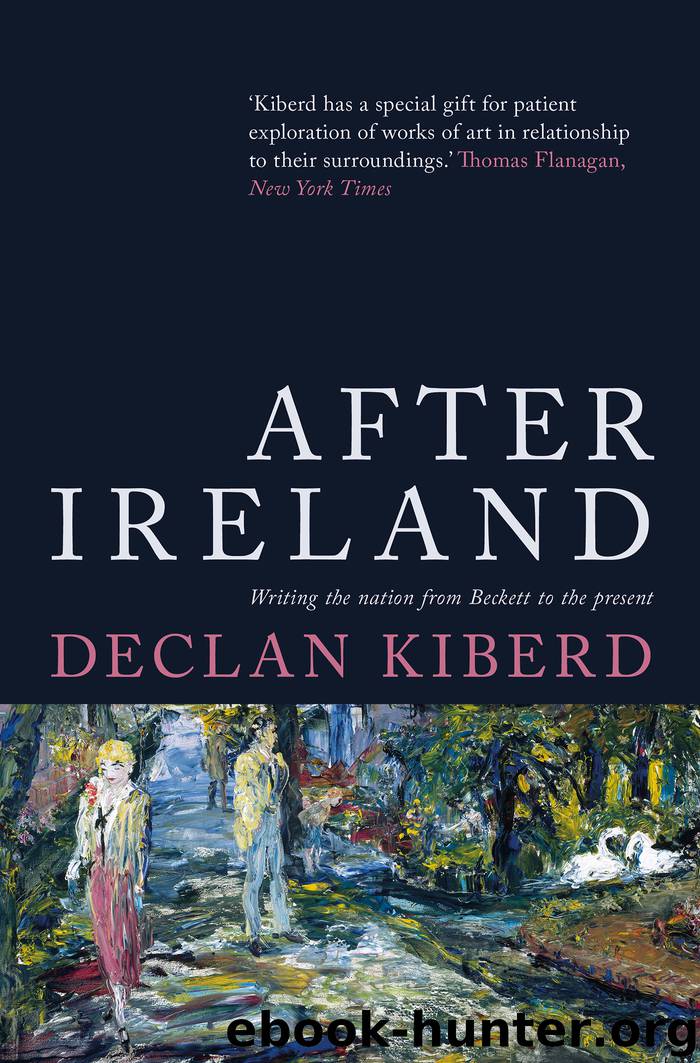
Author:Kiberd, Declan; [Kiberd, Declan]
Language: eng
Format: epub
Publisher: Head of Zeus
16. Derek Mahon’s
Lost Worlds
The dandy confronts the deteriorations of modernity with a face which registers no tremors, but that impassivity is just a pose: inside, the heart is breaking. Derek Mahon wears his rue with a difference. He addresses modern decline with a sense of real outrage, but the indignation is itself a pose. For one thing, it leads him to a fascinated detailing of the minutiae of modern life, beyond whose listings he seldom likes to move; and, when he does make such a move, he takes such a long historical view that he is hard put to sustain a sense of crisis. Things, he sighs, have ever been thus. If they are not getting very much better, analogies with the ancient world also suggest that they are not getting very much worse:
Now we are safe from monsters, and the giants
Who tore up rocks twelve miles by six
And hurled them out to sea to become islands
Can wrong us no more. The sticks
And stones that once broke bones will not now harm
A generation of such sense and charm.1
Up to a point perhaps. These lines were written in all innocence before Northern Ireland erupted into renewed violence.
The ruined dandy, like the destroyed Gaelic bards, knows that his life is over; and yet, inexplicably, it goes on. What is the appropriate grammatical tense to capture such a state? Like Samuel Beckett’s Molloy, the poet feels himself already dead, yet somehow he can hear the song of the birds. One ear is tuned to the melody of the present moment, the other to the distant sounds that come in on the strange frequencies of a long-forgotten civilization. Such a long view compels the poet also to imagine the future, for if the past was once somebody’s hoped-for civilization, so the anticipated future will turn out to have been some even more evolved people’s past. In ‘An Image from Beckett’ the poet contemplates the fate of Matthew Arnold’s optimistic version of culture and places it in balance with Beckett’s mordant view of a life created astride the grave, gleaming for an instant before it is gone:
But in that instant
I was struck by the
Sweetness and light,
The sweetness and light,
Imagining what grave
Cities, what lasting monuments,
Given the time.
They will have buried
Our great-grandchildren, and theirs,
Beside us by now. (NCP 41)
The bleak, glittering images are austere in their bare intensity, as stripped and reduced as the shards of phrasing in Beckett’s own writing; and the anticipatory nostalgia of the speaker indicates a longing to release the present moment, in its capacity to condense all past and future meanings. The landscape, however, is imagined as soon enough bereft of our human presence, which throws the value of this poetic utterance into question:
Still, I am haunted
By that landscape,
The soft rush of its winds,
The uprightness of its
Utilities and schoolchildren –
To whom in my will,
Thus, I have left my will.
I hope they have time,
And light enough, to read it. (NCP 42)
Andrew Marvell, in ‘To his Coy Mistress’, had asked for ‘world enough and time’,2 but Mahon fears also that there may not be enough ‘light’.
Download
This site does not store any files on its server. We only index and link to content provided by other sites. Please contact the content providers to delete copyright contents if any and email us, we'll remove relevant links or contents immediately.
Still Me by Jojo Moyes(11266)
On the Yard (New York Review Books Classics) by Braly Malcolm(5525)
A Year in the Merde by Stephen Clarke(5430)
Eleanor Oliphant Is Completely Fine by Gail Honeyman(5282)
The Bookshop by Penelope Fitzgerald(3854)
How Music Works by David Byrne(3270)
Surprise Me by Kinsella Sophie(3113)
Pharaoh by Wilbur Smith(2993)
Why I Write by George Orwell(2955)
A Column of Fire by Ken Follett(2613)
Churchill by Paul Johnson(2587)
The Beach by Alex Garland(2561)
The Songlines by Bruce Chatwin(2557)
Aubrey–Maturin 02 - [1803-04] - Post Captain by Patrick O'Brian(2306)
Heartless by Mary Balogh(2259)
Elizabeth by Philippa Jones(2205)
Hitler by Ian Kershaw(2199)
Life of Elizabeth I by Alison Weir(2086)
Harry Potter and the Cursed Child by J. K. Rowling & John Tiffany & Jack Thorne(2064)
