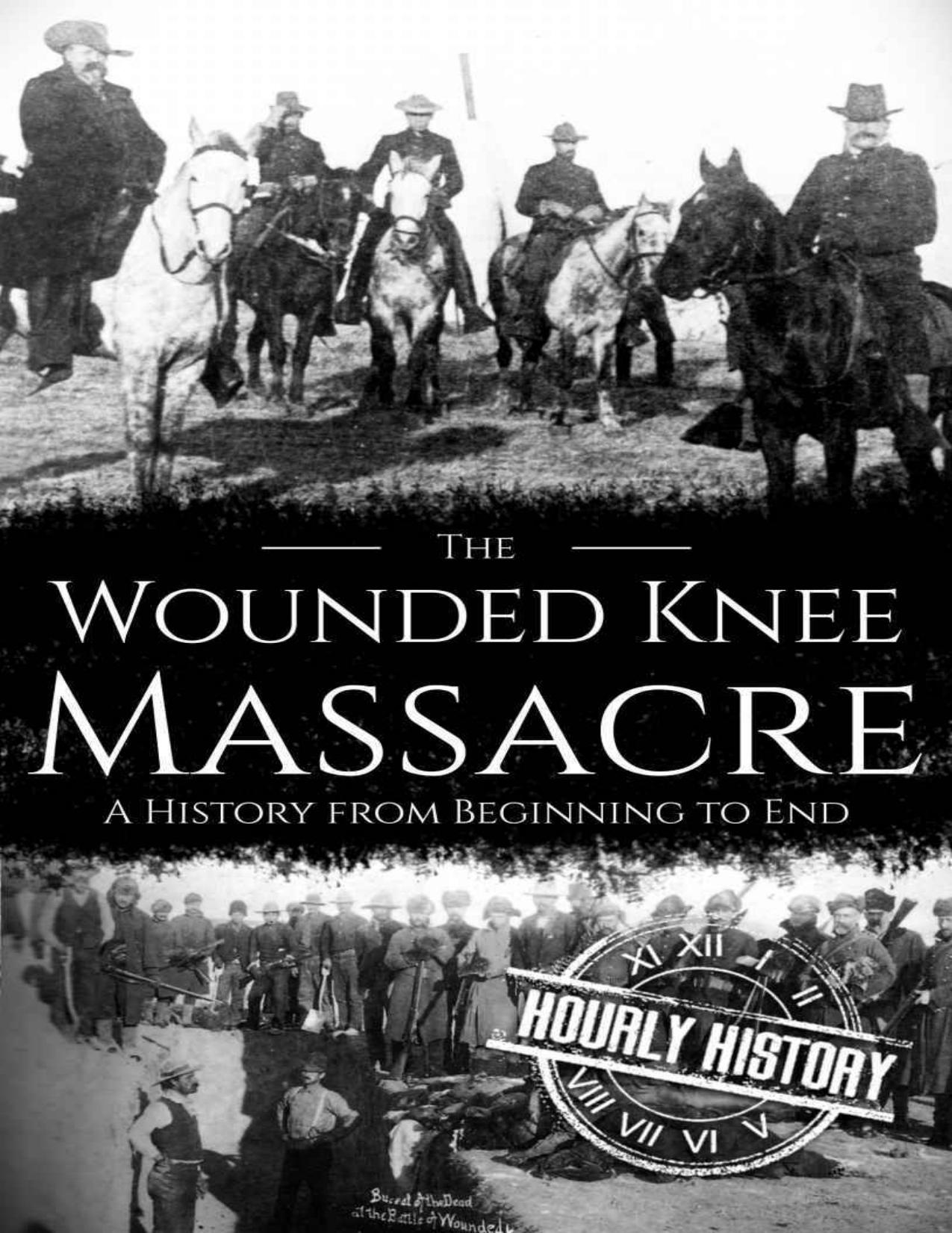
Wounded Knee Massacre: A History from Beginning to End (Native American History Book 6) by Hourly History
Author:Hourly History [History, Hourly]
Language: eng
Format: azw3, pdf
Published: 2020-08-22T16:00:00+00:00
âGeneral Nelson A. Miles, on the Lakota
Initially, most Lakota people were confined on the Great Sioux Reservation, an area of land in the present-day states of South Dakota and Nebraska. However, in 1887, Congress passed a new act where approximately half the land previously allocated to the reservation was made available for public purchase for homesteading. The remaining land was partitioned into five smaller reservations, and the Lakota were mainly confined to two of these: the Standing Rock Reservation in the present-day states of North Dakota and South Dakota and the Red Cloud Reservation (re-named the Pine Ridge Reservation in 1889) in the present-day states of Nebraska and Wyoming.
The Dawes Severalty Act, passed by Congress in 1887, was an attempt to âAmericanizeâ Native Americans living on reservations (and not coincidentally, this act also released a great deal of land previously allocated to reservations for use by white settlers). Each Native American family was offered one hundred and sixty acres of reservation land to own outright. Although this land could not be sold for twenty-five years, it was hoped that the Native American owners would farm it for profit like other farmers in the west, reducing or eliminating their dependence on government subsidy and rations.
The result was an unmitigated disaster. Nomadic buffalo hunters such as the Lakota were forced to settle in fixed, confined areas where they could not live or hunt in the traditional way. Many had little knowledge of agriculture or irrigation, and even those who did often found that the land they had been allocated was unsuitable for farming. Tribes were often forced to live in close proximity to other tribal groups with which there existed historical enmity.
Native American children were forced to attend reservation schools where they were taught to speak, read, and write English. They were also forced to wear the clothing of white Americans and even to have their hair cut short. Reservation truant officers, supported by local police, were empowered to search the homes of Native American families whose children failed to attend these schools. Christian missionaries were sent to reservations to attempt to persuade Native Americans to convert from their traditional religious beliefs, though they had little success.
This attempt to âcivilizeâ Native Americans was an abject failure. Despair, suicide, starvation, and alcoholism became features of most reservations, and traditional family life and social structures were breaking down. By the summer of 1890, it was becoming clear that it simply was not possible to grow sufficient food on the reservation land of the semi-arid plains of South Dakota. The bison which had previously been plentiful in this area had been hunted to virtual extinction.
At the same time, the Bureau of Indian Affairsâthe U.S. government agency responsible for distributing aid and rations to the reservationsâwas directed to reduce the support given to the Lakota by half. This was done in anticipation of the Lakota by that time growing much of their own food, but no account was taken when this failed to happen. The U.S. government was running out of patience with supporting Native Americans living on reservations.
Download
Wounded Knee Massacre: A History from Beginning to End (Native American History Book 6) by Hourly History.pdf
This site does not store any files on its server. We only index and link to content provided by other sites. Please contact the content providers to delete copyright contents if any and email us, we'll remove relevant links or contents immediately.
| Africa | Americas |
| Arctic & Antarctica | Asia |
| Australia & Oceania | Europe |
| Middle East | Russia |
| United States | World |
| Ancient Civilizations | Military |
| Historical Study & Educational Resources |
The Dawn of Everything by David Graeber & David Wengrow(1698)
The Bomber Mafia by Malcolm Gladwell(1620)
Facing the Mountain by Daniel James Brown(1549)
Submerged Prehistory by Benjamin Jonathan; & Clive Bonsall & Catriona Pickard & Anders Fischer(1452)
Wandering in Strange Lands by Morgan Jerkins(1420)
Tip Top by Bill James(1409)
Driving While Brown: Sheriff Joe Arpaio Versus the Latino Resistance by Terry Greene Sterling & Jude Joffe-Block(1372)
Red Roulette : An Insider's Story of Wealth, Power, Corruption, and Vengeance in Today's China (9781982156176) by Shum Desmond(1356)
Evil Geniuses: The Unmaking of America: A Recent History by Kurt Andersen(1348)
The Way of Fire and Ice: The Living Tradition of Norse Paganism by Ryan Smith(1331)
American Kompromat by Craig Unger(1310)
It Was All a Lie by Stuart Stevens;(1296)
F*cking History by The Captain(1294)
American Dreams by Unknown(1279)
Treasure Islands: Tax Havens and the Men who Stole the World by Nicholas Shaxson(1268)
Evil Geniuses by Kurt Andersen(1252)
White House Inc. by Dan Alexander(1208)
The First Conspiracy by Brad Meltzer & Josh Mensch(1169)
The Fifteen Biggest Lies about the Economy: And Everything Else the Right Doesn't Want You to Know about Taxes, Jobs, and Corporate America by Joshua Holland(1121)
