Three Houses by Angela Thirkell
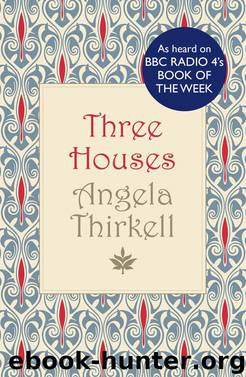
Author:Angela Thirkell [Angela Thirkell]
Language: eng
Format: epub
ISBN: 9780749012342
Publisher: Allison & Busby
Published: 2012-08-17T04:00:00+00:00
III
Gothic House next door was a boarding-house and North End House had all the garden of both houses. A high flint wall ran right across the back of Gothic House and its little paved brick courtyard, dividing it from our garden, and against this wall was a high penthouse roof of red tiles, known as the Cloisters, supported on plain wooden pillars set in a low brick wall. The space below the roof had a wooden floor, making a pleasantly echoing place for our wet-weather playground in summer. It contained a couple of large beehive chairs made of creaking basket-work like the ‘sulkies’ in the garden at Earlham. Grown-ups could sit facing each other in them and talk, or could turn them back to back and read or meditate, undisturbed by the sight of each other. Children could turn them over on to their backs and use them as cradles, or pirate ships, or Spanish galleons, or an Argo, or the Ark. Or they could pull one over on to its face and crouch beneath it in hiding from the world in general and Nanny in particular. Here also were deck chairs and a few rush-bottomed chairs, stained with paint, discarded from the studio, and in one corner a heap of outdoor toys; spades and buckets for the beach, a spotted wooden horse on wheels and the little wooden go-cart which our parents brought from Germany, christened by Jeanne, the French maid, ‘le petit chariot’. It was the kind of low four-wheeled cart that dogs draw in some parts of the Continent, or children drag about in Ludwig Richter’s pictures, and we used it to drag our baby sister and each other about the garden. There were moments when the axles bent or a wheel came off and then we had the pleasure of dragging it round by the village pond to the blacksmith and having real repairs done while we waited. The forge was at the far end of the pond, opposite the Plough Inn, just where the road called Whiteway went up to East Hill. Rottingdean was rich in public-houses; five to a village of about a thousand inhabitants. The White Horse and Royal Oak were houses of some size and pretension, the Plough Inn was more frequented by farmers’ men and labourers who brought horses in to be shod, or wagons to have new metal tyres to their wheels, and there were still the Black Horse and the Queen Victoria – hardly more than ale houses – to supply the needs of the public.
At the end of the cloisters nearest the house there grew a bay-tree affording easy access to the tiled roof on which we walked like cats with bare feet. This spot was technically forbidden for various reasons. Nanny forbade it on general grounds of disapproval of anything we wanted to do. My mother had visions of our mangled forms falling six feet on to the ground on our side, or ten feet into the boarding-house yard on the other.
Download
This site does not store any files on its server. We only index and link to content provided by other sites. Please contact the content providers to delete copyright contents if any and email us, we'll remove relevant links or contents immediately.
Still Foolin’ ’Em by Billy Crystal(36468)
We're Going to Need More Wine by Gabrielle Union(19170)
Plagued by Fire by Paul Hendrickson(17540)
Pimp by Iceberg Slim(14796)
Molly's Game by Molly Bloom(14260)
Becoming by Michelle Obama(10111)
When Breath Becomes Air by Paul Kalanithi(8592)
Educated by Tara Westover(8173)
The Girl Without a Voice by Casey Watson(7976)
The Incest Diary by Anonymous(7828)
Note to Self by Connor Franta(7751)
How to Be a Bawse: A Guide to Conquering Life by Lilly Singh(7615)
The Space Between by Michelle L. Teichman(7036)
What Does This Button Do? by Bruce Dickinson(6315)
Permanent Record by Edward Snowden(5962)
Imperfect by Sanjay Manjrekar(5936)
A Year in the Merde by Stephen Clarke(5523)
Shoe Dog by Phil Knight(5391)
Heated Rivalry by Rachel Reid(5273)
