The Grace of Repentance (Repackaged Edition) (Today's Issues) by Sinclair B. Ferguson
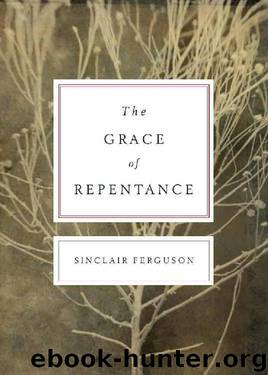
Author:Sinclair B. Ferguson [Ferguson, Sinclair B.]
Language: eng
Format: epub
Publisher: Crossway
Published: 2011-04-07T00:00:00+00:00
A MEDIEVAL THREAT
Little did Martin Luther realize that by nailing his theses to the Wittenberg Castle Church door, he simultaneously “nailed” the Gospel of Christ into the heart of the church. He was calling Christendom to repentance.
Repentance which is occupied with thoughts of peace is hypocrisy. There must be a great earnestness about it and a deep hurt if the old man is to be put off. When lightning strikes a tree or a man, it does two things at once—it rends the tree and swiftly slays the man. But it also turns the face of the dead man and the broken branches of the tree itself toward heaven. (Bainton, Here I Stand, p. 48)
Luther’s emphasis on the radical and lifelong character of repentance is the common testimony of the Reformers. John Calvin, Luther’s younger French contemporary, taught that repentance is really the concrete expression of divine regeneration and renewal. In fact, Calvin defines regeneration as repentance (as the chapter title of his Institutes of the Christian Religion [Philadelphia: Westminster, 1960], III, iii, 1 makes plain). Even more, Calvin provides us with an in-depth exegesis of what repentance is, showing that it can never be separated from faith, though it should not be confused with it.
According to Calvin, repentance involves a threefold cord: “denial of ourselves, mortification of our flesh, and meditation on the heavenly life” (Commentary on the Acts of the Apostles, 14-28 [Grand Rapids, Mich.: Eerdmans, 1966], p. 176).
This means that true repentance can never be reduced to a single act found only at the beginning of the Christian life. It arises in the context of our union with Jesus Christ; and since its goal is our restoration into the image of Christ, it involves the ongoing practical outworking of our union with Christ in his death and resurrection—what Calvin calls mortification and vivification (Institutes, III, iii, 3)—that is, being conformed to Christ crucified and risen.
It is not only my life as an individual that must be repentance-shaped, however. This must also be true of the whole church united to Christ by the Holy Spirit. Repentance is worked out both inwardly and outwardly in entire communities of believers. Thus says Calvin:
Download
This site does not store any files on its server. We only index and link to content provided by other sites. Please contact the content providers to delete copyright contents if any and email us, we'll remove relevant links or contents immediately.
The 5 Love Languages: The Secret to Love That Lasts by Gary Chapman(9784)
The Space Between by Michelle L. Teichman(6929)
Assassin’s Fate by Robin Hobb(6199)
Wiseguy by Nicholas Pileggi(5770)
Everything Happens for a Reason by Kate Bowler(4733)
Gerald's Game by Stephen King(4641)
Pillow Thoughts by Courtney Peppernell(4271)
A Simplified Life by Emily Ley(4157)
The Power of Positive Thinking by Norman Vincent Peale(4061)
Harry Potter and the Prisoner of Azkaban (Book 3) by J. K. Rowling(3347)
Resisting Happiness by Matthew Kelly(3337)
Girl, Wash Your Face by Rachel Hollis(3282)
Being Aware of Being Aware by Rupert Spira(3272)
The Secret Power of Speaking God's Word by Joyce Meyer(3178)
The Code Book by Simon Singh(3177)
More Language of Letting Go: 366 New Daily Meditations by Melody Beattie(3020)
Real Sex by Lauren F. Winner(3014)
Name Book, The: Over 10,000 Names--Their Meanings, Origins, and Spiritual Significance by Astoria Dorothy(2978)
The Holy Spirit by Billy Graham(2944)
