The E-Boat Threat by Cooper Bryan
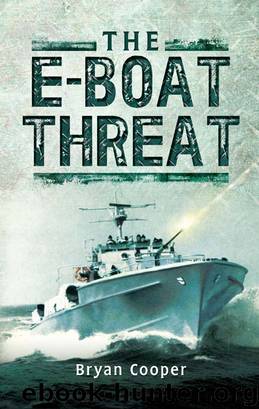
Author:Cooper, Bryan
Language: eng
Format: epub, azw3
ISBN: 9781473853935
Publisher: Pen and Sword
Published: 2015-02-27T16:00:00+00:00
Experiments were also carried out with much smaller craft. These were intended to be carried on board cruisers during their roving activities round the world against merchant shipping and lowered into the water when a suitable target presented itself. The prototype LS (light fast boat) was built in 1941 by the Dornier Works at Friedrichshaven on Lake Constance. It was only 13.4 metres overall but carried a crew of five and was armed with two 45cm ( 18inch) torpedoes, two 20mm guns and two machine-guns. Although powered by only two 850 hp engines it had a speed of 40 knots in calm waters, primarily due to the use of steel-reinforced light alloy for construction. This prototype was taken on board the auxiliary cruiser Michel into the Indian Ocean in 1942, but experience showed that the torpedoes were too small to cause much damage, even when they hit, which was not often owing to the craft’s lack of seaworthiness. Only very few of these boats were built. Even less successful was a slightly larger craft of 16 metres intended for use on the Russian lakes. They were so badly constructed, continually springing leaks, that the commander shipped them back to Germany as being totally unsuitable and a danger to their crews.
One of the original eight craft built for the Turkish Navy by Camper and Nicholson in 1942 but taken over by the Admiralty, this one was completed as an MGB while five became blockade runners, bringing machine tools and ball bearings from Sweden. The three MGBs (502, 503 and 509) were armed with a 2-pounder Pom-Pom in power turret forward, a twin .5inch machine-gun in power turrets on either side of the bridge, a twin 20mm Oerlikon in power turret amidships, a 6-pounder hand operated aft, and two twin .303inch machine-guns. This series displaced 95 tons and were powered by three Davey Paxman diesels of 1,000 hp each which gave a maximum speed of 28 knots, although super-charged Packards were fitted to MGB 509 to increase speed to 31 knots. When the blockade runners were no longer required at the end of 1944, they reverted to their original MGB numbers (504 – 508) and armament. In 1945 the surviving boats were rearmed and had 1500 added to their pennant numbers
Download
This site does not store any files on its server. We only index and link to content provided by other sites. Please contact the content providers to delete copyright contents if any and email us, we'll remove relevant links or contents immediately.
| Africa | Americas |
| Arctic & Antarctica | Asia |
| Australia & Oceania | Europe |
| Middle East | Russia |
| United States | World |
| Ancient Civilizations | Military |
| Historical Study & Educational Resources |
The Radium Girls by Kate Moore(12036)
100 Deadly Skills by Clint Emerson(4932)
Rise and Kill First by Ronen Bergman(4797)
The Templars by Dan Jones(4695)
The Doomsday Machine by Daniel Ellsberg(4493)
The Rape of Nanking by Iris Chang(4224)
Killing England by Bill O'Reilly(4008)
Stalin by Stephen Kotkin(3973)
Hitler in Los Angeles by Steven J. Ross(3949)
12 Strong by Doug Stanton(3554)
Hitler's Monsters by Eric Kurlander(3348)
Blood and Sand by Alex Von Tunzelmann(3207)
The Code Book by Simon Singh(3197)
Darkest Hour by Anthony McCarten(3135)
The Art of War Visualized by Jessica Hagy(3014)
Hitler's Flying Saucers: A Guide to German Flying Discs of the Second World War by Stevens Henry(2759)
Babylon's Ark by Lawrence Anthony(2686)
The Second World Wars by Victor Davis Hanson(2529)
Tobruk by Peter Fitzsimons(2521)
