The Bay of Pigs by Alejandro de Quesada
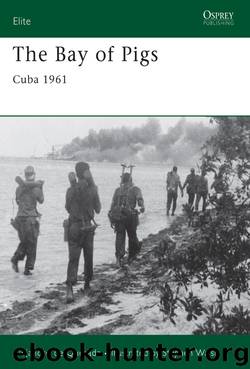
Author:Alejandro de Quesada
Language: eng
Format: epub
Tags: The Bay of Pigs
ISBN: 9781780961422
Publisher: Osprey Publishing
Published: 2011-09-11T16:00:00+00:00
As D-Day drew to an end, the Brigade held beachheads around both Red and Blue Beaches, as well as the airfield at Girón. The force at Red Beach was bearing the brunt of the action, with high casualties and decreasing ammunition and supplies. The FAR/MNR were threatening to push down the road into Playa Larga, under the umbrella of Castro’s air force. Brigade air support had been weak, and four aircraft had been lost; two ships had been sunk, and two more had completely departed the area.
A militiaman armed with a folding-stock Vz25 SMG is seen here examining what appears to be an unexploded 200lb fragmentation bomb spilled from the bay of a shot-down Liberation Air Force B-26B. (ADEQHA)
Washington knew that ammunition was running low, and ordered airdrops from the Nicaraguan base for the night of April 17. Missions were flown by four C-54s and two C-46s; of these, five of the drops were successful but the cargo of the sixth was blown out to sea. In addition, the Barbara J and the Blagar were ordered to resume resupply after nightfall. Some supplies were delivered ashore, but the limited remaining landing craft were not able to sustain the needs of the Brigade.
The CIA’s failure to notify the network of infiltrators and the Cuban underground of the invasion, even after it had begun, wasted a potentially useful asset. One infiltrator later reported that around noon of D-Day he finally received a message that the invasion had begun and he should blow the bridges between Central Australia and Playa Larga. He could not do this in daylight because of the massive Cuban mobilization – and it would have made little difference anyway, since the militia had crossed the bridges six hours earlier. The failure to use the covert forces available to the CIA cost them the opportunity to divert Castro’s forces, and allowed them to focus solely on the beachheads.
In the meantime, the Joint Chiefs had taken all steps to be ready if called upon to intervene in the battle, and were prepared to offer any support ordered by the president. They had moved several aviation units inside striking distance, to bases in the South, and the Navy was prepared to assist with air cover, escort or naval gunfire as soon as the word was given; but the word never came. At the old Opa Locka Naval Air Station just outside Miami, the Cuban exile officials of the provisional government were still waiting – under strict guard in the barracks – to be transported to the beachhead. They had been furnished with a radio by their guards, and heard the optimistic claims of Radio Swan that the invasion force was winning the battle. The CIA public relations office in New York released what they called the Cuban Revolutionary Council’s Bulletin Number 3; the announcement read:
The Cuban Revolutionary Council wishes to announce that the principal battle of the Cuban Revolt against Castro will be fought in the next few hours. Action today was
Download
This site does not store any files on its server. We only index and link to content provided by other sites. Please contact the content providers to delete copyright contents if any and email us, we'll remove relevant links or contents immediately.
| Africa | Americas |
| Arctic & Antarctica | Asia |
| Australia & Oceania | Europe |
| Middle East | Russia |
| United States | World |
| Ancient Civilizations | Military |
| Historical Study & Educational Resources |
The Radium Girls by Kate Moore(12036)
100 Deadly Skills by Clint Emerson(4932)
Rise and Kill First by Ronen Bergman(4797)
The Templars by Dan Jones(4695)
The Doomsday Machine by Daniel Ellsberg(4493)
The Rape of Nanking by Iris Chang(4224)
Killing England by Bill O'Reilly(4008)
Stalin by Stephen Kotkin(3973)
Hitler in Los Angeles by Steven J. Ross(3949)
12 Strong by Doug Stanton(3554)
Hitler's Monsters by Eric Kurlander(3348)
Blood and Sand by Alex Von Tunzelmann(3207)
The Code Book by Simon Singh(3197)
Darkest Hour by Anthony McCarten(3135)
The Art of War Visualized by Jessica Hagy(3014)
Hitler's Flying Saucers: A Guide to German Flying Discs of the Second World War by Stevens Henry(2759)
Babylon's Ark by Lawrence Anthony(2686)
The Second World Wars by Victor Davis Hanson(2529)
Tobruk by Peter Fitzsimons(2521)
