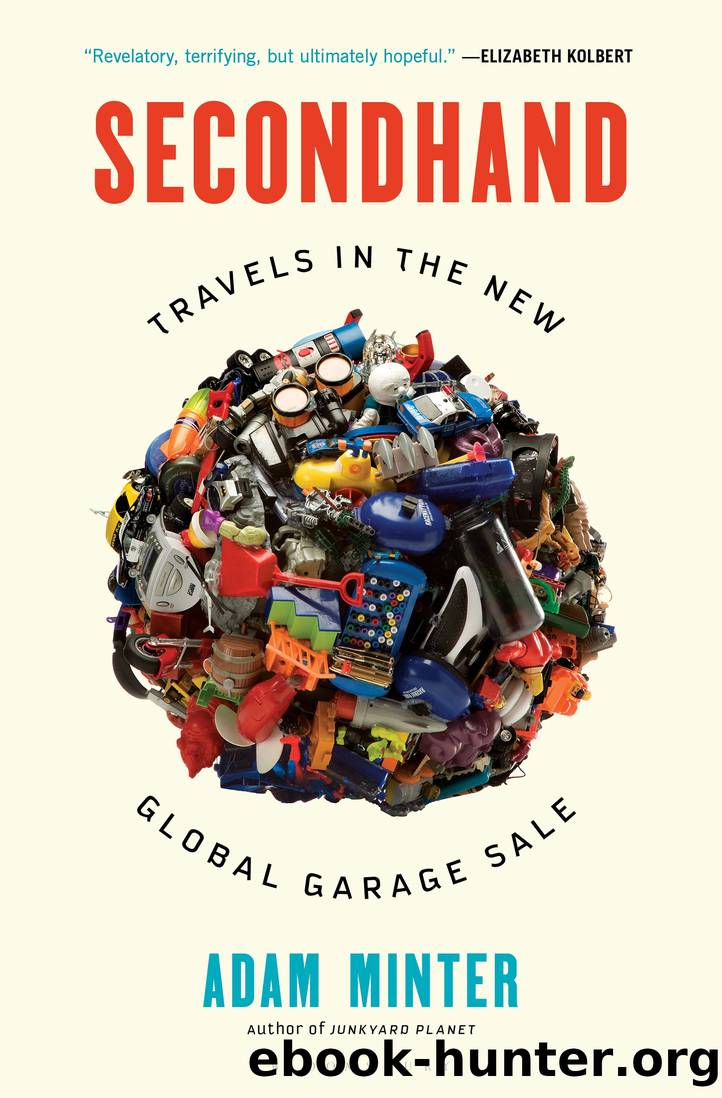
Secondhand by Adam Minter
Author:Adam Minter
Language: eng
Format: epub
Publisher: Bloomsbury Publishing
On December 10, 1974, the New York Times published a curious article under the headline DECLINING QUALITY IN CLOTHES: THE MAKERS AND SELLERS TELL WHY. The author, Enid Nemy, opened by noting a now-forgotten mid-1970s grievance:
An increasing number of consumers are complaining about a deterioration in qualityâfood doesnât taste the same, automobiles donât last as long, appliances collapse, the list is endless.
The fashion industry is no exception.
At the time, the United States was the source of most goods consumed by Americans. Hong Kong, then under the jurisdiction of the United Kingdom, made and exported some garments (including, reportedly, garments smuggled from China). But the overall total was too small to impact U.S. manufacturers and consumers. The notion that China, still bogged down by the violent Cultural Revolution, might one day disrupt the global economic order was preposterous.
Nemy didnât point fingers at others for what she characterized as a plague of âpoor fit, inferior fabrics and shoddy workmanship.â Instead, she provided room for four American apparel manufacturing and retailing veterans to explain it. Their conclusion, as summarized by Nemy, was that âquality generally has been declining since World War [II] and that what had been expediency at the time had now become a way of life.â
She reported several factors accounting for the decades-long descent: a lack of product inspectors, âa dwindling supply of skilled labor,â a shift to piecework (making collars only, for example, while another factory makes cuffs) rather than whole-garment manufacturing, andâmost notablyâthe relentless march of fashion. Paul Heller, then president of the Carr Buying Office, a company that purchased goods on behalf of hundreds of shops and department stores around the United States, spoke of the latter in terms that will be familiar to contemporary critics of fast fashion:
HELLER: Thereâs no question that our poorest quality comes from the hot fashions fad manufacturer. No doubt about it. And yet there is, particularly in young junior areas, an enormous consumer demand for this type of fashion.
Are you saying that a good deal of the fault is due to consumer acceptance of poor quality?
HELLER: No question. She is the final arbiter. And for every garment that is returned there may be 10 others that should have been returned but the customer manages to live with it because she wants that look on her back. She loves the dress.
The global dominance of Chinaâs textile manufacturers didnât happen for another fifteen years. Arguably, fast fashion wouldnât happen for another twenty. But viewed from 1974, itâs difficult to argue that Chinaâs âcheapâ clothing is a recent phenomenon. Rather, itâs an evolution in customer tolerance that began with the industrial revolution. Thanks to technology, improved logistics, and entrepreneurial know-how, Chinaâand East Asian manufacturing in generalâhas managed to do it better than anybody else.
Will Africaâs consumers be the first to turn against the deteriorating quality of clothing? Probably not. Chinese textile exports to Africa have been growing for decades, and several African countries, including Rwanda and Ethiopia, are eager hosts to Chinese apparel manufacturers. Secondhand
Download
This site does not store any files on its server. We only index and link to content provided by other sites. Please contact the content providers to delete copyright contents if any and email us, we'll remove relevant links or contents immediately.
International Integration of the Brazilian Economy by Elias C. Grivoyannis(111079)
The Radium Girls by Kate Moore(12036)
Turbulence by E. J. Noyes(8057)
Nudge - Improving Decisions about Health, Wealth, and Happiness by Thaler Sunstein(7712)
The Black Swan by Nassim Nicholas Taleb(7137)
Rich Dad Poor Dad by Robert T. Kiyosaki(6646)
Pioneering Portfolio Management by David F. Swensen(6305)
Man-made Catastrophes and Risk Information Concealment by Dmitry Chernov & Didier Sornette(6029)
Zero to One by Peter Thiel(5808)
Secrecy World by Jake Bernstein(4756)
Millionaire: The Philanderer, Gambler, and Duelist Who Invented Modern Finance by Janet Gleeson(4483)
The Age of Surveillance Capitalism by Shoshana Zuboff(4310)
Skin in the Game by Nassim Nicholas Taleb(4257)
The Money Culture by Michael Lewis(4212)
Bullshit Jobs by David Graeber(4197)
Skin in the Game: Hidden Asymmetries in Daily Life by Nassim Nicholas Taleb(4012)
The Dhandho Investor by Mohnish Pabrai(3776)
The Wisdom of Finance by Mihir Desai(3754)
Blockchain Basics by Daniel Drescher(3586)
