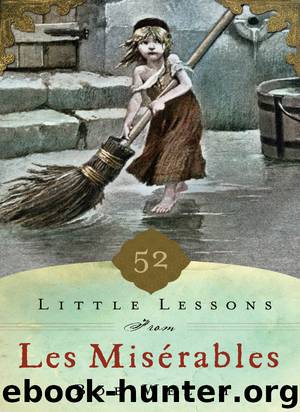
52 Little Lessons from Les Miserables by Bob Welch
Author:Bob Welch
Language: eng
Format: epub
Tags: ebook
Publisher: Thomas Nelson
Published: 2014-07-31T16:00:00+00:00
Lesson
29
WISDOM CAN COME FROM WEIRD PLACES
God has his own ways.1
—LES MISÉRABLES
DESPITE HUGO’S OBVIOUS DISLIKE OF CONVENTS, HE CREDITS one as putting an important piece in the puzzle that is becoming Jean Valjean: “The convent contributed, like Cosette, to confirm and complete in Jean Valjean the bishop’s work,” he writes.2
That’s high praise. The bishop, of course, is the one whose mercy has set Valjean free to become a new man. And yet Valjean’s time as a gardener in the convent also proves to be a fruitful experience while he avoids the snares of Javert. The experience nurtures him with a sense of humility.
The setting keeps his focus on the grace of the bishop instead of on the greed of the men whose “robbery, fraud, violence, lust, homicide” had led them to be his prison mates on the slave galleys.3
“So long as he compared himself only with the bishop, he had found himself unworthy and remained humble,” writes Hugo, “but, for some time now, he had been comparing himself with the rest of men, and pride was springing up in him. Who knows? He might have finished by going gradually back to hatred. The convent stopped him in his descent.”4
In the book, Hugo allows Valjean a broader mind about convents than he, as an author, expresses. He contrasts what he refers to as Valjean’s two “prisons”—the actual one in Toulon and the virtual one in Paris. “Two seats of slavery,” he writes.5 And yet, in the women’s devotion to prayer, in their innocence, in their regiment aimed at purity, Valjean sees a certain virtue in the convent that he had not found in prison.
“In the first, the captives were chained by chains alone; in the other, chained by faith.” The first produces “desperate depravity, a cry of rage against human society, sarcasm against heaven.” The second? “Benediction and love.” In the evenings, he kneels in prayer before the sister performing the reparation. “It was as though he did not dare kneel directly before God.”6
Valjean realizes he has learned from both experiences, honing a sense of humility toward self and reverence for God. “Had it not been for the [prison], he would have fallen back into crime,” writes Hugo, “and had it not been for the [convent], into punishment.”7
All of which serves as a reminder that God can teach us through the most unlikely experiences, people, and places: through injustice (in Valjean’s case, a prison where he is sent for stealing a loaf of bread), through inconvenience (certainly life in the convent provides a few), even through exile (life among the nuns to avoid Javert’s detection).
In 1945, Aleksandr Solzhenitsyn, the Russian writer and dissident, was arrested and exiled, ultimately to a number of Russian prisons and work camps. During an eleven-year imprisonment, he developed cancer. But amid such darkness he found light; amid hopelessness, hope; amid godlessness, God. He went on to write such classics as One Day in the Life of Ivan Denisovich. He won a Nobel Prize. He trumpeted the idea of individual responsibility, the idea that the world is not divided into good guys and bad guys.
Download
This site does not store any files on its server. We only index and link to content provided by other sites. Please contact the content providers to delete copyright contents if any and email us, we'll remove relevant links or contents immediately.
The 5 Love Languages: The Secret to Love That Lasts by Gary Chapman(9792)
The Space Between by Michelle L. Teichman(6932)
Assassin’s Fate by Robin Hobb(6200)
Wiseguy by Nicholas Pileggi(5771)
Everything Happens for a Reason by Kate Bowler(4734)
Gerald's Game by Stephen King(4642)
Pillow Thoughts by Courtney Peppernell(4273)
A Simplified Life by Emily Ley(4159)
The Power of Positive Thinking by Norman Vincent Peale(4062)
Harry Potter and the Prisoner of Azkaban (Book 3) by J. K. Rowling(3357)
Resisting Happiness by Matthew Kelly(3337)
Girl, Wash Your Face by Rachel Hollis(3282)
Being Aware of Being Aware by Rupert Spira(3273)
The Secret Power of Speaking God's Word by Joyce Meyer(3186)
The Code Book by Simon Singh(3184)
More Language of Letting Go: 366 New Daily Meditations by Melody Beattie(3024)
Real Sex by Lauren F. Winner(3016)
Name Book, The: Over 10,000 Names--Their Meanings, Origins, and Spiritual Significance by Astoria Dorothy(2983)
The Holy Spirit by Billy Graham(2945)
