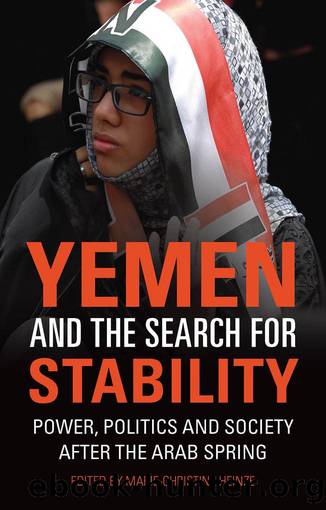
Yemen and the Search for Stability by Marie-Christine Heinze;
Author:Marie-Christine Heinze;
Language: eng
Format: epub
ISBN: 9781786723512
Publisher: Bloomsbury UK
REPORTS AND GUARANTEES
Despite these obstacles and threats, the NDC was concluded on 25 January 2014, the day of the joint signing of the final report. The NDC final report is a compendium of the final reports of the nine subcommittees, and includes nearly 1,800 resolutions (pl. qararat), as well as several appendices which define the mechanisms for the implementation of the resolutions (Republic of Yemen 2014).
The final report of the SaÊ¿da subcommittee is a joint document agreed on by all its members, but its preamble and the vast majority of the 59 resolutions bear the signature of the Huthis. Even in regard to points of contention â such as the disarmament of the conflict parties and the re-opening of the province to state influence â formulations were found which met the demands of the Huthis. There were different views as to why the Sunni Islamists managed to incorporate only a few of their demands into the report. Some observers suggested a connection with the Islamistsâ recent domestic vulnerability in the new national environment. Others indicated that the Sunni Islamists, who were being excessively harassed and humiliated by the Huthis outside the conference venue, had been largely flying blind throughout the crisis. In addition, the NDC process was under the close surveillance of the UN and the GCC, which rendered the introduction of Islamist formulations in the report virtually impossible.
The bargaining power of the Huthis and the relative weakness of their opponents were already apparent in the introduction of the final report, which turned the resolution of the âSaÊ¿da Issueâ into the resolution of the âHuthi Issueâ, as critics from the ranks of SaÊ¿da's Sunni Islamists complained (al-Sabahi 2013). The wording of the whole report mirrored the rhetoric of the Huthi envoys to the NDC: By appointing, amongst others, Ê¿Ali al-Bukhayti, Ahmad Sharaf al-Din, and Ê¿Abd al-Karim Jadban, particular emphasis had been placed on the moderate, rather leftist spectrum among the Huthis, whose remarkably liberal consensus positions advocated the reconciliation with their opponents and the establishment of a civil state, based on freedom of belief, political pluralism and balance of power, thus aligning their positions with those of youth, women, and civil society representatives.
The final report identified the following causes of the SaÊ¿da problem: incomplete state formation and developmental grievances in the province; external interference, particularly with regard to the spread of ideas which impacted on the historical coexistence between Upper Yemen's basic doctrines (Zaydism and Sunnism); and the politics of divide and rule (al-idara bi-l-azmat) pursued by the Yemeni government. The introduction stated that in 2004 the repression and detention of the supporters of Husayn al-Huthi by the government eventually led to the outbreak of the first of six SaÊ¿da Wars. Against this background, the final report argued for the creation of a watan yatasiÊ¿ li-l-jamiÊ¿ (a homeland which belongs to all) in which âcitizens must live in complete freedom in terms of intellectual and religious and personal freedomsâ.
The struggle for formulations and interpretations during the NDC was exemplified in
Download
This site does not store any files on its server. We only index and link to content provided by other sites. Please contact the content providers to delete copyright contents if any and email us, we'll remove relevant links or contents immediately.
| Anthropology | Archaeology |
| Philosophy | Politics & Government |
| Social Sciences | Sociology |
| Women's Studies |
The Secret History by Donna Tartt(19114)
The Social Justice Warrior Handbook by Lisa De Pasquale(12198)
Thirteen Reasons Why by Jay Asher(8924)
This Is How You Lose Her by Junot Diaz(6895)
Weapons of Math Destruction by Cathy O'Neil(6287)
Zero to One by Peter Thiel(5809)
Beartown by Fredrik Backman(5770)
The Myth of the Strong Leader by Archie Brown(5514)
The Fire Next Time by James Baldwin(5457)
How Democracies Die by Steven Levitsky & Daniel Ziblatt(5226)
Promise Me, Dad by Joe Biden(5160)
Stone's Rules by Roger Stone(5092)
A Higher Loyalty: Truth, Lies, and Leadership by James Comey(4969)
100 Deadly Skills by Clint Emerson(4936)
Rise and Kill First by Ronen Bergman(4802)
Secrecy World by Jake Bernstein(4757)
The David Icke Guide to the Global Conspiracy (and how to end it) by David Icke(4725)
The Farm by Tom Rob Smith(4518)
The Doomsday Machine by Daniel Ellsberg(4494)
