Wonder of Wonders by Wall Keith;
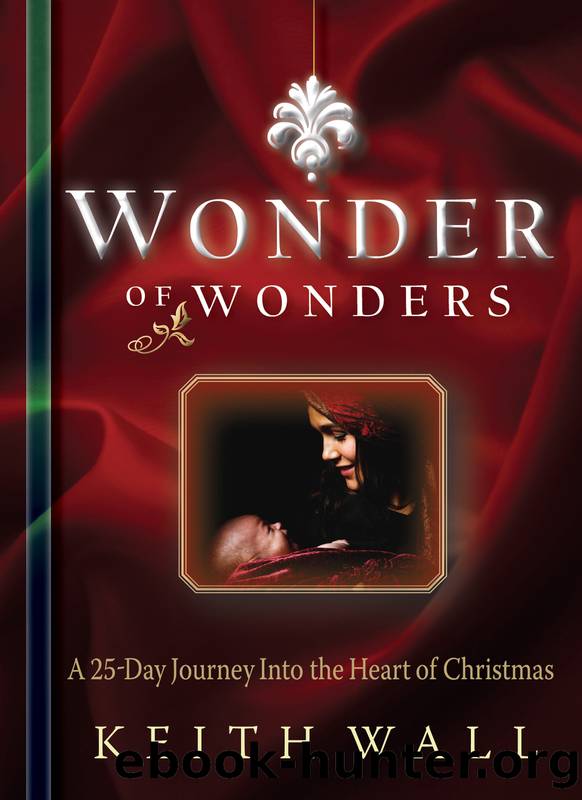
Author:Wall, Keith;
Language: eng
Format: epub
Publisher: Authentic Media
Iâve learned that you can
tell a lot about a person by the way
he or she handles these three things:
a rainy day, lost luggage,
and tangled Christmas lights.
MAYA ANGELOU
FOURTEEN
JINGLE BELLS AND JANGLED NERVES
A fresh look at an old problem holiday stress.
WHEN YOU WERE A KID, the word Christmas had magical power. No matter what time of year you heard it, the sound evoked images of sugar cookies and warm pajamas ⦠a tinsel-draped tree towering over mounds of brightly colored gifts ⦠school vacation ⦠songs and stories andâif you were luckyâsnow outside. Christmas was synonymous with feelings of âhappiness,â âcomfortâ and âwell-being.â
And stress.
Well, not back then, of course. This new word association arises later, when you have kids of your own, bills to pay, bosses (and maybe spouses) to pacify, and fewer and fewer hours in the day in which to accomplish more and more. And thatâs without adding on the demands of gift shopping, holiday traffic, office parties, pageant rehearsals, visiting relatives, the need to arrange day care for kids home from school, andâif youâre unluckyâsnow to shovel from the driveway.
It is sad but true: Christmas can be stressful for grown-ups. Itâs not easy to get in the âproperâ spirit when you are struggling just to keep your head above water. Perhaps the worst part of all is the feeling of failure that often accompanies the strain. You think having frayed nerves during the holidays is a sure sign youâre doing something wrong. If you were a better person, then your experience of this Christmas would more closely resemble the very first one, wouldnât it? After all, that night was the perfect example of peace on earth, a standard God calls us to reach for in our lives. This idea is reinforced all through the holidays. Just consider the lyrics of one of our most beloved carols:
Silent night, holy night
All is calm, all is bright
Round yon virgin, mother and child
Holy infant so, tender and mild
Sleep in heavenly peace,
Sleep in heavenly peace.
Every schoolchild knows these words by heart before theyâve made it through their first holiday music concert. There are as many recordings of the song as there are Christmas albumsâand all of them, it seems, get airtime during the holiday season. With good reason; both the lyrics and the music are remarkably beautiful and inspiring. But look closely at the serene image it creates in our minds of what the âholy nightâ of Jesusâ birth must have been like: still, quiet, calm, bright, a realm of heavenly peace. It paints an idyllic picture of the world as it should be: harmonious and blissful, where angelic choirs overpower all chaos. In other words, a world that is very different from the one you live in day by stressful day. Somewhere, something doesnât add up.
Maybe nineteenth-century life in the Austrian countrysideâwhere âSilent Nightâsâ composers lived when they wrote the music and lyricsâwas exactly this sort of paradise every Christmas Eve. Maybe our distant ancestors all had plenty of time to contemplate the true meaning of the holiday and had no difficulty embodying the Nativity.
Download
This site does not store any files on its server. We only index and link to content provided by other sites. Please contact the content providers to delete copyright contents if any and email us, we'll remove relevant links or contents immediately.
Professional Troublemaker by Luvvie Ajayi Jones(29668)
Empire of the Sikhs by Patwant Singh(23089)
Twilight of the Idols With the Antichrist and Ecce Homo by Friedrich Nietzsche(18638)
Plagued by Fire by Paul Hendrickson(17416)
The Sun and Her Flowers by Rupi Kaur(14526)
Norse Mythology by Gaiman Neil(13372)
A Journey Through Charms and Defence Against the Dark Arts (Harry Potter: A Journey Throughâ¦) by Pottermore Publishing(9276)
Fangirl by Rainbow Rowell(9259)
Adultolescence by Gabbie Hanna(8929)
Wonder by R.J. Palacio(8584)
Tools of Titans by Timothy Ferriss(8402)
Becoming Supernatural by Dr. Joe Dispenza(8223)
How to Bang a Billionaire by Alexis Hall(8160)
Wonder by R. J. Palacio(8115)
Crystal Healing for Women by Mariah K. Lyons(7932)
The Road Less Traveled by M. Scott Peck(7605)
The Lost Art of Listening by Michael P. Nichols(7507)
The Witchcraft of Salem Village by Shirley Jackson(7277)
The Institute by Stephen King(7043)
