Women of War, Women of Woe by Taylor Marion Ann;de Groot Christiana;De Groot Christiana;Taylor Marion Ann;
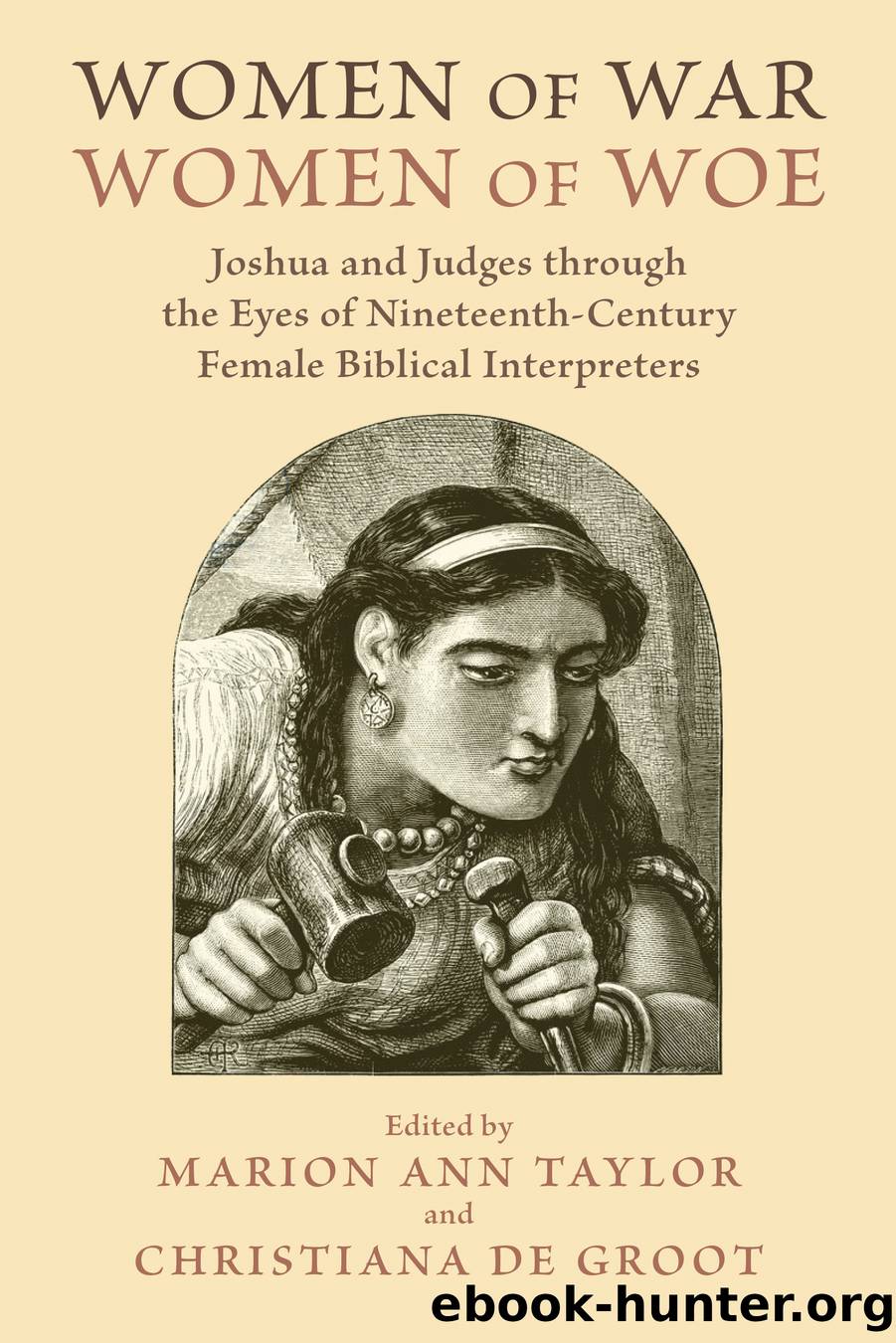
Author:Taylor, Marion Ann;de Groot, Christiana;De Groot, Christiana;Taylor, Marion Ann;
Language: eng
Format: epub
Publisher: Wm. B. Eerdmans Publishing Co.
Published: 2016-04-15T15:18:26+00:00
Emily Owen
Jael: A Heroine?
Emily Owen (1822â85) was born in Gloucester, England, to Mary and William Montague. In 1843 she married Octavius Friere Owen, who had earned an M.A. from Christ Church, Oxford, and was an Anglican priest, domestic chaplain to the Duke of Portland, translator, editor, and prolific writer. In addition to giving birth to ten children, Owen, who published as Mrs. Octavius Friere Owen, was a composer and published a number of books, including The Heroines of History (1854) and The Heroines of Domestic Life (1861).
The Heroines of History, as the title suggests, explores the subject of heroism as it relates to women. Owenâs design in writing a history of female heroes was âto instruct by attraction.â She identifies herself as a historian âwander[ing] through the garden of the Past, cull[ing] from each fairest plant the brightest hints, the richest odours, to stimulate the ambition or support the endurance of the young mothers of the future generation.â15 She divides history into three eras: Jewish, Classic, and Modern, including in the Jewish era only Jael, Judith, Salamona, and Marianne. Twenty other heroines are discussed in her book.
Owenâs historical interests are apparent in her treatment of Jael. She stresses differences in education and circumstances between her own time, which she idealizes, and the world of Jael. At the same time, she wonders if Jael âmay have been endowed with a heart as tender, a mental organization as delicate, to which the very name of violence, or a deed of bloodshed, was as repellent as to your own, or to that of any other sensitively nurtured daughter of our favoured land!â That being said, she refuses to interpret the story in light of her own assumptions about the nature of women.
Owen draws on historical and biblical scholarship to illumine the story and shows appreciation for Jewish tradition, introducing an alternative reading that further justifies Jaelâs act as it implies that Sisera expected sexual favors from Jael. She notes Charles Taylorâs justifications of Jaelâs actions and, rather than engaging them one by one, states that her method is to stick to what is explicitly stated in the passage â a very Protestant hermeneutic.16 Owen recognizes that this means the reader is left to interpret a text that contains obscurity about the motivations of Jael. This explicit acknowledgement of the ambiguity of the text and her decision to respect this characteristic make Owen an unusual commentator, as most smooth out the rough spots to bring them into conformity with their own convictions.
Owen discusses the reference to Jael as âblessedâ in Deborahâs song, claiming that it refers to the results of her actions rather than their innate goodness. Her conclusions are similar to Grandfatherâs claim in Eliza Smithâs work that applause is often for the success of a project rather than its own virtue. Owen approaches the difficulties regarding the ethics of Jaelâs actions by considering other examples where God uses questionable characters and tactics to accomplish holy tasks. Owen also is the only interpreter to note the parallel between Jael and Judith in the Apocrypha.
Download
This site does not store any files on its server. We only index and link to content provided by other sites. Please contact the content providers to delete copyright contents if any and email us, we'll remove relevant links or contents immediately.
Professional Troublemaker by Luvvie Ajayi Jones(29651)
Empire of the Sikhs by Patwant Singh(23074)
Twilight of the Idols With the Antichrist and Ecce Homo by Friedrich Nietzsche(18626)
Plagued by Fire by Paul Hendrickson(17405)
The Sun and Her Flowers by Rupi Kaur(14511)
Norse Mythology by Gaiman Neil(13349)
A Journey Through Charms and Defence Against the Dark Arts (Harry Potter: A Journey Throughâ¦) by Pottermore Publishing(9275)
Fangirl by Rainbow Rowell(9229)
Adultolescence by Gabbie Hanna(8923)
Wonder by R.J. Palacio(8573)
Tools of Titans by Timothy Ferriss(8369)
Becoming Supernatural by Dr. Joe Dispenza(8204)
How to Bang a Billionaire by Alexis Hall(8146)
Wonder by R. J. Palacio(8100)
Crystal Healing for Women by Mariah K. Lyons(7928)
The Road Less Traveled by M. Scott Peck(7594)
The Lost Art of Listening by Michael P. Nichols(7494)
The Witchcraft of Salem Village by Shirley Jackson(7257)
The Institute by Stephen King(7027)
