Women Bishops and Rhetorics of Shalom by Spencer Leland G.;
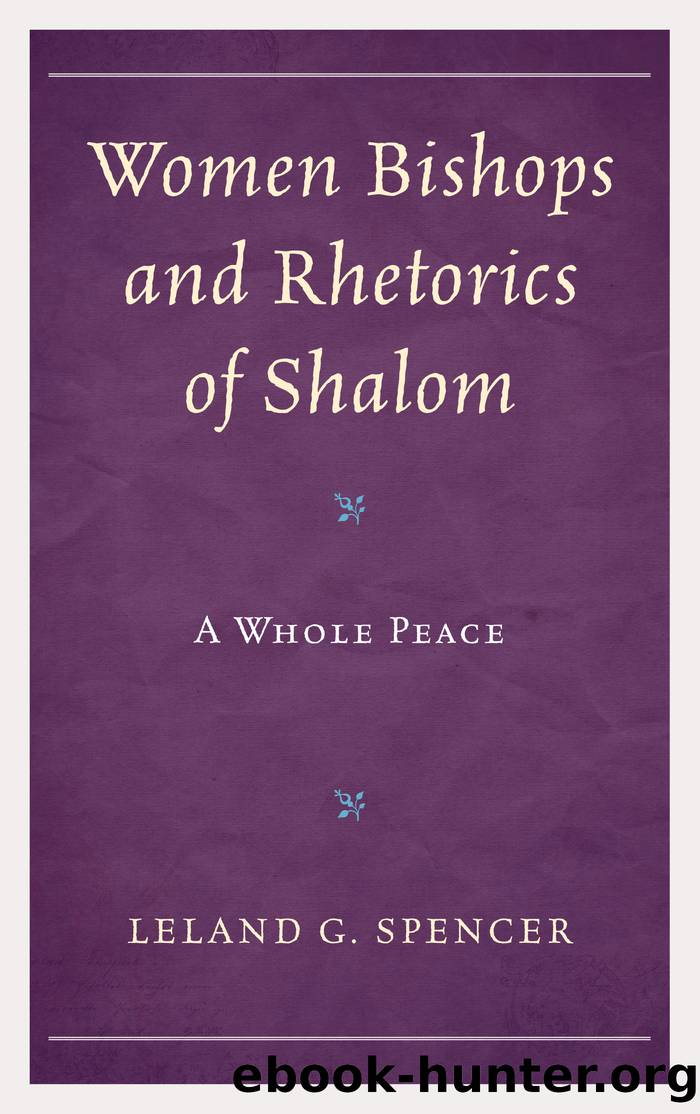
Author:Spencer, Leland G.;
Language: eng
Format: epub
Tags: undefined
Publisher: Lexington Books/Fortress Academic
Published: 2012-08-15T00:00:00+00:00
The white pastor, who took for granted that racism was simply the natural order of the world, felt proud of himself for spending the time and money to leave his important pursuit of an advanced degree in theology to attend the funeral of a black woman who probably had no more than a high school education (if that). Despite her race, despite his presumption of social superiority, he loved her so much that he bore the inconvenience of traveling to his hometown for her funeral. In his mind, the hapless white pastorâs decision to come home for his mammyâs funeral evidenced not only his love for her, but also a pardon from complicity in the structural institution of white supremacy. Kellyâs workshop addressing racism had felt accusatory to him, and he needed to explain himself, to defend why he should not have to listen to Kellyâs teachings about racism. âYouâre too hard on us,â he complained. After all, what could heâa white man who loved a black woman enough to travel for her funeralâhave to learn about racism?
In a profound moment of role reversal, Kelly inverted the arrogant white pastorâs self-congratulatory tone when she insisted that his caregiverâs love strikes her as a âmiracle.â Truly embracing irony, Kelly reversed the social roles of black and white. The character who represents the miracle of love is not the haughty white pastor but the black woman who manages to love so unlovable a character. The audience should identify not with the educated white man with all the markers of status and privilege, but with the nameless black mammy who is memorable not for her status, her education, or her power, but for the love she showed to another. The miracle of the black caregiverâs love for the white child stood in for the miracle of black people who manage to love a church with a troubling racist history. In a Christian context, the allusion to Jesusâs miraculous love for a sinful church is unmistakable. The love of the black caregiver for the white child is the love of black people for Methodism, the love of Jesus for a sinful church.
As a storyteller, Kelly allows the audience to listen in or overhear her conversation with the white pastor. Rather than confronting the audience directly, she removes them one step further from the feeling of condemnation. With their guard lowered, Kelly draws the audience into the manâs (uncomfortably familiar) defense of his own racism. The main strategic reversal of the story then sets up the prophetic blow to come. Kellyâs commitment to an absolute truth and unwillingness to compromise is evident. Her interlocutor confidently declares that racism is not a sin. In her answer, Kelly responds not just to the white pastor but to white audience members who have inexplicably found ways to reconcile Christianity and Apartheid, or those who, like the white pastor, wish people of color would stop âbeing too hardâ in their prophetic responses to racism. The white pastor likely represents
Download
This site does not store any files on its server. We only index and link to content provided by other sites. Please contact the content providers to delete copyright contents if any and email us, we'll remove relevant links or contents immediately.
Professional Troublemaker by Luvvie Ajayi Jones(29651)
Empire of the Sikhs by Patwant Singh(23073)
Twilight of the Idols With the Antichrist and Ecce Homo by Friedrich Nietzsche(18622)
Plagued by Fire by Paul Hendrickson(17405)
The Sun and Her Flowers by Rupi Kaur(14510)
Norse Mythology by Gaiman Neil(13348)
A Journey Through Charms and Defence Against the Dark Arts (Harry Potter: A Journey Throughâ¦) by Pottermore Publishing(9269)
Fangirl by Rainbow Rowell(9229)
Adultolescence by Gabbie Hanna(8922)
Wonder by R.J. Palacio(8570)
Tools of Titans by Timothy Ferriss(8365)
Becoming Supernatural by Dr. Joe Dispenza(8200)
How to Bang a Billionaire by Alexis Hall(8145)
Wonder by R. J. Palacio(8097)
Crystal Healing for Women by Mariah K. Lyons(7928)
The Road Less Traveled by M. Scott Peck(7594)
The Lost Art of Listening by Michael P. Nichols(7494)
The Witchcraft of Salem Village by Shirley Jackson(7257)
The Institute by Stephen King(7023)
