Women and the Subversion of the Community by Dalla Costa Mariarosa; Barbagallo Camille; Cleaver Harry
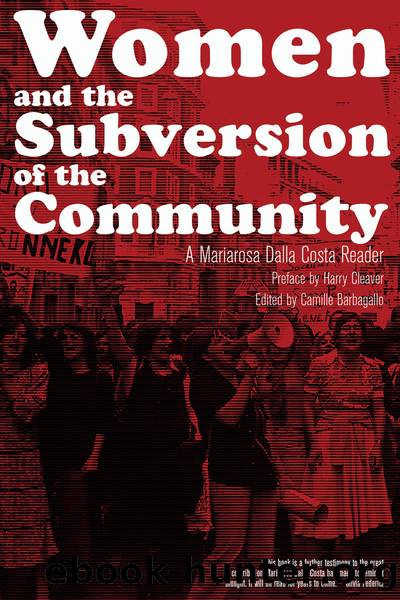
Author:Dalla Costa, Mariarosa; Barbagallo, Camille; Cleaver, Harry
Language: eng
Format: epub
Publisher: PM Press
Published: 2019-11-15T00:00:00+00:00
Family and Welfare in the New Deal (1985)
Translated by Richard Braude
The Padua WFH committeeâs musical group performs at a March 8, 1974, demonstration for wages for housework in Mestre, Venice.
âWas the New Deal a success or a failure?â Regarding this much debated question, I maintain that there was no doubt a crucially positive aspect to the New Deal in the United States. I see the New Deal as an important test case for the functioning of the modern family in times of crisis. One in which the womanâas housewife and administrator of the wage, primarily responsible for the good running of the family, but also as an external laborer, and as a laborer involved in unregulated workâmust provide the family with sustenance in a context of overarching male unemployment, market instability, and the establishment of social security/assistance procedures.1
In the 1930s, female labor powerâvia processes that had unfolded over the preceding decades and involved a radical transformation in the family structureâwas asked to serve a new function, a function that was central to the emergence of a new system of reproduction of the labor force. This emerged, on the one hand, through the establishment of âcollective bargainingâ and the stateâs new role in relation to the economy in order to ensure the size and increase of the wage and, on the other hand, through the establishment of social security to guarantee the reintegration of labor power during periods when it is not directly involved in the productive cycleâincluding policies for the elderly and the unemployedâor when it could not, in any case, be employed, for example, sick pay and, in a different way, aid to families with dependent children.
The spread of unemployment, which increasingly appeared to be connected with the new forms of the cycle of accumulation, gradually made the political establishment aware of the necessity to invest in human capital in order to regulate the market and raise labor productivity. The new role demanded of public funding and the acceptance of budget deficit were the political establishmentâs response to the necessity to support the reproduction of labor power and a closer connection of its forms to those of the production of commodities. In this sense, we can say that in the 1930s the most progressive nineteenth-century recommendations advanced by many authors matured, especially Marshallâs proposed investment in the working class, finding concrete expression in the attempt to create a plan on both productive and social levels. By 1914, Fordâs âFive-Dollar Dayâ wage policy2 already guaranteed workers in the most advanced sectors the possibility to support a wife and have a house.
After the crisis of 1929, this âreproductive formâ of labor power had to be guaranteed on a much wider social basis, effectively a âgeneralâ one, and the necessity to invest in human capital so as to raise and sustain its reproduction beyond the cyclical oscillation of employment opportunities became increasingly clear. The new social security/assistance measures formed the basic response. Yet within this framework of radically transformed social reproduction (the
Download
This site does not store any files on its server. We only index and link to content provided by other sites. Please contact the content providers to delete copyright contents if any and email us, we'll remove relevant links or contents immediately.
| Anthropology | Archaeology |
| Philosophy | Politics & Government |
| Social Sciences | Sociology |
| Women's Studies |
Born to Run: by Christopher McDougall(7121)
The Leavers by Lisa Ko(6946)
iGen by Jean M. Twenge(5409)
Sapiens by Yuval Noah Harari(5366)
Spare by Prince Harry The Duke of Sussex(5181)
The Kite Runner by Khaled Hosseini(5170)
Machine Learning at Scale with H2O by Gregory Keys | David Whiting(4296)
Bullshit Jobs by David Graeber(4179)
Never by Ken Follett(3937)
Goodbye Paradise(3802)
Livewired by David Eagleman(3765)
Fairy Tale by Stephen King(3370)
A Dictionary of Sociology by Unknown(3077)
Harry Potter 4 - Harry Potter and The Goblet of Fire by J.K.Rowling(3061)
The Social Psychology of Inequality by Unknown(3022)
The Club by A.L. Brooks(2919)
Will by Will Smith(2911)
0041152001443424520 .pdf by Unknown(2843)
People of the Earth: An Introduction to World Prehistory by Dr. Brian Fagan & Nadia Durrani(2733)
