Will Dollars Save the World? by Henry Hazlitt
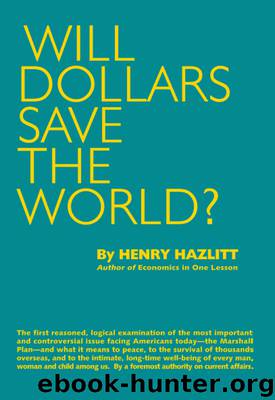
Author:Henry Hazlitt [Henry Hazlitt]
Language: eng
Format: epub
ISBN: 978-1-61016-469-6
Publisher: D. Appleton-Century Company, Inc.
Published: 1947-11-06T16:00:00+00:00
THE SIXTEEN-NATION REPORT
THE REPORT of the Paris conference of sixteen nations in response to the Marshall proposal does nothing to shake this conclusion. Let us begin with the over-all estimates that these nations put out of their needs—or rather of what they call their combined prospective “deficit”—over the next four years.
The report places this deficit at the huge sum of $22,440,000,000. Elsewhere in its text it mentions the need of some $3,000,000,000 for currency stabilization loans. These appear to be outside the foregoing total. If we add them we get a grand total of $25,000,000,000 as the estimate of the outside “needs” of these countries for the next four years. When we put on top of this some $15,000,000,000 that the United States will have spent since V-J Day by the end of the present year in the attempt to rebuild Europe, it brings the bill to the staggering total of $40,000,000,000.
How much validity do these “deficit” figures presented by the sixteen European nations really have? The original total that the sixteen nations arrived at, we must remember, amounted to more than $29,000,000,000. (And this apparently did not include the $3,000,000,000 estimate for currency stabilization.) Not until after our State Department privately protested that this sum was too large was it reduced to $22,440,000,000. The estimate eventually published presumably meets our State Department’s demands, in that it is lower than the original estimate, and tapers down each year. But suppose our government does all that is now demanded of it, and Europe’s economy nevertheless still breaks down? Will we not be told that it was our fault—that our aid was “too little and too late”—that these were not Europe’s real estimates of its needs, but merely slashed figures put forward to conciliate the State Department and an “economy-minded” Congress?
Even apart from this, what reason is there to take seriously these estimates of annual deficits? The report itself declares: “Unfortunately, the size of the problem has proved greater than was expected. The disruption caused by the war was more far-reaching and the obstacles to recovery more formidable than was realized even six months ago.” But if the sixteen nations admit that they then failed to guess right even six months ahead, what reason is there to suppose that they are now guessing right four years ahead? And if (as we must suspect) the deterioration in those six months was not the result of a war that ended more than two years ago but of new factors, and primarily of the unsound economic policies followed by European governments in those six months, then the prospective European “deficit” could be either much greater or much less than the figures presented, depending upon the future policies followed.
It is impossible, moreover, for any nation to predict its future trade deficit by adding together its future “requirements” of specific goods. For such “requirements,” as we have already seen, are arbitrary except in relation to some standard, and the standard adopted must itself be arbitrary. If there
Download
This site does not store any files on its server. We only index and link to content provided by other sites. Please contact the content providers to delete copyright contents if any and email us, we'll remove relevant links or contents immediately.
The Brazilian Economy since the Great Financial Crisis of 20072008 by Philip Arestis Carolina Troncoso Baltar & Daniela Magalhães Prates(325758)
International Integration of the Brazilian Economy by Elias C. Grivoyannis(111447)
The Art of Coaching by Elena Aguilar(53462)
Flexible Working by Dale Gemma;(23329)
How to Stop Living Paycheck to Paycheck by Avery Breyer(19791)
Thinking, Fast and Slow by Kahneman Daniel(12450)
The Acquirer's Multiple: How the Billionaire Contrarians of Deep Value Beat the Market by Tobias Carlisle(12392)
The Radium Girls by Kate Moore(12110)
The Art of Thinking Clearly by Rolf Dobelli(10635)
Hit Refresh by Satya Nadella(9209)
The Compound Effect by Darren Hardy(9087)
Tools of Titans by Timothy Ferriss(8514)
Atomic Habits: Tiny Changes, Remarkable Results by James Clear(8443)
Turbulence by E. J. Noyes(8141)
A Court of Wings and Ruin by Sarah J. Maas(7984)
Change Your Questions, Change Your Life by Marilee Adams(7872)
Nudge - Improving Decisions about Health, Wealth, and Happiness by Thaler Sunstein(7770)
How to Be a Bawse: A Guide to Conquering Life by Lilly Singh(7561)
Win Bigly by Scott Adams(7282)
