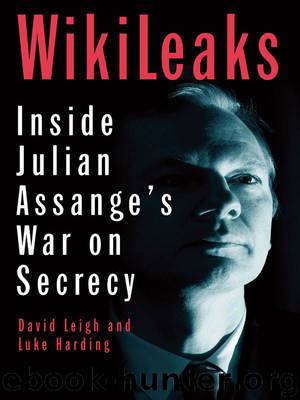
WikiLeaks: Inside Julian Assange's war on secrecy by Harding Luke & Leigh David
Author:Harding, Luke & Leigh, David [Leigh, David]
Language: eng
Format: epub
ISBN: 9780852652404
Publisher: Guardian Books
Published: 2012-08-15T22:00:00+00:00
CHAPTER 13
Uneasy partners
Editor’s office, the Guardian, Kings Place, London
1 November 2010
“I’m a combative person”
JULIAN ASSANGE, TED CONFERENCE, OXFORD, 2010
The three partner papers decided it was time for a meeting with Julian Assange. Everything was threatening to get rather messy. The embattled WikiLeaks founder now wanted the Americans frozen out of the much-delayed deal to publish the diplomatic cables jointly – a punishment, so it was said, for a recent profile of him, by the New York Times veteran London correspondent John F Burns. Assange had intensely disliked it.
The British were anxious about the fact that another copy of the cables had apparently fallen into the hands of Heather Brooke, a London-based American journalist and freedom of information activist. And the Germans were worried that things could get acrimonious all round unless the editors held a clear-the-air meeting with what was left of WikiLeaks.
There were at least three loose copies of the cables believed to be circulating now: with Brooke in the UK, Daniel Ellsberg – of Pentagon papers fame – in the US, and Smári McCarthy, an Icelandic former WikiLeaks programmer who had, according to Assange, let a copy pass to Brooke. David Leigh had signalled to the New York Times he was willing personally to hand them a copy if Assange would not co-operate. But none of the huge secret cache of state department dispatches had yet actually been analysed and published to the world as originally planned. Would the whole audacious project end in tears?
The conference was arranged for 1 November, at the Guardian’s London offices near King’s Cross station, with an initial meeting to go through the material in detail, trying to reach agreement on a possible day-by-day running order. Assange was supposed to join around 6pm – but a series of text messages to deputy editor Ian Katz indicated he was running late. Around 7pm, Rusbridger’s phone rang. It was Mark Stephens, a British libel lawyer he’d known for years. He said he had something to tell him: could he come straight round? Twenty minutes later Stephens burst through the door of the editor’s office, followed by Assange himself, along with his dour Icelandic lieutenant Kristinn Hrafnsson, and a young woman lawyer, later introduced as a junior solicitor in Stephens’ office, Jennifer Robinson. It looked, and felt, like an ambush.
Assange had barely sat down before he started angrily denouncing the Guardian. Did the New York Times have the cables? How did they have them? Who had given them to them? This was a breach of trust. His voice was raised and angry. Every time Rusbridger tried to respond, he pitched in with another question. When he finally paused for breath Rusbridger pointed out that the Spiegel people and other Guardian executives were waiting. Why didn’t we tell them to come in to continue the discussion? But Assange’s fury returned: this matter had to be settled first. He needed to know the truth about the New York Times. “We are getting the feeling that a large organisation is trying to find ways to step around a gentlemen’s agreement.
Download
This site does not store any files on its server. We only index and link to content provided by other sites. Please contact the content providers to delete copyright contents if any and email us, we'll remove relevant links or contents immediately.
| Anthropology | Archaeology |
| Philosophy | Politics & Government |
| Social Sciences | Sociology |
| Women's Studies |
The Secret History by Donna Tartt(19102)
The Social Justice Warrior Handbook by Lisa De Pasquale(12197)
Thirteen Reasons Why by Jay Asher(8918)
This Is How You Lose Her by Junot Diaz(6893)
Weapons of Math Destruction by Cathy O'Neil(6284)
Zero to One by Peter Thiel(5807)
Beartown by Fredrik Backman(5766)
The Myth of the Strong Leader by Archie Brown(5512)
The Fire Next Time by James Baldwin(5454)
How Democracies Die by Steven Levitsky & Daniel Ziblatt(5223)
Promise Me, Dad by Joe Biden(5157)
Stone's Rules by Roger Stone(5090)
A Higher Loyalty: Truth, Lies, and Leadership by James Comey(4966)
100 Deadly Skills by Clint Emerson(4931)
Rise and Kill First by Ronen Bergman(4797)
Secrecy World by Jake Bernstein(4756)
The David Icke Guide to the Global Conspiracy (and how to end it) by David Icke(4722)
The Farm by Tom Rob Smith(4516)
The Doomsday Machine by Daniel Ellsberg(4493)
