Why Liberalism Works by Deirdre Nansen McCloskey
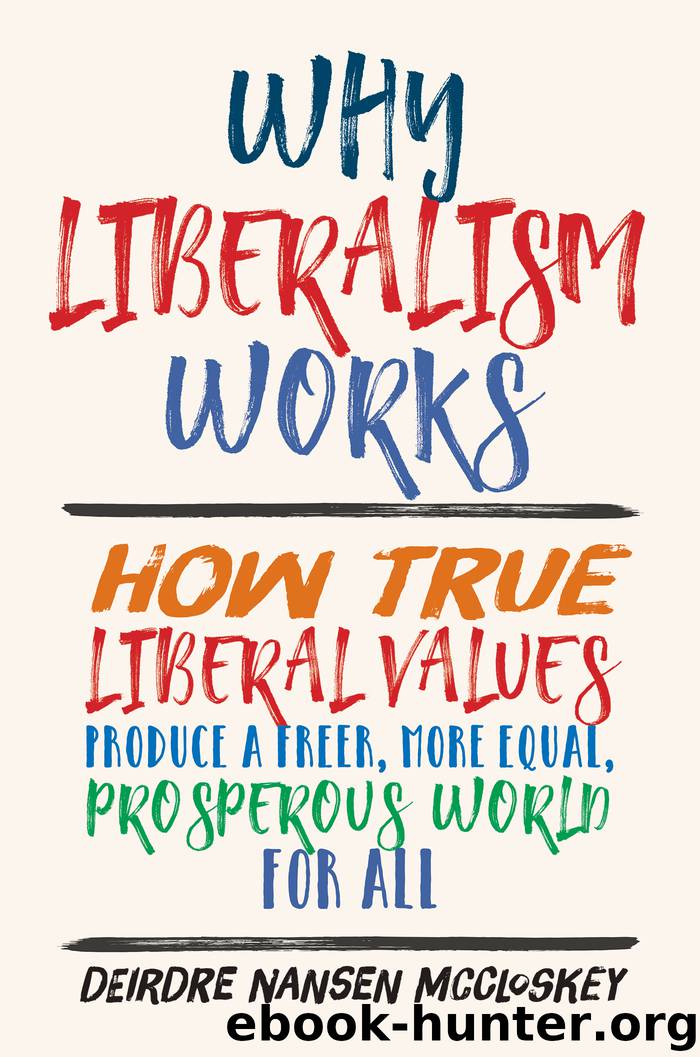
Author:Deirdre Nansen McCloskey
Language: eng
Format: epub
Publisher: Yale University Press
Published: 2019-10-13T16:00:00+00:00
31. The Ethical Accounting of Inequality Is Mistaken
It is important in thinking about the issues Piketty so energetically raises to keep straight what exactly is unequal. Physical capital and the claims to it (bonds, stocks, deeds) are unequally owned, of course, although trade-union pension funds and the like do work the other way to some degree. The yield on such portions of the nation’s capital stock is indeed the income of the rich, especially the rich by inheritance, whom Piketty worries most about. But, as I have noted, if capital is more comprehensively measured to include the increasingly important human capital such as engineering degrees and the increasingly important commonly owned capital such as superhighways and public parks and modern knowledge (think: the internet), the income yield on the capital is less unequally owned than are paper claims to physical capital.
Further, consumption in turn is much less unequally enjoyed than income. A rich person owning seven houses might be thought to be seven times better off than a poor person with barely one. But of course she’s not, because she can consume only one house at a time, and can consume only one pair of shoes at a time, and so forth. The diamond bracelet sitting un-worn at the bottom of her ample jewelry box is a scandal, because she could have paid the annual school fees of a thousand families in Mozambique with what she foolishly spent on the bauble that was fashionable last season in Cannes. She ought to be ashamed to indulge in such expenditure. It is an important ethical issue, if not a public issue. But anyway the expenditure has not increased her actual, point-of-use consumption.
Further still, and crucially, the consumption of basic capabilities or necessities is very much more equally enjoyed nowadays than the rest of consumption, or income, or capital, or financial wealth, and has become more and more equal as the Great Enrichment spreads. Therefore economic growth, however unequally it is accumulated as wealth or earned as income, is already more egalitarian in its consumption, and by now is very equal indeed in such necessitous consumption. As the American economist John Bates Clark predicted in 1901, “The typical laborer will increase his wages from one dollar a day to two, from two to four and from four to eight [which was accurate in real terms of per-person income down to the present, though the calculation does not allow for the radically improved quality of goods and services since 1901]. Such gains will mean infinitely more to him than any possible increase of capital can mean to the rich. . . . This very change will bring with it a continual approach to equality of genuine comfort.”1
In 2013 the economists Donald Boudreaux and Mark Perry noted that “according to the [Federal] Bureau of Economic Analysis, spending by households on many of modern life’s ‘basics’—food at home, automobiles, clothing and footwear, household furnishings and equipment, and housing and utilities—fell from 53 percent of disposable income in 1950 to 44 percent in 1970 to 32 percent today.
Download
This site does not store any files on its server. We only index and link to content provided by other sites. Please contact the content providers to delete copyright contents if any and email us, we'll remove relevant links or contents immediately.
| Anarchism | Communism & Socialism |
| Conservatism & Liberalism | Democracy |
| Fascism | Libertarianism |
| Nationalism | Radicalism |
| Utopian |
The Secret History by Donna Tartt(19017)
The Social Justice Warrior Handbook by Lisa De Pasquale(12182)
Thirteen Reasons Why by Jay Asher(8880)
This Is How You Lose Her by Junot Diaz(6868)
Weapons of Math Destruction by Cathy O'Neil(6257)
Zero to One by Peter Thiel(5778)
Beartown by Fredrik Backman(5726)
The Myth of the Strong Leader by Archie Brown(5490)
The Fire Next Time by James Baldwin(5421)
How Democracies Die by Steven Levitsky & Daniel Ziblatt(5207)
Promise Me, Dad by Joe Biden(5138)
Stone's Rules by Roger Stone(5073)
A Higher Loyalty: Truth, Lies, and Leadership by James Comey(4944)
100 Deadly Skills by Clint Emerson(4909)
Rise and Kill First by Ronen Bergman(4767)
Secrecy World by Jake Bernstein(4735)
The David Icke Guide to the Global Conspiracy (and how to end it) by David Icke(4694)
The Farm by Tom Rob Smith(4498)
The Doomsday Machine by Daniel Ellsberg(4479)
