Who Serves?: The Persistent Myth of the Underclass Army by Sue E. Berryman
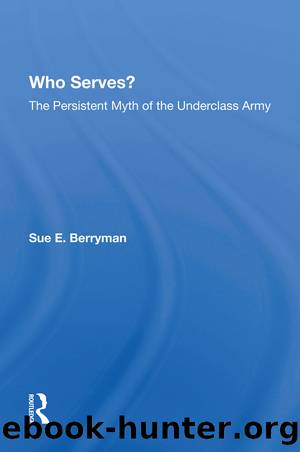
Author:Sue E. Berryman [Berryman, Sue E.]
Language: eng
Format: epub
Tags: Political Science, General
ISBN: 9780813371849
Google: 3ftNEAAAQBAJ
Goodreads: 3606753
Publisher: Westview Press
Published: 1988-05-19T00:00:00+00:00
NOTES
1. New York Times, November 3, 1974.
2. Note that any reasonably random draft imposes de facto quotas on all youth subgroups.
3. Report of the Presidentâs Commission on an All-Volunteer Force, 1970, pp. 141â142. According to Schnexnider and Butler, it was rumored that the Georgia State Patrol had developed contingency plans to contain any outbreaks among heavily black units at Ft Benning, Georgia. Although rumors are often wildly inaccurate, their very existence testifies to the fears that militarily trained blacks generate (Schnexnider and Butler, 1976, p. 424).
4. Congressional Digest, May 1971, pp. 154â158.
5. The unexpectedly high turnover among first-term enlistees has produced relatively high circulation between the civilian and military sectors.
6. For example, see Binkin and Eitelberg, 1982.
7. During World War I the black leader, W.E.B. DuBois obtained promises from Secretary of War Newton Baker that at least 35 percent of black troops would be assigned to combat duty in order to give them opportunities to demonstrate their heroism. Baker failed to keep his promise. By the end of World War I black soldiers accounted for only one-thirtieth of the combat forces, but one-third of those performing labor chores (Foner, 1974).
8. In histories published immediately after the Spanish-American War, writers such as Richard Harding Davis and George Kennan reported that blacks had fought with âutmost courage, coolness, and determination.â War correspondent Stephen Bonsai reported from the front that no four white regiments could compare with the combat performance of the four Hack regiments.
9. The social psychological literature documents the stress that role conflicts impose on individuals, one of the early studies being Killianâs descriptions (1952) of conflicts between professional and kinship obligations in disasters. In their classic analysis of cohesion and disintegration in the Wehrmacht in World War II, Shils and Janowitz (1948) reported that soldiersâ concerns about their families negatively affected unit cohesion. The German government took several steps to reduce soldiersâ conflicts between their military and kinship dutiesâfor example, censoring family mail to prevent news of famine and bombing raids from reaching soldiers at the front.
10. The source for these poll data was the Institute for Research in Social Science, University of North Carolina, Chapel Hill, Louis Harris and Associates, Study 1926, March/April 1969.
11. The countries were: West Germany, Yugoslavia, Rumania, Italy, Finland, India, Indonesia, Formosa, Canada, Mexico, Brazil, Thailand, Malaysia, Ethiopia, Kenya, Bolivia, and Bahama Islands.
12. The twenty-five countries were: Argentina, Australia, Brazil, Canada, Chile, China (Communist China), Cuba, Egypt, France, India, Iran, Israel, Italy, Japan, Mexico, Netherlands (Holland), Philippines, Poland, South Africa, Sweden, Switzerland, Taiwan (Nationalist China) United Kingdom (England), USSR (Russia), and West Germany.
13. The authors point out that in the case of South Africa, the symbol âAfrica,â rather than the apartheid regime, is salient.
14. Dr. Steven Schlossman, then an historian at RAND, conducted this review.
15. Curran and Ponomareff (1982) report what looks like a similar situation in post-World War II Russia. Emigre interviewees report that in 1956 native Georgian troops refused to fire on their own population during the uprising at Tbilisi. The Soviets now
Download
This site does not store any files on its server. We only index and link to content provided by other sites. Please contact the content providers to delete copyright contents if any and email us, we'll remove relevant links or contents immediately.
| Anthropology | Archaeology |
| Philosophy | Politics & Government |
| Social Sciences | Sociology |
| Women's Studies |
The Secret History by Donna Tartt(19092)
The Social Justice Warrior Handbook by Lisa De Pasquale(12191)
Thirteen Reasons Why by Jay Asher(8912)
This Is How You Lose Her by Junot Diaz(6889)
Weapons of Math Destruction by Cathy O'Neil(6281)
Zero to One by Peter Thiel(5802)
Beartown by Fredrik Backman(5759)
The Myth of the Strong Leader by Archie Brown(5509)
The Fire Next Time by James Baldwin(5449)
How Democracies Die by Steven Levitsky & Daniel Ziblatt(5219)
Promise Me, Dad by Joe Biden(5154)
Stone's Rules by Roger Stone(5088)
A Higher Loyalty: Truth, Lies, and Leadership by James Comey(4964)
100 Deadly Skills by Clint Emerson(4927)
Rise and Kill First by Ronen Bergman(4790)
Secrecy World by Jake Bernstein(4753)
The David Icke Guide to the Global Conspiracy (and how to end it) by David Icke(4720)
The Farm by Tom Rob Smith(4514)
The Doomsday Machine by Daniel Ellsberg(4490)
