Who Has Bewitched You? a Study in Galatians by Spence Alan J.;
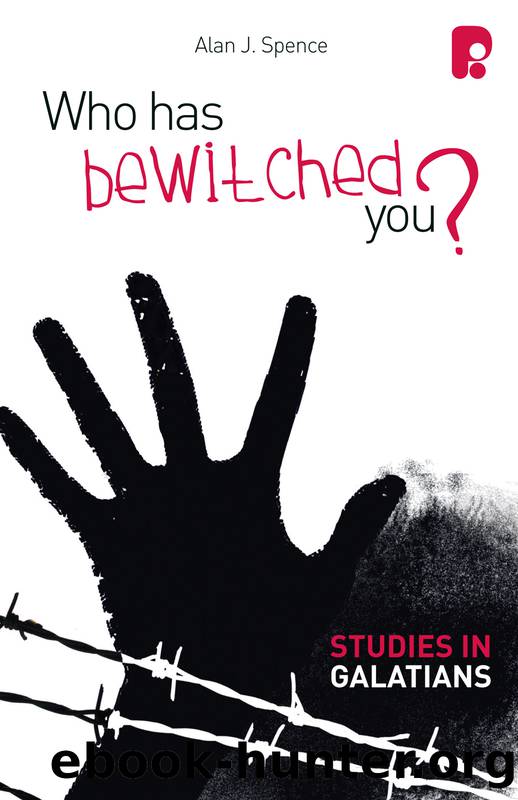
Author:Spence, Alan J.;
Language: eng
Format: epub
Publisher: Authentic Media
Published: 2013-08-15T00:00:00+00:00
Questions for reflection
1. Why were the Galatians so easily bewitched? Will it always be so with the church?
2. Are we released from the custodianship or enslavement of the moral law? In what sense?
3. How does the exercise of a genuine human faith affirm Godâs freedom, grace and sovereignty?
Chapter Four
The law as guardian
Over the course of the last three chapters, Paul has offered a multi-layered defence of the gospel. His central thesis is that we find peace with God and experience all the benefits of salvation not by satisfying the demands of the law, but through our faith in Jesus Christ. His presentation has been logical and persuasive. It has also been somewhat dense. Like a lecturer who is aware that he might be losing a section of his audience, Paul pauses for a moment to expand on a key theme introduced a little earlier, one that has far-reaching implications.
What I am saying is that as long as an heir is under age, he is no different from a slave, although he owns the whole estate. The heir is subject to guardians and trustees until the time set by his father. (vv. 1,2)
The obvious problem many Jewish Christians would have had with Paulâs presentation of the gospel is that it appears to undermine the religious significance of the Mosaic Law. He responds to this concern by arguing that the law was never intended to bring about spiritual life. Its role from the time of Moses to the coming of Christ was that of a guardian.1 It was to function, one might say, as a governess or an au pair to guide and care for the children who had yet to reach maturity. But, and this is a key question, who in Paulâs mind are these under-age children who are in need of trustees, children who will one day inherit the whole estate? Is it the Jewish nation before the time of Christ? If so, is it the whole people of Israel or only part of that community? Or is Paul offering a generalized outline of the way of salvation and âthe heirâ refers to all those who would come to faith and freedom in Jesus Christ, both Jews and Greeks? Perhaps these various perspectives are not mutually exclusive.
Letâs look again at his argument in the last chapter. In order to explain the role of the law, Paul puts before us an historical timeline that includes four significant events. God made a promise to Abraham that he would be the father of many children; 430 years later, the law is given to serve as a guardian of these children; with the coming of Christ, who is the fulfilment of the promise to Abraham, the period of guardianship is over; finally, through the preaching of the gospel, the children attain adulthood and enter their full inheritance.
If we allow this timeline to shape our reading of the text, then the minor children are, in the first place, the people of Israel.2 But this does not mean that it is every Jew.
Download
This site does not store any files on its server. We only index and link to content provided by other sites. Please contact the content providers to delete copyright contents if any and email us, we'll remove relevant links or contents immediately.
Professional Troublemaker by Luvvie Ajayi Jones(29668)
Empire of the Sikhs by Patwant Singh(23089)
Twilight of the Idols With the Antichrist and Ecce Homo by Friedrich Nietzsche(18638)
Plagued by Fire by Paul Hendrickson(17416)
The Sun and Her Flowers by Rupi Kaur(14526)
Norse Mythology by Gaiman Neil(13372)
A Journey Through Charms and Defence Against the Dark Arts (Harry Potter: A Journey Throughâ¦) by Pottermore Publishing(9276)
Fangirl by Rainbow Rowell(9259)
Adultolescence by Gabbie Hanna(8929)
Wonder by R.J. Palacio(8584)
Tools of Titans by Timothy Ferriss(8402)
Becoming Supernatural by Dr. Joe Dispenza(8223)
How to Bang a Billionaire by Alexis Hall(8160)
Wonder by R. J. Palacio(8115)
Crystal Healing for Women by Mariah K. Lyons(7933)
The Road Less Traveled by M. Scott Peck(7605)
The Lost Art of Listening by Michael P. Nichols(7507)
The Witchcraft of Salem Village by Shirley Jackson(7277)
The Institute by Stephen King(7043)
