Whiteshift by Eric Kaufmann
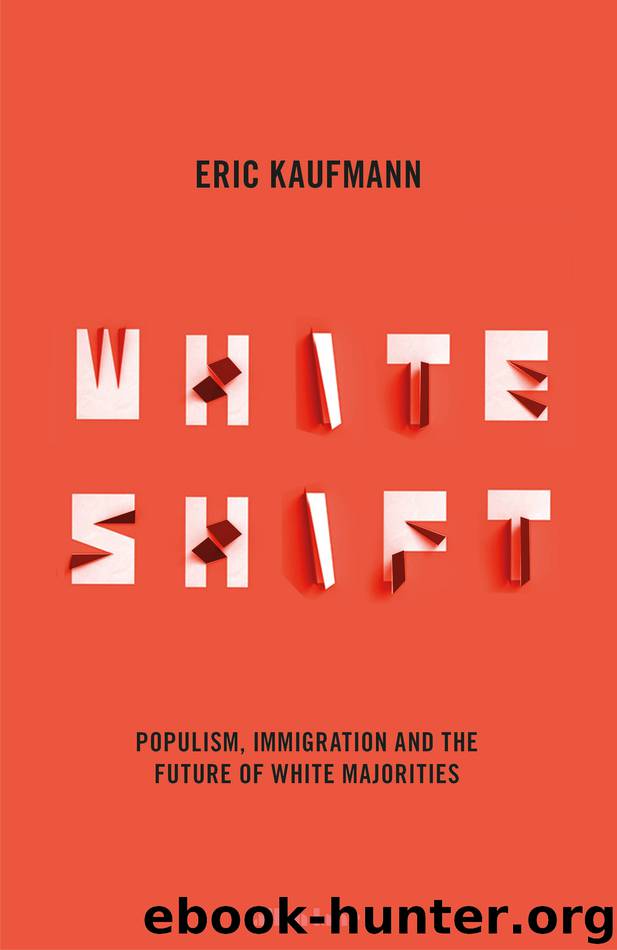
Author:Eric Kaufmann
Language: eng
Format: epub
ISBN: 9780241317129
Publisher: Penguin Books Ltd
Published: 2018-09-30T16:00:00+00:00
Part II
* * *
REPRESS
7
Left-Modernism: From Nineteenth-Century Bohemia to the Campus Wars
Majorities may resist newcomers, but as the previous three chapters have shown, majority ‘voice’ is in tension with a second response: to repress anxieties in the name of anti-racism, the cornerstone of a liberal-egalitarian belief system that dominates Western high culture. All social systems work with the grain of some of our evolutionary psychology and against other parts of it. The repression of instincts occurs whenever we desire a gold watch or our neighbour’s spouse. Controlling some evolutionary drives is a normal part of life, but the form this suppression takes varies from place to place. Historians and sociologists of emotion draw attention to how norms regulate which emotions can be expressed, by whom, in what social situations. Men are often discouraged from crying, for example, while women who don’t cry at the death of a loved one may be sanctioned. Emotional norms may shift over time. The sociologist Norbert Elias writes of how the ‘civilizing process’ in Europe between the Middle Ages and eighteenth century increasingly restrained urges such as urinating at the table or settling arguments by duelling.1 Norms work by triggering emotional rather than rational responses to violations. If someone relieves themselves at dinner, this is met with disgust, not a disquisition.
Norms can repress ideas as well as behaviours. Societies enshrine conceptions of the sacred and profane which derive from the dominant ideology of society. The anthropologist Mary Douglas surmises that all societies, not just religious ones, maintain conceptions of what is taboo. This is linked to notions of cleanliness and purity, helping to simplify a complex world and provide moral certainty in ethically ambiguous situations.2 Ideas which run counter to sacred beliefs, like telling a Sioux tribal gathering that ‘the Great Spirit is a social construction’, violate these taboos. As with reactions to public urinating, taboos encourage an emotional response to transgression. They convey society’s disapproval of norm-violating behaviour and shortcut the need to justify the norm each time it’s invoked. Norms like patriotism or anti-racism are rarely explicitly codified. As an American sociologist, Kai Erikson, wrote in 1962, norms are the ‘accumulation of decisions made by the community over a long period’ which gradually gather moral force. ‘Each time the community censures some act of deviance … it sharpens the authority of the violated norm and re-establishes the boundaries of the group.’3
No society can do without norms; the challenge is to ensure they rest on a sound ethical foundation, with the degree of emotional disapproval proportionate to the offence. We should express disapproval when someone suggests in casual conversation that mass murder is a good strategy for dealing with the poor. This said, the ethical foundations of taboos are often shaky. Expressing support for atheism in Pakistan today, homosexuality in Victorian England or communism in 1950s America activated taboos that lacked a sound ethical basis or a sense of proportion calibrated to the actual danger. What’s more, there should be a space – the university – where arguments are not forbidden and can be aired and discussed rationally.
Download
This site does not store any files on its server. We only index and link to content provided by other sites. Please contact the content providers to delete copyright contents if any and email us, we'll remove relevant links or contents immediately.
The Brazilian Economy since the Great Financial Crisis of 20072008 by Philip Arestis Carolina Troncoso Baltar & Daniela Magalhães Prates(368551)
International Integration of the Brazilian Economy by Elias C. Grivoyannis(111625)
The Art of Coaching by Elena Aguilar(53686)
Flexible Working by Dale Gemma;(23363)
How to Stop Living Paycheck to Paycheck by Avery Breyer(19839)
Thinking, Fast and Slow by Kahneman Daniel(12548)
The Acquirer's Multiple: How the Billionaire Contrarians of Deep Value Beat the Market by Tobias Carlisle(12438)
The Radium Girls by Kate Moore(12209)
The Art of Thinking Clearly by Rolf Dobelli(10731)
Hit Refresh by Satya Nadella(9267)
The Compound Effect by Darren Hardy(9172)
Tools of Titans by Timothy Ferriss(8616)
Atomic Habits: Tiny Changes, Remarkable Results by James Clear(8531)
Turbulence by E. J. Noyes(8230)
A Court of Wings and Ruin by Sarah J. Maas(8127)
Change Your Questions, Change Your Life by Marilee Adams(7943)
Nudge - Improving Decisions about Health, Wealth, and Happiness by Thaler Sunstein(7865)
How to Be a Bawse: A Guide to Conquering Life by Lilly Singh(7632)
Win Bigly by Scott Adams(7353)
