Where Paralytics Walk and the Blind See by Mary Dunn;
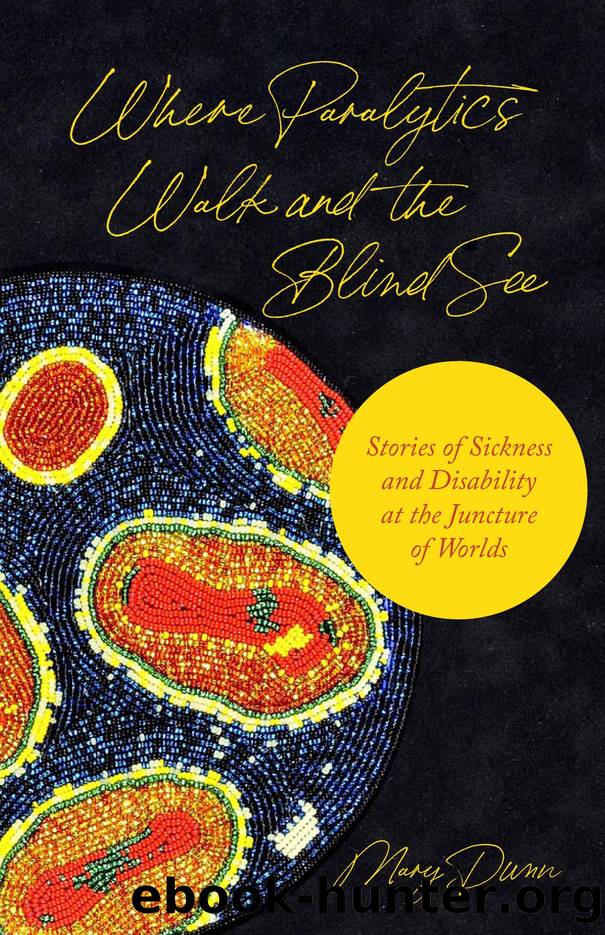
Author:Mary Dunn;
Language: eng
Format: epub
Publisher: Princeton University Press
Published: 2022-03-30T00:00:00+00:00
* * *
Within the cultural context of an early modern Catholicism suspicious of visionaries and alive to the dangers of the devilâs play, Catherine de Saint-Augustinâs extraordinary embodied experience as the double victim of both demonic obsession and divine justice was a problem. And Ragueneauâs Vie de la Mère Catherine de Saint-Augustin was the solution. Leaning on analytical tools borrowed from Mitchell and Snyderâs Narrative Prosthesis, I have argued that Catherineâs embattled body enables, like a prosthesis, the progress of Ragueneauâs hagiographic narrative toward its Christological end and that Ragueneauâs hagiographic narrative, in turn, functions prosthetically as a medium for returning Catherine to âan acceptable degree of difference.â104 An extended illness narrative, the Vie de la Mère Catherine de Saint-Augustin makes embodied difference meaningful as an index of sanctity. The hermeneutic key that underwrites Ragueneauâs inscription of Catherine at once in imitatio Christi and at the same time in imitatio sanctorum, her embodied difference functions within the context of the Vie to integrate Catherine both socially and spiritually within the double horizon of the gospel story and the hagiographic tradition. Like a master craftsman, Ragueneau molds Catherine, carving here and shaping there, until she emerges at the end of the Vie as both alter Christus and alter sanctus, a suffering savior dedicated to the salvation of a sinful Canada in the model of Christ and his saints.
There are reasons to wonder, however, whether Ragueneauâs Vie really did solve the problem posed by Catherineâs ambiguous, anomalous (and deeply embodied) spiritual extravagance. Although Ragueneauâs intention had been to âedify the public and console good souls by the example of a life and a death ⦠pure and ⦠precious before God,â evidence suggests that the Vie was received unevenly upon its publication in France in 1671.105 Some readers, to be sure, did âfind something to admire ⦠and something to imitateâ in the Vie, as Ragueneau had hoped.106 The âidle young manâ whose chance encounter with the Vie is described in the Histoire de lâHôtel Dieu de Quebec was moved, for instance, to join the Jesuits in New France after reading about âthe excessive suffering that [Catherine] endured and the great crosses that she bore in Canada.â107 Others, however, scoffed at the baroque excesses of the Vie. As early as 1691, the Recollect missionary and historian Chrestien Le Clercq lampooned Ragueneau (albeit indirectly) for introducing âhyperbole and ⦠similar fictionsâ into Catherineâs vita. Florid descriptions of âvisions, apparitions, revelations, raptures, and ecstasies ⦠miracles and prodigies ⦠fasts ⦠alms ⦠prayers ⦠fervors ⦠[and other] holy follies,â Le Clercq opined, are forgivable when the subject is a secular one, but not when the subject is sacred, for âthey tend to undermine belief in true historical facts.â108 While some writers would go so far as to âplace seven devils in a girlâs tooth to prove her sanctity,â Le Clercq himself preferred âtruth and the fidelity of the historian.â109 Nearly two hundred years later, the editor of the Annuaire du Département de
Download
This site does not store any files on its server. We only index and link to content provided by other sites. Please contact the content providers to delete copyright contents if any and email us, we'll remove relevant links or contents immediately.
| Arms Control | Diplomacy |
| Security | Trades & Tariffs |
| Treaties | African |
| Asian | Australian & Oceanian |
| Canadian | Caribbean & Latin American |
| European | Middle Eastern |
| Russian & Former Soviet Union |
The Secret History by Donna Tartt(19105)
The Social Justice Warrior Handbook by Lisa De Pasquale(12197)
Thirteen Reasons Why by Jay Asher(8921)
This Is How You Lose Her by Junot Diaz(6894)
Weapons of Math Destruction by Cathy O'Neil(6285)
Zero to One by Peter Thiel(5808)
Beartown by Fredrik Backman(5769)
The Myth of the Strong Leader by Archie Brown(5513)
The Fire Next Time by James Baldwin(5454)
How Democracies Die by Steven Levitsky & Daniel Ziblatt(5225)
Promise Me, Dad by Joe Biden(5157)
Stone's Rules by Roger Stone(5091)
A Higher Loyalty: Truth, Lies, and Leadership by James Comey(4967)
100 Deadly Skills by Clint Emerson(4932)
Rise and Kill First by Ronen Bergman(4797)
Secrecy World by Jake Bernstein(4756)
The David Icke Guide to the Global Conspiracy (and how to end it) by David Icke(4724)
The Farm by Tom Rob Smith(4517)
The Doomsday Machine by Daniel Ellsberg(4493)
