What's Wrong with Antitheory? by Jeffrey R. Di Leo;
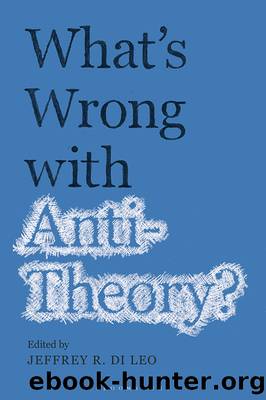
Author:Jeffrey R. Di Leo;
Language: eng
Format: epub
Publisher: Bloomsbury UK
8
Antitheory in Postcolonial Perspective
Nicole Simek
It has become commonplace to note that postcolonial studies, like literary criticism more generally, has been traversing a crisis of conscience and methodology over the past decades, as scholars have questioned the purpose and efficacy of literary critique and pondered the future of the academy itself in precarious times. In the following pages, I would like to think through the relationship between debates internal to postcolonial studies and those playing out within the various antitheory strands of thought that have emerged in literary criticism under the banners of surface reading, distant reading, or description. These antihermeneutic trends all take issue with suspicion as a critical method and mood or affect and seek to overcome what they view as the hubristic excesses of the theory era: an overly confident belief in literary criticism’s—and the literary critic’s—contribution to emancipatory politics, a narrow and limiting antagonistic approach to its objects of analysis, and the contradictory reproduction of elitist hierarchies among critics ostensibly dedicated to democratization as an ideal. Postcolonial studies scholars have been raising similar questions about the adequacy of postcolonial models of critique for addressing new configurations of power in a globalized era—or, indeed, for rectifying older forms of colonial exploitation that proceeded apace despite the field’s critical interventions. Yet given the field’s investment in critique and a hermeneutics of suspicion, it is not surprising that postcolonial critics would evidence strong skepticism about the values of neutrality, interpretive-free or interpretive-light description, or the benevolence of algorithms and machine-assisted research invoked by thinkers like Franco Moretti or Stephen Best and Sharon Marcus.
Given the differences between, on the one hand, a postcritical position emphasizing the pursuit of “minimal critical agency” and “undistorted, complete descriptions,” as Best and Marcus put it in their 2009 introduction to a special issue of Representations devoted to “The Way We Read Now,”1 and a postcolonial position emphasizing, on the contrary, the ideological function of claims to neutrality and objectivity, it is striking that many of the stated aims or motivations of the antitheory turn seem to converge with those of the hermeneutic traditions they repudiate. In privileging neutral description over prescriptive critique, surface readers, for example, argue that we need to correct for theory’s formulaic and instrumental use of texts in the service of a predefined political program. In so doing, they aim to cultivate a respect and openness to the text that is not so far removed from critical theory’s desire to root out instrumental rationality, or postcolonial studies’ goal of elucidating and reforming relations of domination and exploitation. My interest here is in exploring the appeal or pull of these converging and diverging lines of argument, the stakes that are held to be at play, and the kinds of investments that shape our various understandings of worth—our understandings of what questions are worth asking and why. This is as important for postcolonial critics who wish to extend or refresh the power of critique, as it is to descriptive readers who see suspicion as an obstacle or a drain on creative resources.
Download
This site does not store any files on its server. We only index and link to content provided by other sites. Please contact the content providers to delete copyright contents if any and email us, we'll remove relevant links or contents immediately.
4 3 2 1: A Novel by Paul Auster(12522)
The handmaid's tale by Margaret Atwood(7837)
Giovanni's Room by James Baldwin(7441)
Asking the Right Questions: A Guide to Critical Thinking by M. Neil Browne & Stuart M. Keeley(5838)
Big Magic: Creative Living Beyond Fear by Elizabeth Gilbert(5837)
Ego Is the Enemy by Ryan Holiday(5532)
The Body: A Guide for Occupants by Bill Bryson(5182)
On Writing A Memoir of the Craft by Stephen King(5005)
Ken Follett - World without end by Ken Follett(4790)
Adulting by Kelly Williams Brown(4623)
Bluets by Maggie Nelson(4607)
Eat That Frog! by Brian Tracy(4603)
Guilty Pleasures by Laurell K Hamilton(4512)
The Poetry of Pablo Neruda by Pablo Neruda(4173)
Alive: The Story of the Andes Survivors by Piers Paul Read(4080)
Fingerprints of the Gods by Graham Hancock(4050)
The Book of Joy by Dalai Lama(4048)
White Noise - A Novel by Don DeLillo(4047)
The Bookshop by Penelope Fitzgerald(3903)
