What's That Sound?: An Introduction to Rock and Its History by John Covach
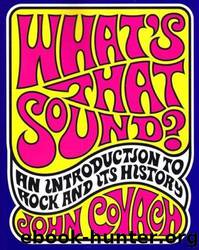
Author:John Covach
Language: eng
Format: azw3, epub
Tags: Non-Fiction, Music, History
ISBN: 9780393975758
Publisher: W. W. Norton & Company
Published: 2006-03-08T06:00:00+00:00
Listening Guide
Get Music S wwnorton.com/studyspace
Santana, “Evil Ways” Columbia 4-45069
Words and music by Sonny Henry, produced by Brent Dangerfi eld and Santana. The song reached # 9 on the
Billboard “Hot 100” chart in early 1970.
FORM: Simple verse, based on a two-chord vamp that remains constant except for the last bars of each verse.
Each verse is based on a 16-measure structure, though the last measures can be repeated to create an 18-bar
verse, as in verses 1 and 3. The solos are built on the two-chord vamp and unfold in 4-bar units. Note that the organ solo is 24 bars in length, which is simply six times through the 4-bar unit. Heading into the third verse, the band plays a 4-bar interlude that sets the scene for this fi nal verse and closes out the organ solo.
TIME SIGNATURE: 4/4, with a strong emphasis on Latin rhythms, especially during the guitar solo at the end.
INSTRUMENTATION: Electric guitar, Hammond organ, bass, drums, various Latin percussion, lead and
background vocals
0:00–0:18
Introduction, 8 mm.
After a brief lead-in from the drums, the entire band enters with
the two-chord vamp that forms the basis for the song.
0:18–0:54
Verse 1, 18 mm.
Vocals enter, sung mostly in unison by multiple voices. The 16-
bar structure is extended by two measures to create an 18-bar
section. “You got to change …”
0:54–1:27
Verse 2, 16 mm.
Very similar to verse 1, except that the section is not extended by
2 bars and is thus 16 bars in length. “When I come home …”
1:27–2:17
Organ solo, 24 mm.
Solo begins slowly, developing more activity and energy as it
unfolds, leading to a climax in the closing measures.
2:17–2:25
Interlude, 4 mm.
Band comes together on the two-chord vamp to mark the end of
the organ solo and the beginning of verse 3.
2:25–3:01
Verse 3, 18mm.
Similar to verse 2, except that the 2-bar extension at the end
serves to launch the guitar solo. “When I come home …”
3:01–3:54
Guitar solo, 24 mm. + fade High-energy guitar solo, as the rhythm section becomes much
more active and drives the music forward before the song eventu-
ally fades out.
tempo 12-bar blues tune. While Santana’s music is often referred to as “Latin rock,”
and ZZ Top is considered Texas blues, neither is typically thought of as southern
rock (much less country rock). Stylistically, however, the music of both bands is
similar to that of the southern rock bands. Santana most closely parallels the Allman
Brothers with an emphasis on improvisation, while the tighter arrangements in ZZ
Top’s music are more similar to Lynyrd Skynyrd. The key element in the music of
both groups is a signifi cant stylistic debt to the electric blues.
WTS3e_8_70s_4PP.indd 312
20/12/11 9:33 PM
AMERICAN BLUES ROCK AND SOUTHERN ROCK
3 1 3
American Bands: Steppenwolf, Three Dog Night, Grand Funk Railroad, and
Aerosmith. The musical impact of the blues in American rock in the early 1970s was
not restricted to the South. Bands such as Steppenwolf, Grand Funk Railroad, and
Aerosmith were all infl uenced strongly by the blues tradition. German-born singer
and guitarist John Kay spent time in many of the important musical hot spots of the
1960s. He visited the folk scene in New York, experienced San Francisco
Download
What's That Sound?: An Introduction to Rock and Its History by John Covach.epub
This site does not store any files on its server. We only index and link to content provided by other sites. Please contact the content providers to delete copyright contents if any and email us, we'll remove relevant links or contents immediately.
| Books & Reading | Comparative Literature |
| Criticism & Theory | Genres & Styles |
| Movements & Periods | Reference |
| Regional & Cultural | Women Authors |
4 3 2 1: A Novel by Paul Auster(12375)
The handmaid's tale by Margaret Atwood(7757)
Giovanni's Room by James Baldwin(7326)
Asking the Right Questions: A Guide to Critical Thinking by M. Neil Browne & Stuart M. Keeley(5758)
Big Magic: Creative Living Beyond Fear by Elizabeth Gilbert(5754)
Ego Is the Enemy by Ryan Holiday(5413)
The Body: A Guide for Occupants by Bill Bryson(5080)
On Writing A Memoir of the Craft by Stephen King(4935)
Ken Follett - World without end by Ken Follett(4723)
Adulting by Kelly Williams Brown(4565)
Bluets by Maggie Nelson(4547)
Eat That Frog! by Brian Tracy(4525)
Guilty Pleasures by Laurell K Hamilton(4439)
The Poetry of Pablo Neruda by Pablo Neruda(4097)
Alive: The Story of the Andes Survivors by Piers Paul Read(4018)
White Noise - A Novel by Don DeLillo(4002)
Fingerprints of the Gods by Graham Hancock(3996)
The Book of Joy by Dalai Lama(3976)
The Bookshop by Penelope Fitzgerald(3844)
