What Would Madison Do?: The Father of the Constitution Meets Modern American Politics by Benjamin Wittes & Pietro S Nivola
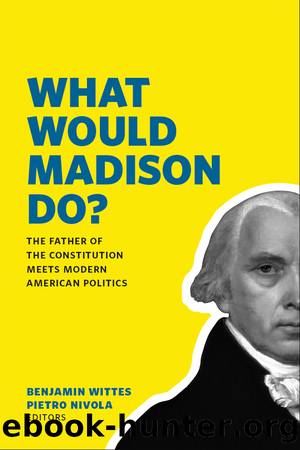
Author:Benjamin Wittes & Pietro S Nivola [Wittes, Benjamin & Nivola, Pietro S]
Language: eng
Format: epub
ISBN: 9780815726586
Google: swHevgEACAAJ
Barnesnoble:
Goodreads: 35464257
Publisher: Brookings Institution Press
Published: 2015-09-14T00:00:00+00:00
Notes
1. One should distinguish the political impulses on which either House or Senate may act from the procedural constraints that impair any action. The former may provide countless cases of misjudgment, but the latter deal with institutional impairments to action, which is a better example of incapacity.
2. My understanding of this issue was much improved by a lunchtime conversation with former senator Jeff Bingaman and a public discussion at Stanford Law School in which he participated along with former senator Russ Feingold and Burt Neuborne of the New York University School of Law.
3. See the brief account in Thomas E. Mann and Norman J. Ornstein, It's Even Worse than It Looks: How the American Constitutional System Collided with the New Politics of Extremism (New York: Basic Books, 2012), pp. 89â91.
4. See the proposals discussed in Mann and Ornstein, It's Even Worse than It Looks, pp. 166â72.
5. Letter from Caleb Wallace to Madison, July 12, 1785, in The Papers of James Madison: Congressional Series, vol. 8, edited by William T. Hutchinson and others (University of Chicago Press and University of Virginia Press, 1962â91), pp. 322â23.
6. Letter from Madison to Wallace, August 23, 1785, in Papers of Madison, vol. 8, pp. 350â51.
7. Federalist No. 10, in Jack N. Rakove, James Madison: Writings (New York: Library of America, 1999), p. 165.
8. See, for example, the influential work of John Brewer, The Sinews of Power: War, Money, and the English State, 1689â1783 (Harvard University Press, 1990).
9. Quotations in this and the following paragraph come from Madison's preconvention memorandum, âVices of the Political System of the U. States,â in Rakove, James Madison: Writings, pp. 74â76.
10. John Adams, Thoughts on Government (Philadelphia, 1776), in The Foundersâ Constitution, vol. 1, edited by Philip Kurland and Ralph Lerner (University of Chicago Press, 1987), p. 108.
11. Max Farrand, Records of the Federal Convention of 1787, vol. 1 (Yale University Press, 1966), p. 151.
12. Ibid., p. 154.
13. Ibid., p. 168.
14. Ibid., p. 218.
15. Ibid., p. 214.
16. Ibid., p. 361.
17. Ibid., pp. 468â69.
18. Ibid., p. 484.
19. Ibid., p. 486.
20. Ibid., pp. 527â28. Madison originally wrote âdelusionâ in his notes, then replaced it at some later point with âalternative.â
21. Ibid., p. 554. Madison's notes of his own remarks for this date do not make this point, but William Paterson's notes confirm King's summary. Ibid., pp. 555â56.
22. Farrand, Records of the Federal Convention of 1787, vol. 2, pp. 9â10.
23. Ibid., pp. 630â31. After his original motion failed, Sherman proposed eliminating Article V entirely, which would make the equal state vote and every other clause unamendable.
24. âI have known one man where his State was represented by only two & were divided oppose Six States in Cong. on an import[ant] occasion for 3 days, and finally compelled [them] to gratify his Caprice in order to obtain his suffrage.â I have not worked out when this might have been. On David Howell's disruptive role, see Jack Rakove, The Beginnings of National Politics: An Interpretive History of the Continental Congress (New York, 1979), pp. 313â17.
25. Federalist No.
Download
This site does not store any files on its server. We only index and link to content provided by other sites. Please contact the content providers to delete copyright contents if any and email us, we'll remove relevant links or contents immediately.
The Secret History by Donna Tartt(19058)
The Social Justice Warrior Handbook by Lisa De Pasquale(12187)
Thirteen Reasons Why by Jay Asher(8894)
This Is How You Lose Her by Junot Diaz(6877)
Weapons of Math Destruction by Cathy O'Neil(6267)
Zero to One by Peter Thiel(5789)
Beartown by Fredrik Backman(5737)
The Myth of the Strong Leader by Archie Brown(5500)
The Fire Next Time by James Baldwin(5432)
How Democracies Die by Steven Levitsky & Daniel Ziblatt(5216)
Promise Me, Dad by Joe Biden(5144)
Stone's Rules by Roger Stone(5081)
A Higher Loyalty: Truth, Lies, and Leadership by James Comey(4954)
100 Deadly Skills by Clint Emerson(4921)
Rise and Kill First by Ronen Bergman(4780)
Secrecy World by Jake Bernstein(4742)
The David Icke Guide to the Global Conspiracy (and how to end it) by David Icke(4709)
The Farm by Tom Rob Smith(4502)
The Doomsday Machine by Daniel Ellsberg(4485)
