What Was Liberalism? by James Traub
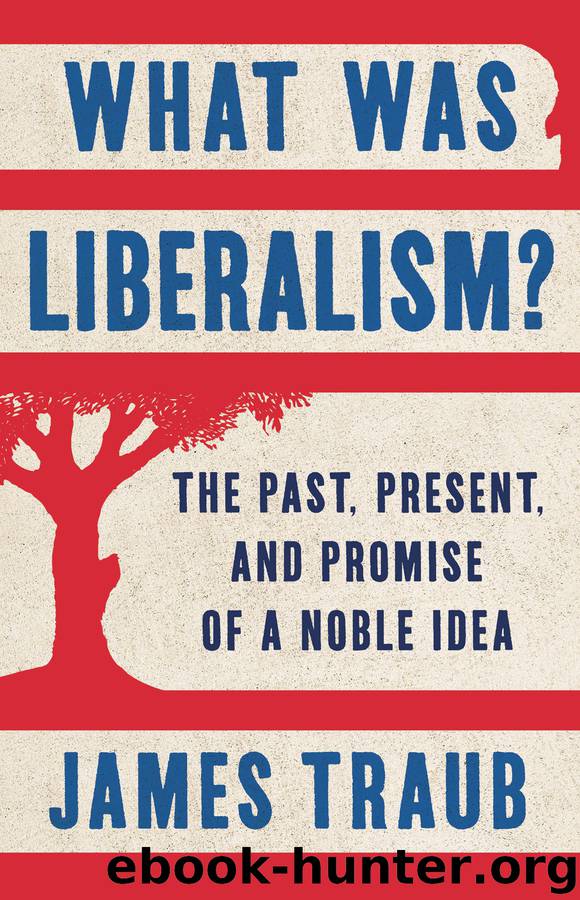
Author:James Traub
Language: eng
Format: epub
Publisher: Basic Books
Published: 2019-09-23T16:00:00+00:00
CHAPTER SEVEN
The Great Society Goes Up in Flames
Liberalism had unleashed forces that its leaders could neither control nor keep within the confines of traditional political negotiation.
—THOMAS BYRNE EDSALL and MARY D. EDSALL
THE CIVIL RIGHTS REVOLUTION CAME OF AGE IN 1965. CONGRESS passed the Voting Rights Act, which barred the use of literacy tests in the South and, extraordinarily, required most southern states to receive advance permission from the Justice Department before making changes in voting laws. The law made black political representation in the South possible for the first time since Reconstruction. The Economic Opportunity Act, also passed in 1965, committed the government to moving toward economic equality for blacks. The combination of the Voting Rights Act with the Economic Opportunity Act and Civil Rights Act, both passed the year before, collectively fulfilled the promise that Hubert Humphrey had so brashly made at the 1948 Democratic convention. Yet the nation was terribly divided in a way that had not seemed true only a few years before. Six days after the Voting Rights Act passed, rioting broke out in Watts. Americans watched on television as this ghetto neighborhood of Los Angeles was looted and burned over five days. The two events had nothing to do with one another, but the proximity implied a terrible judgment about liberal benevolence. Activism, it seemed, had not healed a terrible breach but widened it.
America’s commitment to liberalism did not end in the years after the civil rights revolution. Rather, one could no longer say, as a whole generation of thinkers had, that the nation was indissolubly wedded to liberalism. This did not happen because the material conditions that had made liberalism possible had disappeared—as might be said, for example, of Weimar Germany, where economic crisis promoted an extremism of left and right. Nor did it happen because a potent ideological rival challenged political liberalism; that would come later. It would be closer to the truth to say that liberalism suffered the consequences of its own successes. A young generation raised on a stultifying diet of prosperity and self-satisfaction rebelled against liberal pieties. Black beneficiaries of civil rights legislation failed to respond with the patient gratitude white Americans expected. Liberal policies not only failed to cure black poverty but alienated the working-class whites who had once formed the base of the Democratic Party. Anti-liberalism thus became a potent political force. “Liberalism,” as Thomas Byrne Edsall and Mary D. Edsall would later put it in Chain Reaction, their analysis of liberal decline, “had unleashed forces that its leaders could neither control nor keep within the confines of traditional political negotiation.”1
Those forces included a left-wing radicalism that regarded Cold War liberalism as a relic of postwar America. Young people growing up in the late 1950s were neither attracted to the flame of Communism nor repelled by it. Stalin was dead, and his successor, Nikita Khrushchev, had denounced his crimes. The Soviet Union seemed more dismal than dangerous. The 1962 manifesto of the Students for a Democratic Society (SDS),
Download
This site does not store any files on its server. We only index and link to content provided by other sites. Please contact the content providers to delete copyright contents if any and email us, we'll remove relevant links or contents immediately.
| Anarchism | Communism & Socialism |
| Conservatism & Liberalism | Democracy |
| Fascism | Libertarianism |
| Nationalism | Radicalism |
| Utopian |
The Secret History by Donna Tartt(19010)
The Social Justice Warrior Handbook by Lisa De Pasquale(12179)
Thirteen Reasons Why by Jay Asher(8878)
This Is How You Lose Her by Junot Diaz(6866)
Weapons of Math Destruction by Cathy O'Neil(6253)
Zero to One by Peter Thiel(5776)
Beartown by Fredrik Backman(5722)
The Myth of the Strong Leader by Archie Brown(5487)
The Fire Next Time by James Baldwin(5418)
How Democracies Die by Steven Levitsky & Daniel Ziblatt(5207)
Promise Me, Dad by Joe Biden(5135)
Stone's Rules by Roger Stone(5070)
A Higher Loyalty: Truth, Lies, and Leadership by James Comey(4942)
100 Deadly Skills by Clint Emerson(4904)
Rise and Kill First by Ronen Bergman(4766)
Secrecy World by Jake Bernstein(4733)
The David Icke Guide to the Global Conspiracy (and how to end it) by David Icke(4691)
The Farm by Tom Rob Smith(4494)
The Doomsday Machine by Daniel Ellsberg(4477)
