What Fanon Said by Gordon Lewis R.; Dayan-Herzbrun Sonia; Cornell Drucilla
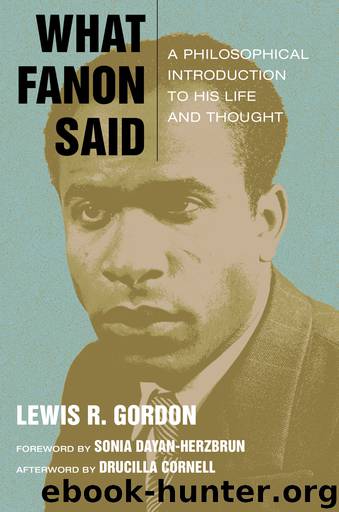
Author:Gordon, Lewis R.; Dayan-Herzbrun, Sonia; Cornell, Drucilla [Gordon, Lewis R.]
Language: eng
Format: epub
Publisher: Fordham University Press
Published: 2015-11-06T05:00:00+00:00
Figure 3. Frantz Fanon with his hospital team in Tunis.
Tunis, in a way, was like a lab for Fanon’s theories of psychotherapy. His argument, after all, was that therapy was contradictory under institutional structures of dehumanization. That the FLN was engaged in a revolutionary struggle meant that his patients were actively engaged in an evolving praxis of humanization, which encouraged his humanistic aims.
Fanon also worked with the editorial team of the FLN journal Résistance Algérienne, which was shortly afterward followed by El Moudjahid (“the Warrior”). He eventually served as a representative of the Gouvernement provisoire de la République algérienne (GPRA, Provisional Government of the Republic of Algeria) in other parts of Africa. Some of his El Moudjahid writings are included in Toward the African Revolution, although, as Alice Cherki reminds us, Fanon was not the author of some of the pieces included in the collection, though his voice in the ones included is apparent. The editorial board insisted on anonymity of authorship in the spirit of the collective.
The importance of his efforts to forge alliances between the GPRA and other African nations—especially those south of the Sahara—cannot be overestimated. European colonization of Africa had brought, as well, criteria that separated North Africa racially from the rest of Africa. Arab hegemony and the legacies of colonization have maintained structural antiblack racism in North Africa from before Fanon’s time to the present, although the status of the Arabic-speaking population there has many of the badges of being “colored.”34 The history of Arab presence in North Africa itself was an imperial one, a result of past Muslim empires or Caliphates where, too, there was the kidnapping of blacks (in addition to white Christians) into slavery.35 A “Semitic” people, the Arab population and many of the indigenous and nonindigenous populations of the region—Semites and, in the old-style racial categories, “Negroes”—mixed to create the populations of Fanon’s time. Fanon, from the standpoint of “black Africa,” was defending a land from a set of colonizers, ultimately, in the name of previous colonizers.36 For them, it was hypocritical for Algerians to seek solidarity with black Africans under the banner of African solidarity when, but for becoming a French colony, they (save, perhaps, some among the Berber and various “black,” nomadic African minorities) would have identified with Europe and the Middle East. Fanon—a black man from Martinique—embodied an effort toward a new relationship of the North with sub-Saharan Africa at a time when people of the latter were making connections across the global black diaspora. He was for the most part very effective in this regard. He negotiated routes through various countries to establish supply lines across the Sahara and worked out shipments of guns and medical supplies, though he wasn’t able to come to an agreement with Mali over the southern border of Algeria as a front against the French. Serving as a delegate at the Pan-African Congress meeting in Accra in December 1958, he gave a public address and met with such African leaders as Kwame Nkrumah, Félix Moumié, and Patrice Lumumba.
Download
This site does not store any files on its server. We only index and link to content provided by other sites. Please contact the content providers to delete copyright contents if any and email us, we'll remove relevant links or contents immediately.
| Anthropology | Archaeology |
| Philosophy | Politics & Government |
| Social Sciences | Sociology |
| Women's Studies |
Nudge - Improving Decisions about Health, Wealth, and Happiness by Thaler Sunstein(7693)
The Fire Next Time by James Baldwin(5431)
iGen by Jean M. Twenge(5408)
Adulting by Kelly Williams Brown(4566)
The Sports Rules Book by Human Kinetics(4379)
The Hacking of the American Mind by Robert H. Lustig(4375)
The Ethical Slut by Janet W. Hardy(4242)
Captivate by Vanessa Van Edwards(3838)
Mummy Knew by Lisa James(3686)
In a Sunburned Country by Bill Bryson(3537)
The Worm at the Core by Sheldon Solomon(3486)
Ants Among Elephants by Sujatha Gidla(3461)
The 48 laws of power by Robert Greene & Joost Elffers(3249)
Suicide: A Study in Sociology by Emile Durkheim(3018)
The Slow Fix: Solve Problems, Work Smarter, and Live Better In a World Addicted to Speed by Carl Honore(3007)
The Tipping Point by Malcolm Gladwell(2914)
Humans of New York by Brandon Stanton(2868)
Handbook of Forensic Sociology and Psychology by Stephen J. Morewitz & Mark L. Goldstein(2704)
The Happy Hooker by Xaviera Hollander(2686)
