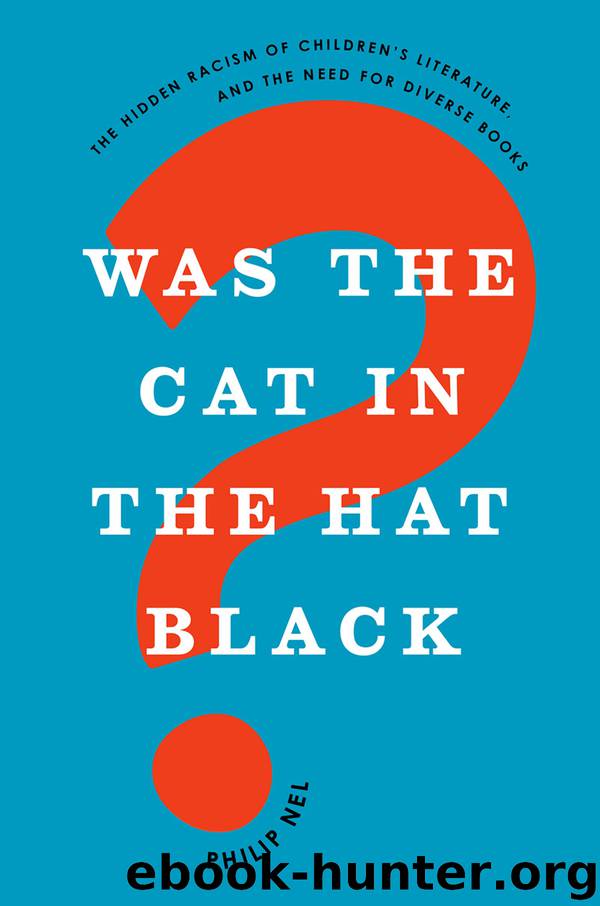
Was the Cat in the Hat Black? by Philip Nel
Author:Philip Nel
Language: eng
Format: epub
Publisher: Oxford University Press
Published: 2017-03-05T16:00:00+00:00
NO NEED FOR TRICKS: WE CANNOT INCREASE UNDERSTANDING BY DENYING DIFFERENCE
Surprisingly, some have alleged that a kind of literary whitewashing might actually increase understanding between people of different races. However, and contrary to what Laura Miller has argued, whitewashed covers are unlikely to “trick” White readers “into identifying with” non-White characters. They are much more likely to cause White readers to miss the ethnicity of the characters altogether. Miller cites a study by Lisa Libby and Geoff Kaufman, in which straight males read a story featuring a gay protagonist and White males read a story featuring a Black protagonist. According to the study’s authors, the later the story revealed the fact of the character’s race or sexuality, the higher the likelihood that the White or straight reader would identify with that character. “If we subscribe to the idea that literature ought to improve people’s characters,” Miller writes, “then perhaps authors and publishers should be encouraged to conceal a main character’s race or sexual orientation from readers until they become invested in him or her.” She concludes by coming out in favor of “a little judicious whitewashing” because it “has literally been demonstrated to change hearts and minds, at least for a while.”13
Though a laudable sentiment, this is a dubious claim. The argument promoted by Miller, Libby, and Kaufman treats race and sexuality as hats that can be worn or discarded, and not as something central to a person’s identity. In their study, Libby and Kaufman refer to both race and sexuality as “outgroup status,” and the phrase’s use in their description of their experiment is telling: “We predicted that delaying the revelation of a character’s outgroup status in a narrative that otherwise encouraged experience-taking would allow readers to experientially merge with an outgroup member. To test this hypothesis we manipulated the sexual orientation (Study 5) and race (Study 6) of the main character—as well as the timing of that revelation.” In identifying sexual orientation and race as something that can easily be withheld or revealed, the authors of the study do not treat sexual orientation or racial identity as complex social phenomena, but rather as arbitrary markers of difference. The motives of the study—and of whitewashing, were it used in this way—are excellent. But their treatment of difference as merely cosmetic risks propagating a deeper misunderstanding. A society that embraces diversity does not agree merely to overlook dissimilarity; it does not say that we can only respect one another if we ignore our differences. Instead, it tries to understand these dissimilarities and encourages us to learn from what we lack in common (as well as what we share). The notion that difference can only be bridged by trickery—the subterfuge of a misleading cover or ambiguous textual description—makes human variance into an obstacle, instead of recognizing it as an opportunity to learn about someone different from you.14
Whitewashing and Kaufman and Libby’s argument both rest on the assumption that a White reader is incapable of identifying with a non-White character. Proponents of
Download
This site does not store any files on its server. We only index and link to content provided by other sites. Please contact the content providers to delete copyright contents if any and email us, we'll remove relevant links or contents immediately.
| African | Asian |
| Australian & Oceanian | Canadian |
| Caribbean & Latin American | European |
| Jewish | Middle Eastern |
| Russian | United States |
4 3 2 1: A Novel by Paul Auster(12364)
The handmaid's tale by Margaret Atwood(7750)
Giovanni's Room by James Baldwin(7317)
Asking the Right Questions: A Guide to Critical Thinking by M. Neil Browne & Stuart M. Keeley(5752)
Big Magic: Creative Living Beyond Fear by Elizabeth Gilbert(5749)
Ego Is the Enemy by Ryan Holiday(5412)
The Body: A Guide for Occupants by Bill Bryson(5075)
On Writing A Memoir of the Craft by Stephen King(4925)
Ken Follett - World without end by Ken Follett(4719)
Adulting by Kelly Williams Brown(4564)
Bluets by Maggie Nelson(4542)
Eat That Frog! by Brian Tracy(4518)
Guilty Pleasures by Laurell K Hamilton(4437)
The Poetry of Pablo Neruda by Pablo Neruda(4090)
Alive: The Story of the Andes Survivors by Piers Paul Read(4017)
White Noise - A Novel by Don DeLillo(4000)
Fingerprints of the Gods by Graham Hancock(3985)
The Book of Joy by Dalai Lama(3970)
The Bookshop by Penelope Fitzgerald(3843)
