Volition's Face by Escobedo Andrew;
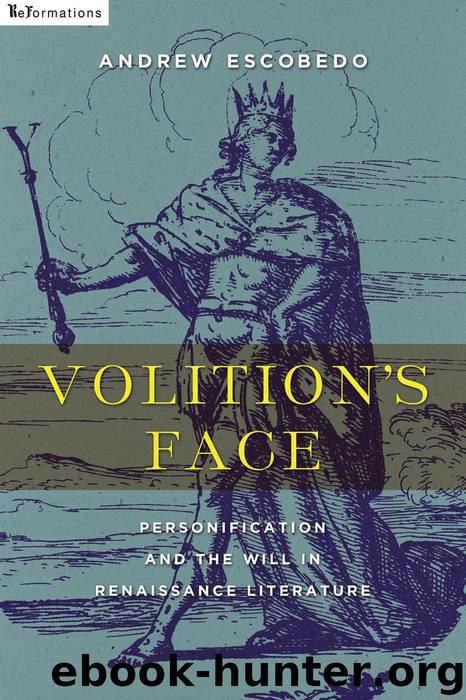
Author:Escobedo, Andrew;
Language: eng
Format: epub
Publisher: University of Notre Dame Press
Published: 2017-04-09T04:00:00+00:00
“Love, the Most Powerful Passion.” Andrea Alciato, Emblemes (Paris, 1549), 128. Reproduced with permission of the Folger Shakespeare Library.
Chapter Five
LOVE AND SPENSER’S CUPID
It is almost possible to sketch a history of the personifications of Conscience and Despair prior to their appearance in Tudor literature. There is no hope of such a sketch in the case of Love. By the time Hesiod depicts Eros in the eighth century BCE, love already slides among the overlapping categories of human passion, deity, daemon, and personification. Moreover, in subsequent Greek and Roman portrayals it is sometimes notoriously difficult to discern whether the poet understands the character named Love as an actual god or as a poetic figure. Even in later Christian poetry, where the one god has chased away the many, we cannot always be certain if a given appearance of Cupid belongs to a fictional pagan pantheon (Jove, Apollo, Diana, etc.) or a prosopopoetic projection of human passions (Joy, Doubt, Jealousy, Wrath, etc.). In the history of Love there are too many personifications, and too often we can’t even be sure that they are personifications.
There is no point pretending, it seems to me, that the tradition of personifying Love involves less messiness than it does. What I propose to do instead in this chapter is confine myself to a particular strand of messy love discourse—Platonism—and briefly follow that strand through to its prosopopoetic culmination in Renaissance literature, Spenser’s The Faerie Queene. This chapter’s argument, then, will hinge on the claim that the poem’s personification of love derives less from the poetic accounts of Cupid in Moschus’s Idylls, Apuleius’s Metamorphosis, or Petrarch’s Trionfi, and more from a tradition of philosophical commentary that imagined the figure of Cupid to accommodate love’s cruelty with its goodness.
Interpreting the personification of Love through a Platonic lens is a choice with consequences, of course. Bruce Smith may be right that the Platonic dialogues represent an early effort to domesticate desire within the house of logos: “All attempts to reconcile eros and words, in queer theory no less than in Renaissance Neoplatonism, follow from Plato’s attempt in the Symposium to ally eros with ideas.”1 Yet by the same token, as David Halperin has remarked, the Symposium and the Phaedrus represent the first formal analysis of erotic desire in the West.2 And the terms of Plato’s analysis include prosopopoeia.
At the heart of his account of love in the Symposium, Plato inserts what appears to be a personification allegory, spoken by the prophetess Diotima. During Aphrodite’s birthday party, Need (Penia) shows up at the door begging for food and shelter. Once inside, she notices Resource (Poros), the son of Craft (Mētis), in the garden of Zeus, sleeping off his liberal consumption of strong nectar. Thinking that getting pregnant by someone like Resource might lessen her neediness, Need lies with Resource and eventually gives birth to Love (Eros), who becomes a pursuer of beauty because he was born on Aphrodite’s birthday.3 In subsequent retellings, the details are sometimes rearranged: Natale Conti has an
Download
This site does not store any files on its server. We only index and link to content provided by other sites. Please contact the content providers to delete copyright contents if any and email us, we'll remove relevant links or contents immediately.
4 3 2 1: A Novel by Paul Auster(12405)
The handmaid's tale by Margaret Atwood(7773)
Giovanni's Room by James Baldwin(7353)
Big Magic: Creative Living Beyond Fear by Elizabeth Gilbert(5780)
Asking the Right Questions: A Guide to Critical Thinking by M. Neil Browne & Stuart M. Keeley(5779)
Ego Is the Enemy by Ryan Holiday(5455)
The Body: A Guide for Occupants by Bill Bryson(5103)
On Writing A Memoir of the Craft by Stephen King(4948)
Ken Follett - World without end by Ken Follett(4740)
Adulting by Kelly Williams Brown(4582)
Bluets by Maggie Nelson(4563)
Eat That Frog! by Brian Tracy(4546)
Guilty Pleasures by Laurell K Hamilton(4454)
The Poetry of Pablo Neruda by Pablo Neruda(4113)
Alive: The Story of the Andes Survivors by Piers Paul Read(4037)
White Noise - A Novel by Don DeLillo(4018)
Fingerprints of the Gods by Graham Hancock(4009)
The Book of Joy by Dalai Lama(3996)
The Bookshop by Penelope Fitzgerald(3857)
