Vietnam by Thich Nhat Hanh
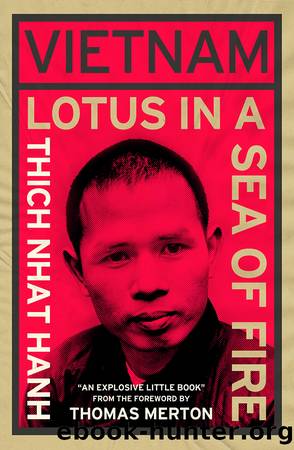
Author:Thich Nhat Hanh [Nhat Hanh, Thich]
Language: eng
Format: epub
ISBN: 9781952692048
Publisher: Parallax Press
Ngo Dinh Diem: A Catholic Dictator
From 1955 on, the United States began to send in âadvisersâ to work with the Diem government on technical, political, and military matters. A referendum arranged by the Diem government in October 1955, resulted in the overthrow of Bao Dai and the election of Diem as president of South Vietnam.
With the assistance of the United States, President Ngo Dinh Diem was able to demonstrate his anti-French attitudes, although of course these came after the French had been defeated at Dien Bien Phu. The alleged efforts of the Diem government to resume sovereignty from the French presented no difficulties whatever, given American help, but added prestige to Diemâs reputation. The Vietnamese, who had hated the French colonialists for a long time, now welcomed anyone who could demonstrate himself to be anti-French. In September 1954, Diem had dissolved the joint Franco-Vietnamese tribunals and the French-dominated federal security police. He also ended French domination of financial matters by terminating French control of the Indo-Chinese bank in favor of the establishment of a national bank and a national bureau of exchange. The agreement signed with the French on December 29, 1954, acknowledged the right of the Vietnamese to control their own foreign trade. The administration of Saigon University was transferred from French control to the Vietnamese government. Beginning with Diemâs accession to the premiership in July 1954, American aid was channeled directly to the Vietnamese instead of through the French. Norodom Palace, which had been referred to as the palace of the governor-general, was turned over to the Vietnamese and was renamed dinh doc lap (Independence Palace). The ceremony of the transfer of Norodom Palace was emphasized as symbolic of the resumption of Vietnamese sovereignty after a century of domination by the French.
At the time, the United States had no combat troops in Vietnam, and the relationship between American policy and French policy was unknown to the Vietnamese. Furthermore, people in the cities especially were able to observe the help that the Americans were giving in the solution of economic and social problems, and consequently did not look on them with the hostility they had had for the French. It was the most favorable period for Americans in Vietnam; it is unfortunate that they did not make better use of it.
President Diemâs most valuable contribution was the awareness that he created of a distinction between national resistance and Communists.29
29 Because âanti-communismâ has taken on a mystical, nonrational, almost religious character in the United States and some other Western countries, I want to explain that I do not use it in these terms in referring to my own attitude or that of Vietnamese Buddhist or other nationalist leaders. Communism has a base of social and personal idealism, and recruits thousands of people who are passionately concerned to eliminate the exploitation and inequality that have characterized much of Western society, and to create a form of social organization whose slogan will be âfrom each according to his ability, to each according to his need.
Download
This site does not store any files on its server. We only index and link to content provided by other sites. Please contact the content providers to delete copyright contents if any and email us, we'll remove relevant links or contents immediately.
The Secret History by Donna Tartt(19088)
The Social Justice Warrior Handbook by Lisa De Pasquale(12190)
Thirteen Reasons Why by Jay Asher(8910)
This Is How You Lose Her by Junot Diaz(6887)
Weapons of Math Destruction by Cathy O'Neil(6280)
Zero to One by Peter Thiel(5802)
Beartown by Fredrik Backman(5754)
The Myth of the Strong Leader by Archie Brown(5507)
The Fire Next Time by James Baldwin(5446)
How Democracies Die by Steven Levitsky & Daniel Ziblatt(5219)
Promise Me, Dad by Joe Biden(5153)
Stone's Rules by Roger Stone(5088)
A Higher Loyalty: Truth, Lies, and Leadership by James Comey(4964)
100 Deadly Skills by Clint Emerson(4925)
Rise and Kill First by Ronen Bergman(4789)
Secrecy World by Jake Bernstein(4753)
The David Icke Guide to the Global Conspiracy (and how to end it) by David Icke(4720)
The Farm by Tom Rob Smith(4513)
The Doomsday Machine by Daniel Ellsberg(4490)
