Utopia and Its Discontents by Sebastian Mitchell;
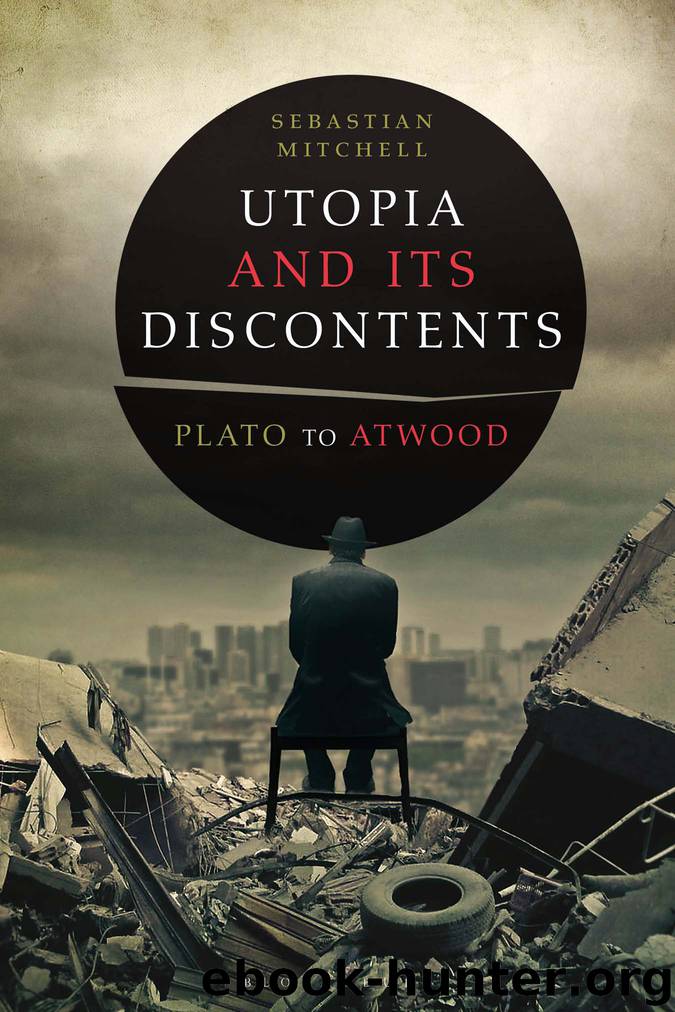
Author:Sebastian Mitchell;
Language: eng
Format: epub
ISBN: 9781441172181
Publisher: Bloomsbury UK
Published: 2020-01-09T16:00:00+00:00
One might approach Island (1962), Aldous Huxley’s last novel, as a decisive casting off of Wellsian influence (a process commenced in his fiction from the late 1930s in works such as Eyeless in Gaza (1935), Ends and Means (1937), and Grey Eminence (1941)). However, Plato is still there through negative inflection right at the end. The native Palanese, Lakshmi, is in the final stages of terminal cancer. She is asked by her daughter-in-law about what is on her mind. She replies ‘“Socrates”’, ‘“Gibber, Gibber, Gibber – even when he’s actually swallowed the stuff. Don’t let me talk”’, she says, ‘“Help me get out of my own light”’.44 The reference is to Plato’s Phaedo, the dialogue in which Socrates, having been sentenced to death for impiety and corrupting youth, drinks the hemlock. In fact, having discussed immortality, purification of the soul and the realm of eternal ideas, Socrates says almost nothing once he has drained the cup. However, Lakshmi’s terminal outburst suggests irritation with Socratic dialogue as a prolix disquisition which fails to provide a satisfactory resolution to the ethical and metaphysical conundrums it raises. Plato’s influence can also be detected indirectly in Huxley’s debut novel, Crome Yellow (1921). Its protagonist is a young diffident poet, Denis Stone, a version of Huxley himself. The country house, Crome, is based on the gatherings of Huxley’s patroness Lady Ottoline Morrell at Garsington Manor, near Oxford. This community falls short of the expected standards of a virtuous and harmonious society, but Denis still sees it as eminently desirable, and suffers in the conclusion the same fate of the poets in the Republic, of being exiled, forced in his case to catch the train back to London, a circumstance he likens to death.
Crome Yellow also contains Huxley’s earliest discussion of a technological society liberated from natural reproduction and the obligations of kinship. A house guest, Scogan, possibly modelled on the geneticist J.B.S. Haldane and Bertrand Russell, advocates an extreme form of scientism for the benefit of humankind. The most remarkable achievement, he declares, will be the development of ‘the means of disassociating love from propagation’. He looks forward to a time in which ‘an impersonal generation will take the place of Nature’s hideous system. In vast state incubators, rows upon rows of gravid bottles, will supply the world with the population it requires. The family will disappear; […]; and Eros, beautifully and irresponsibly free, will flit like a gay butterfly from flower to flower through a sunlit world’.45 The vision, of course, would form the basis of Brave New World (1932). Huxley, brother of the biologist Julian Huxley and nephew of Darwin’s supporter and Wells’ lecturer, T.H. Huxley, was conversant with the scientific discoveries and discussion of the 1920s and early 1930s, but he objected to the socially progressive claims which were made for science. The Eton- and Oxford-educated Aldous was patricianly dismissive of Wells, writing in 1927 that he struck him ‘as a rather horrid, vulgar man’, though the authors corresponded and were on dining terms in the 1920s and 1930s, even after the publication of Brave New World.
Download
This site does not store any files on its server. We only index and link to content provided by other sites. Please contact the content providers to delete copyright contents if any and email us, we'll remove relevant links or contents immediately.
4 3 2 1: A Novel by Paul Auster(12359)
The handmaid's tale by Margaret Atwood(7737)
Giovanni's Room by James Baldwin(7309)
Asking the Right Questions: A Guide to Critical Thinking by M. Neil Browne & Stuart M. Keeley(5745)
Big Magic: Creative Living Beyond Fear by Elizabeth Gilbert(5731)
Ego Is the Enemy by Ryan Holiday(5400)
The Body: A Guide for Occupants by Bill Bryson(5067)
On Writing A Memoir of the Craft by Stephen King(4923)
Ken Follett - World without end by Ken Follett(4712)
Adulting by Kelly Williams Brown(4557)
Bluets by Maggie Nelson(4539)
Eat That Frog! by Brian Tracy(4505)
Guilty Pleasures by Laurell K Hamilton(4430)
The Poetry of Pablo Neruda by Pablo Neruda(4084)
Alive: The Story of the Andes Survivors by Piers Paul Read(4013)
White Noise - A Novel by Don DeLillo(3998)
Fingerprints of the Gods by Graham Hancock(3981)
The Book of Joy by Dalai Lama(3964)
The Bookshop by Penelope Fitzgerald(3831)
