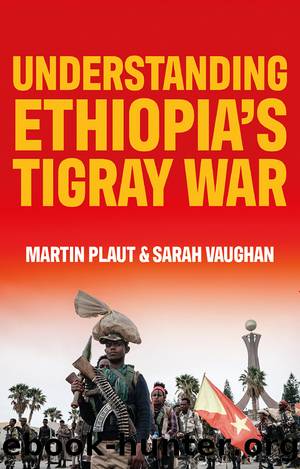
Understanding Ethiopia's Tigray War by Martin Plaut;Sarah Vaughan;
Author:Martin Plaut;Sarah Vaughan;
Language: eng
Format: epub
Publisher: Lightning Source Inc. (Tier 1)
Published: 2023-02-11T00:00:00+00:00
8
THE PENDULUM OF WAR SWINGSâ
AND SWINGS AGAIN
Martin Plaut and Ermias Teka
Introduction
It is worth pausing to reflect on the significance of the re-emergence of the Tigrayan military following the defeat of November 2020. The Tigrayan forces had been transformed from a local militiaâor special forceâand adapted to guerrilla warfare. They then developed their fighting capability so that they could confront two of Africaâs largest militaries, Ethiopia and Eritrea. Between them they had a total of some 335,000 troops plus substantial reserves.1 They had been augmented by Somali troops, Amhara special forces, and other militia. Many African armies are largely paper organisations, but this is not the case with either Ethiopia or Eritrea. They had fought each other in the vicious border war of 1998â2000 using everything from aerial attacks to heavy artillery and tanks. Ethiopia had a deservedly strong reputation as a contributor to UN and African peacekeeping forces, with troops stationed in Somalia, South Sudan and several other complex and difficult locations. The Eritreans had limited experience of recent warfare but had trained almost their entire younger generation by means of their system of mandatory and indefinite conscription. Confronting these combined forces was an extraordinary achievement for Mekele, even if the Ethiopian government was correct when it alleged that the Tigrayans had been developing their special forces prior to the conflict.
By the end of June 2021 the Tigrayans had recaptured their capital and driven the invading forces from large parts of Tigray. They rapidly re-established their administrative structures. Key political figures returned to their offices, with Debretsion Gebremichael resuming his role as president of Tigray. The regional House of Representatives resumed its sessions.
At the same time all communications with Tigray remained severed, and Abiy and Isaias established what amounted to a siege of the region. A senior UN official conceded that starvation was being used as a weapon while the UN Office for the Coordination of Humanitarian Affairs described the situation in Tigray as a âde facto aid blockadeâ.2 Banking, telecommunications and electricity were discontinued after the Ethiopian forces withdrew. The International Crisis Group reported: âRetreating federal soldiers looted UN satellite internet equipment and reportedly emptied banks before fleeing Mekele. Addis Ababa has closed Tigrayâs airspace and Ethiopian soldiers and Amhara forces have been blocking World Food Programme trucks from reaching Mekelleâ.3 Some humanitarian flights into Mekele were permitted, but most aid convoys by road were slowed to a trickle, restricted or halted altogether. In a public statement Abiy said that the government was determined not to repeat the mistakes made by the Derg during its long confrontation with the TPLF in the 1980s.
The main reason why Woyane [the Tigrayans] defeated the Derg during the war of âEthiopia firstâ was by using the Dergâs weapon and food. So, given the current situation, if we stay there for long, we are going to provide them with many weapons. When it comes to food [aid], if one family has five children, they register that they have 7, 8, or 10 children. Then they receive the rations of ten.
Download
This site does not store any files on its server. We only index and link to content provided by other sites. Please contact the content providers to delete copyright contents if any and email us, we'll remove relevant links or contents immediately.
| Anthropology | Archaeology |
| Philosophy | Politics & Government |
| Social Sciences | Sociology |
| Women's Studies |
The Secret History by Donna Tartt(19103)
The Social Justice Warrior Handbook by Lisa De Pasquale(12197)
Thirteen Reasons Why by Jay Asher(8919)
This Is How You Lose Her by Junot Diaz(6894)
Weapons of Math Destruction by Cathy O'Neil(6285)
Zero to One by Peter Thiel(5808)
Beartown by Fredrik Backman(5768)
The Myth of the Strong Leader by Archie Brown(5513)
The Fire Next Time by James Baldwin(5454)
How Democracies Die by Steven Levitsky & Daniel Ziblatt(5225)
Promise Me, Dad by Joe Biden(5157)
Stone's Rules by Roger Stone(5091)
A Higher Loyalty: Truth, Lies, and Leadership by James Comey(4967)
100 Deadly Skills by Clint Emerson(4932)
Rise and Kill First by Ronen Bergman(4797)
Secrecy World by Jake Bernstein(4756)
The David Icke Guide to the Global Conspiracy (and how to end it) by David Icke(4724)
The Farm by Tom Rob Smith(4517)
The Doomsday Machine by Daniel Ellsberg(4493)
