Trojan-Horse Aid by Walsh Susan;
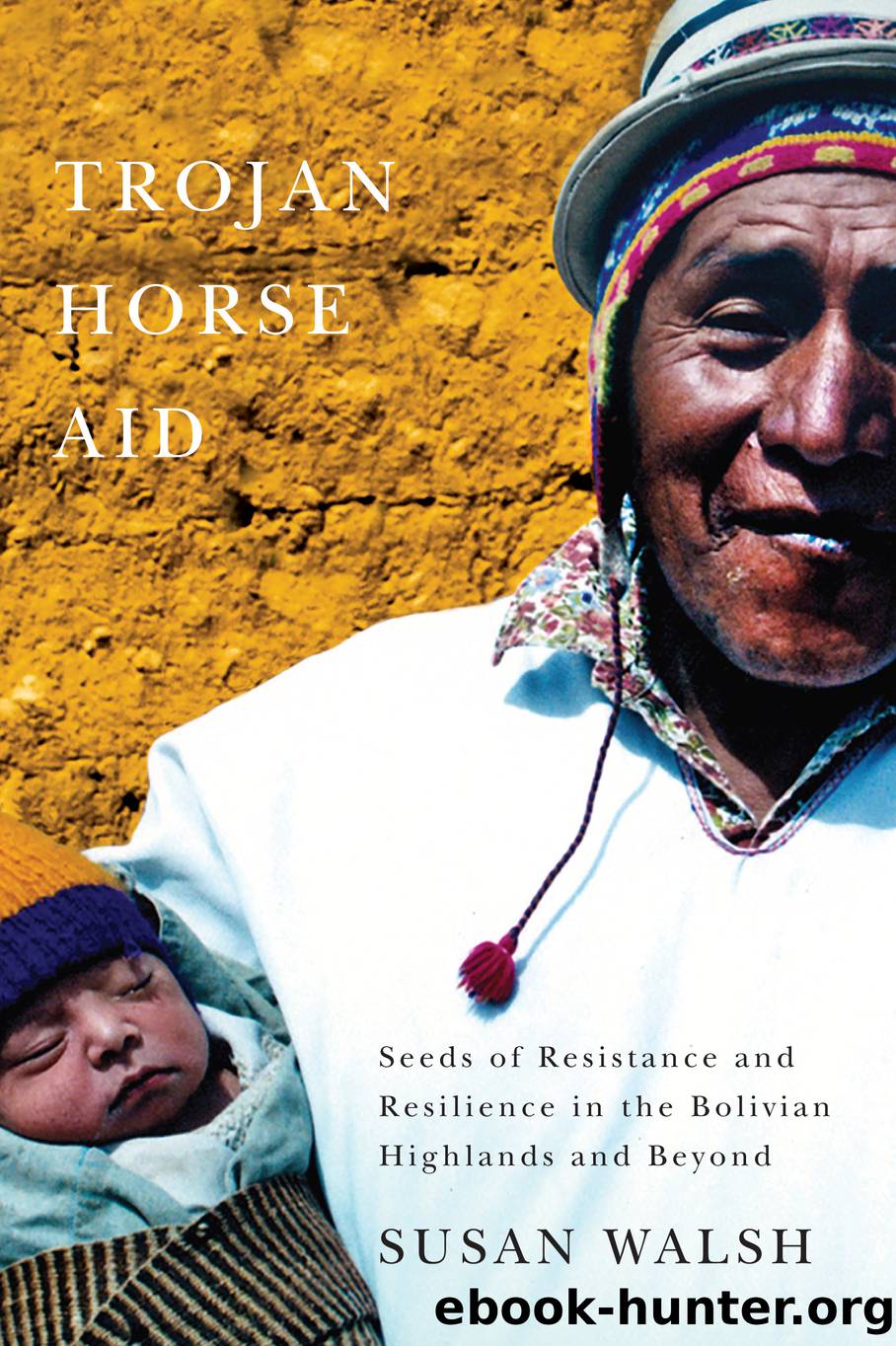
Author:Walsh, Susan;
Language: eng
Format: epub
ISBN: 3332830
Publisher: McGill-Queen's University Press
Published: 2014-08-15T00:00:00+00:00
Pedagogy as praxis is thus purposeful, contextual, transformative, and socially just, an encouraging option for the silenced and oppressed. Freireâs manifesto was a welcome and needed attack on status quo educational models that dismissed and further marginalized peoples outside the socioeconomic and political mainstream. Progressive educators, social activists, development workers, trade unionists, and other community-based movements eagerly embraced and adapted this method of helping disenfranchised peoples assert their identities and right to take charge of their lives. Freireâs participatory methodology and relevance-based curriculum germinated and flowered in literacy programs around the world. For Freire, to read the word was to read the world.70 But therein lies what I consider to be a significant flaw in his analysis.
Freire places considerable emphasis on language and the written word as a means to develop critical consciousness, somewhat contradicting his message about knowledge being produced through interaction. He pays little attention to oral or non-linguistic, experiential knowledge transmission that fits so well with his ideas about knowledge as a relational act. Might capturing knowledge on paper arrest its development? In considering reading and writing as the stepping-stones to historical sensibility and a prerequisite for critical, analytical thinking, there is an uncomfortable hint of the âgreat divideâ school of thought. In his introduction to Education for Critical Consciousness (1973), Freire comments: âThe dimensionality of time is one of the fundamental discoveries in the history of human culture. In illiterate cultures, the âweightâ of apparently limitless time hindered people from reaching that consciousness of temporality, and thereby achieving a sense of their historical nature.â71
In Pedagogy of the Oppressed he further states, âalmost never do they [the oppressed] realize that they too know things they have learned in their relation with the world and with other menâ72 and âindividuals who were submerged in reality, merely âfeelingâ their needs, emerge [when literate] from reality and perceive the causes of their needs.â73
Freire offered marginalized communities, including Indigenous peoples, a guide to a more relevant, critical, and participatory pedagogy and, in so doing, more effective community-change processes. Thanks to his vision, literacy education emerged as a fundamental right within a more progressive educational framework. He asked literacy students to explore the reason for their oppression and warned against the assimilationist, conformist motives of much Western-based education. His insistence on the importance of the written word in a world obsessed with the written language of power is understandable and was politically astute for his support base, Western, urbanized populations in Brazil and beyond. But he paid insufficient attention to alternative modes of knowledge production and transmission in rural and Indigenous societies, or to the issue of how knowledge can change or lose its original meaning when transcribed into text. Freire offered âilliterateâ peoples a way to clear the cobwebs of confusion and victimization, unlocking the gate to meaningful development. This assumption brings us back to an ideology that champions literacy as the key ingredient for critical thinking, and thus full circle to Goody and Wattsâ âConsequences of Literacy.â74
Challenging the idea of literacy education means challenging something deep in the Western psyche.
Download
This site does not store any files on its server. We only index and link to content provided by other sites. Please contact the content providers to delete copyright contents if any and email us, we'll remove relevant links or contents immediately.
| Anthropology | Archaeology |
| Philosophy | Politics & Government |
| Social Sciences | Sociology |
| Women's Studies |
The Secret History by Donna Tartt(19090)
The Social Justice Warrior Handbook by Lisa De Pasquale(12190)
Thirteen Reasons Why by Jay Asher(8910)
This Is How You Lose Her by Junot Diaz(6887)
Weapons of Math Destruction by Cathy O'Neil(6281)
Zero to One by Peter Thiel(5802)
Beartown by Fredrik Backman(5755)
The Myth of the Strong Leader by Archie Brown(5508)
The Fire Next Time by James Baldwin(5446)
How Democracies Die by Steven Levitsky & Daniel Ziblatt(5219)
Promise Me, Dad by Joe Biden(5153)
Stone's Rules by Roger Stone(5088)
A Higher Loyalty: Truth, Lies, and Leadership by James Comey(4964)
100 Deadly Skills by Clint Emerson(4926)
Rise and Kill First by Ronen Bergman(4789)
Secrecy World by Jake Bernstein(4753)
The David Icke Guide to the Global Conspiracy (and how to end it) by David Icke(4720)
The Farm by Tom Rob Smith(4514)
The Doomsday Machine by Daniel Ellsberg(4490)
