To Heal the World? by Jonathan Neumann
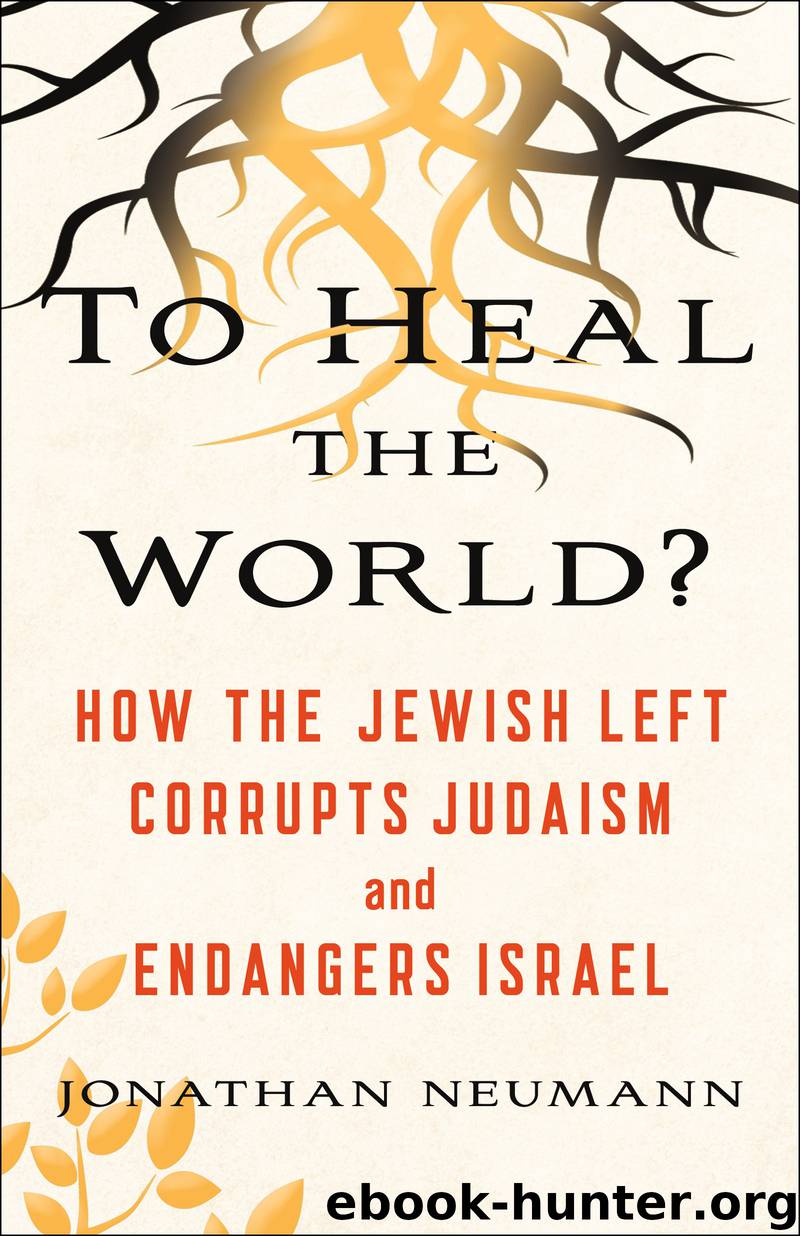
Author:Jonathan Neumann
Language: eng
Format: epub
Publisher: St. Martin's Press
THE MIDRASH
The Midrash is a literary category comprising homiletical rabbinic teachings—mostly from a similar era as the Talmud. They’re commentaries that build on nuances, ambiguities, discrepancies, and other textual anomalies in the Bible to make more general theological, mystical, or normative claims that often depart radically from the plain meaning of the words of the biblical text. This exegetical process will become clear as we explore a couple of examples.
There are lots of these sorts of commentaries, and a very small number of them mention tikkun olam. Jill Jacobs derives from these few a more “literalist” understanding of tikkun olam as denoting the physical repair or stabilization of the natural world—literally a repair of the natural world and the environment. Jewish social justice advocates hope that these appearances of tikkun olam in the Midrash can demonstrate that liberal ecology—a prime facet of Jewish social justice—has long been a concern in rabbinic thought. It’s also a back door into the Bible, since, as we saw, tikkun olam isn’t mentioned anywhere in the Bible. Although the Midrash is a collection of rabbinical commentaries, they’re commentaries that draw out theological meaning from Scripture. So if the Jewish social justice movement can show that tikkun olam is part of the Midrash, they can also make a subtle association of the concept with the Bible.
One such commentary that Jacobs cites is Genesis Rabbah 4:6. It explores the division of the waters (the sea and the sky) on the second day of the Creation story. God creates the seas and the skies by division—He divides the lower waters (the seas) and the upper waters (the skies). But whereas on every other day of the Creation story God declares that His creation is “good,” on this second day He does not say that. The commentary picks up on this:
“And let it divide the waters.” Rabbi Tabyomi said: If “for it was good” is not written in connection with that day, even though that division was made for tikkuno shel olam [“the stability of the world”] and its orderliness, then how much more so should this apply to a division which leads to its [the world’s] confusion!
This is an example of a midrash noticing an omission—the second day of Creation is the only day in the story on which God does not compliment His creation (He doesn’t say that “it was good”). From this omission the commentary draws a moral lesson: if God refrains from praising even a beneficial division, it must be that division in general, especially among people, is a bad thing. What interests Jacobs is less the substance of this commentary than the use of the phrase “tikkun olam.” She observes that this commentary understands tikkun olam as a necessary undertaking for the good of the natural world—the division of the firmament was required as part of the creation of the environment. There is here a “more literal understanding of tikkun olam as the physical repair or stabilization of the world,” she observes. “The world is ‘fixed’ when it is physically viable.
Download
This site does not store any files on its server. We only index and link to content provided by other sites. Please contact the content providers to delete copyright contents if any and email us, we'll remove relevant links or contents immediately.
| Anthropology | Archaeology |
| Philosophy | Politics & Government |
| Social Sciences | Sociology |
| Women's Studies |
The Secret History by Donna Tartt(19007)
The Social Justice Warrior Handbook by Lisa De Pasquale(12178)
Thirteen Reasons Why by Jay Asher(8875)
This Is How You Lose Her by Junot Diaz(6862)
Weapons of Math Destruction by Cathy O'Neil(6252)
Zero to One by Peter Thiel(5772)
Beartown by Fredrik Backman(5719)
The Myth of the Strong Leader by Archie Brown(5484)
The Fire Next Time by James Baldwin(5416)
How Democracies Die by Steven Levitsky & Daniel Ziblatt(5201)
Promise Me, Dad by Joe Biden(5132)
Stone's Rules by Roger Stone(5068)
A Higher Loyalty: Truth, Lies, and Leadership by James Comey(4942)
100 Deadly Skills by Clint Emerson(4901)
Rise and Kill First by Ronen Bergman(4765)
Secrecy World by Jake Bernstein(4732)
The David Icke Guide to the Global Conspiracy (and how to end it) by David Icke(4687)
The Farm by Tom Rob Smith(4490)
The Doomsday Machine by Daniel Ellsberg(4476)
