This Compost by Rasula Jed;
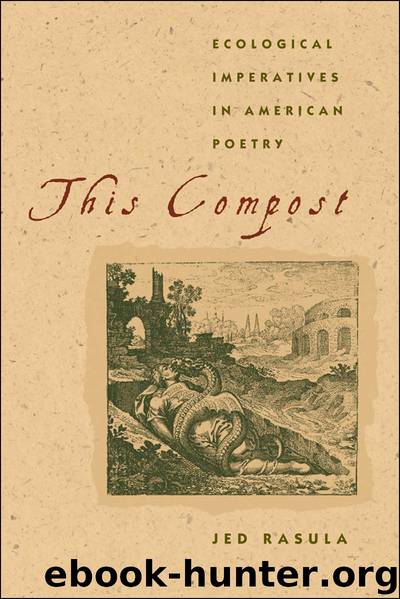
Author:Rasula, Jed;
Language: eng
Format: epub
ISBN: 1224971
Publisher: University of Georgia Press
Published: 2012-09-01T04:00:00+00:00
De rerum natura : epic’s lyric absolute
As Europe succumbs to conflagration in 1940, Kenneth Rexroth, on the California coast, finds himself writing
… this poem
Of the phoenix and the tortoise—
Of what survives and what perishes,
And how, of the fall of history
And waste of fact—on the crumbling
Edge of a ruined polity
That washes away in an ocean
Whose shores are all washing into death.
Even as the sea subsides “To a massive, uneasy torpor,” the “Fragments of its inexhaustible / Life litter the shingle, sea hares, / Broken starfish.” Rexroth imagines the corpse of a Japanese sailor “bumping / In a snarl of kelp in a tidepool”;
And, out of his drained grey flesh, he
Watches me with open hard eyes
Like small indestructible animals—
Me—who stand here on the edge of death,
Seeking the continuity,
The germ plasm, of history,
The epic’s lyric absolute.
The emblematic features of Rexroth’s poem, the phoenix and the tortoise, are versions of history. In the dystopic vision the State is “the organization / Of the evil instincts of mankind”; “Its goal is the achievement / Of the completely atomic / Individual and the pure / Commodity relationship— / The windowless monad sustained / By Providence.” In the perpetuum mobile of administered ecstasy, “The assumption of history / Is that the primary vehicle / Of social memory is the State,” obscuring the broader perspective of a living cosmos,
The vast onion of the actual:
The universe, the galaxy,
the solar system, and the earth,
And life, and human life, and men’s
Relationships, and men, and each man …
History seeping from capsule
To capsule, from periphery
To center, and outward again …
The sparkling quanta of events,
The pulsing wave motion of value … (Rexroth’s ellipses)
Fronting calamity on the Pacific rim, Rexroth, like Jeffers a few years earlier, turns to Epicurean atomism to account for the unaccountable marvel of such pulsation.
Endurance, novelty, and simple
Occurrence—and here I am, a node
In a context of disasters,
Still struggling with the old question,
Often and elaborately begged.
The atoms of Lucretius still,
Falling, inexplicably swerve.
And the generation that purposed
To control history vanishes
In its own apotheosis
Of calamity, unable
To explain why anything
Should happen at all.
One more Spring, and after the bees go,
The soft moths stagger in the firelight;
And silent, vertiginous, sliding,
The great owls hunt low in the air;
And the dwarf owls speak at their burrows.
We walk under setting Orion,
Once more in the dim boom of the sea …
Rexroth, like Lucretius, finds that “the thing that falls away is myself.” The fall is the unfolding—making explicit an implicated universe—of Democritus’s shower of atoms, to which Lucretius adds clinamen atomorum, the “gentle bias,” Coleridge calls it. The clinamen is the skip of the needle, the bump of the table that tumbles the card house, the incalculable diversion, detour (like Duchamp’s “delay in glass”—its shattered accidence preserved), deviation like that which style brings to a text.
Wallace Stevens’s style seems too consistently sonorous to suggest in itself a swerve, but as “gentle bias” it does seem so inclined. Stevens may not have been an enthusiast of Lucretius, but George Santayana’s Three Philosophical Poets (1910) would have at least placed the Roman
Download
This site does not store any files on its server. We only index and link to content provided by other sites. Please contact the content providers to delete copyright contents if any and email us, we'll remove relevant links or contents immediately.
4 3 2 1: A Novel by Paul Auster(12391)
The handmaid's tale by Margaret Atwood(7762)
Giovanni's Room by James Baldwin(7346)
Asking the Right Questions: A Guide to Critical Thinking by M. Neil Browne & Stuart M. Keeley(5772)
Big Magic: Creative Living Beyond Fear by Elizabeth Gilbert(5771)
Ego Is the Enemy by Ryan Holiday(5445)
The Body: A Guide for Occupants by Bill Bryson(5096)
On Writing A Memoir of the Craft by Stephen King(4942)
Ken Follett - World without end by Ken Follett(4731)
Adulting by Kelly Williams Brown(4574)
Bluets by Maggie Nelson(4554)
Eat That Frog! by Brian Tracy(4536)
Guilty Pleasures by Laurell K Hamilton(4448)
The Poetry of Pablo Neruda by Pablo Neruda(4106)
Alive: The Story of the Andes Survivors by Piers Paul Read(4031)
White Noise - A Novel by Don DeLillo(4009)
Fingerprints of the Gods by Graham Hancock(4004)
The Book of Joy by Dalai Lama(3986)
The Bookshop by Penelope Fitzgerald(3852)
