Thinking in Indian by Barreiro José; Barreiro Jose;
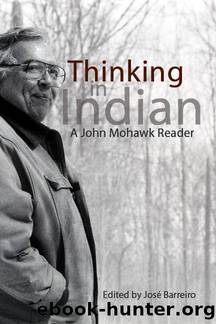
Author:Barreiro, José; Barreiro, Jose;
Language: eng
Format: epub
Publisher: Fulcrum Publishing
Published: 2014-08-05T06:00:00+00:00
Review: The Spirit of Regeneration:
Andean Culture Confronting Western
Notions of Development
The indigenous cultures of the Americas are characterized by a great range of diversity and creativity. One might expect such cultures to generate sophisticated and eloquent critiques of Western colonization, and there have been some, but certainly not as many as might have been expected. There have been resistance movements for the entire period since 1492, of course, but there has not been much in the way of systematic in-depth critiques of Western culture from indigenous intellectuals. There are, to be sure, sentimental reflections and idyllic projections, but few that defend and promote living cultures. This has been true even among indigenous academics.
Until quite recently, few indigenous peoples of the Western Hemisphere had been exposed to the level of education that commands respect on such topics. When India was decolonized, the country was left in the hands of peoples indigenous to the Indian subcontinent, and its educational institutions produced people capable of engaging in an informed critique of Western thought and practices. In the Americas, not a single state government is in the hands of its indigenous people. Spain, for example, left its former colonies in the hands of cultural descendants of the conquistadors who had little connection to the indigenous cultures and, until the 1960s, little interest in exposing indigenous individuals to the fine points of a Western education.
Peru was among the countries to recruit indigenous individuals to universities in hopes such people could solve the daunting problems defined as underdevelopment in the rural countryside. Some of these individuals became dedicated scholars, some became leaders in development initiatives directed at transforming rural indigenous populations, and a few became completely disillusioned with the ideology of Western notions of development. Some of these people founded the Andean Project on Peasant Technologies (PRATEC).
Dr. Frederique Apffel-Marglinâs The Spirit of Regeneration: Andean Culture Confronting Western Notions of Development is a book by and about PRATEC, a group of Andean intellectuals who have come to identify development as a process that advances the goals of Western colonialism while impoverishing the people, degrading the environment, and attacking the spirit of humanity in indigenous Andean communities. Although its founders are individuals with indigenous backgrounds, their work is not specifically an indigenous revitalization movement or even an indigenous rights movement. PRATEC embodies and intends to share principles with peoples across cultures and continents, and it makes no pretensions about reforming any indigenous culture.
There are, to be sure, individual North American indigenous scholars who address some of the same types of issuesâProfessor Vine Deloria Jr. comes to mindâbut there are no indigenous organizations that have addressed an integration of such varied topics as defending and promoting indigenous agricultural techniques, encouraging biodiversity, promoting cultural practices, critiquing mechanized and chemicalized agriculture and critiquing Western technologies and ideologies as part of an overall program of cultural affirmation. PRATECâs members do all this and more. They believe Western forms of colonialism cannot and will not work in the Andes, that the period of Western
Download
This site does not store any files on its server. We only index and link to content provided by other sites. Please contact the content providers to delete copyright contents if any and email us, we'll remove relevant links or contents immediately.
The Fine Print (Dreamland Billionaires Book 1) by Lauren Asher(2548)
Fury of Magnus by Graham McNeill(2437)
The Last House on Needless Street by Catriona Ward(2380)
The Rose Code by Kate Quinn(2189)
A Little Life: A Novel by Hanya Yanagihara(2096)
Malibu Rising by Taylor Jenkins Reid(1902)
The God of the Woods by Liz Moore(1895)
Luster by Raven Leilani(1894)
Transcendent Kingdom by Yaa Gyasi(1846)
Moonflower Murders by Anthony Horowitz(1840)
The Lost Book of the White (The Eldest Curses) by Cassandra Clare & Wesley Chu(1681)
This Changes Everything by Unknown(1499)
The Midwife Murders by James Patterson & Richard Dilallo(1476)
The New Wilderness by Diane Cook(1435)
The Lying Life of Adults by Elena Ferrante(1425)
Wandering in Strange Lands by Morgan Jerkins(1406)
Written in the Stars by Alexandria Bellefleur(1391)
Ambition and Desire: The Dangerous Life of Josephine Bonaparte by Kate Williams(1380)
The Lying Life of Adults by Elena Ferrante;(1302)
