Thinking Globally by Juergensmeyer Mark;
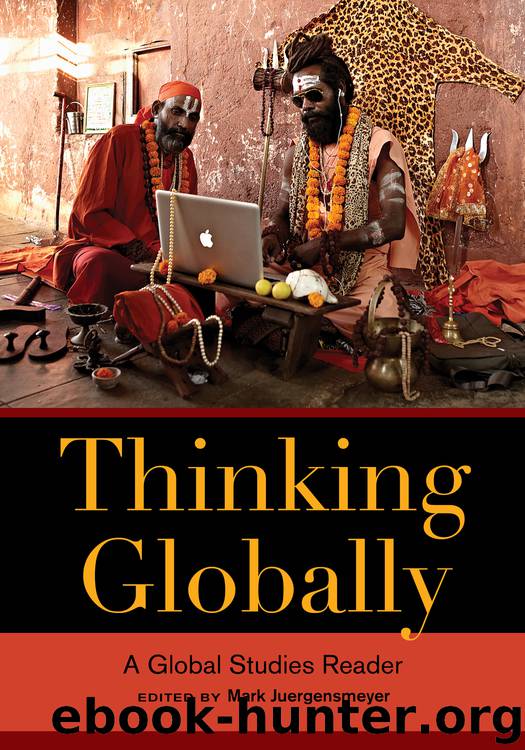
Author:Juergensmeyer, Mark;
Language: eng
Format: epub
Publisher: University of California Press
11
THE EROSION OF THE NATION-STATE
Before I traveled to another country, I used to carefully convert my dollars into German deutschmarks, Italian lira, and all the other currency I would need abroad. Today, I never do such a thing. For one thing, the deutschmark and lira no longer exist; they have been replaced by the European euro. For another thing, all I need is the piece of plastic in my pocket—my credit card.
The disappearance of foreign currency is an eerie symbol of the fading of the idea of the nation-state in the global era. It can be argued that the idea of the nation-state is a fairly new invention in world history, so it is no surprise that its novelty is wearing off; in the twenty-first century it is showing signs of stress, perhaps even becoming obsolete. The globalization of everything—economic production and distribution, financial markets, communications, ethnic communities, religious networks, and ideologies—challenge the notion that the nation is the primary community of reference, and that the nation-states are the only building blocks for world order.
The world has not always consisted of independent nations. For most of world history, political order was under the control of relatively small kingdoms and large empires that swept over vast reaches of topography, usually with only minimal interference with whatever local political arrangements governed the affairs of towns and villages in their precincts. The boundaries between these regions of political control were often fuzzy. The further one got from a center of power, the weaker was the authority’s control, and at the frontiers between the authority of one state and that of another, often a sort of lawless anarchy reigned.
This situation began to change in Europe in the seventeenth century. The region had been ravaged by wars of religion for decades when a peace treaty in 1648 in the Westphalian city of Münster settled the matter with the proclamation in Latin, cuius regio, eius religio (“whose region, their religion”), meaning that the matter of religious affiliation should be linked with the preferences of the ruler. This Westphalian Treaty is often regarded as the beginning of the idea of the nation-state, since for the first time it connected the idea of state power with the culture and identity of a national community. Eventually, this led to the idea of a nationhood with borders rather than frontiers, in which all inhabitants were connected to the network of state authority.
The idea of a nation-state was developed more fully during the European Enlightenment. The eighteenth century French philosopher Jean-Jacques Rousseau thought that there was a natural “social contract” between the people of a nation and those who governed them. The implication was that if rulers abused the trust implied in that contract, they could be deposed. The British philosopher John Locke went further in describing the instruments of democratic authority by which the people could be justly represented in a government that truly represented the citizens of a nation. The idea of democracy and representative government, then, became a tacit requirement for status as a nation-state.
Download
This site does not store any files on its server. We only index and link to content provided by other sites. Please contact the content providers to delete copyright contents if any and email us, we'll remove relevant links or contents immediately.
| Anthropology | Archaeology |
| Philosophy | Politics & Government |
| Social Sciences | Sociology |
| Women's Studies |
Born to Run: by Christopher McDougall(7132)
The Leavers by Lisa Ko(6952)
iGen by Jean M. Twenge(5419)
Sapiens by Yuval Noah Harari(5375)
Spare by Prince Harry The Duke of Sussex(5202)
The Kite Runner by Khaled Hosseini(5188)
Machine Learning at Scale with H2O by Gregory Keys | David Whiting(4317)
Bullshit Jobs by David Graeber(4197)
Never by Ken Follett(3963)
Goodbye Paradise(3813)
Livewired by David Eagleman(3778)
Fairy Tale by Stephen King(3403)
A Dictionary of Sociology by Unknown(3088)
Harry Potter 4 - Harry Potter and The Goblet of Fire by J.K.Rowling(3077)
The Social Psychology of Inequality by Unknown(3039)
The Club by A.L. Brooks(2930)
Will by Will Smith(2930)
0041152001443424520 .pdf by Unknown(2850)
People of the Earth: An Introduction to World Prehistory by Dr. Brian Fagan & Nadia Durrani(2740)
