The Venetian Qur'an by Tommasino Pier Mattia; Notini Sylvia;
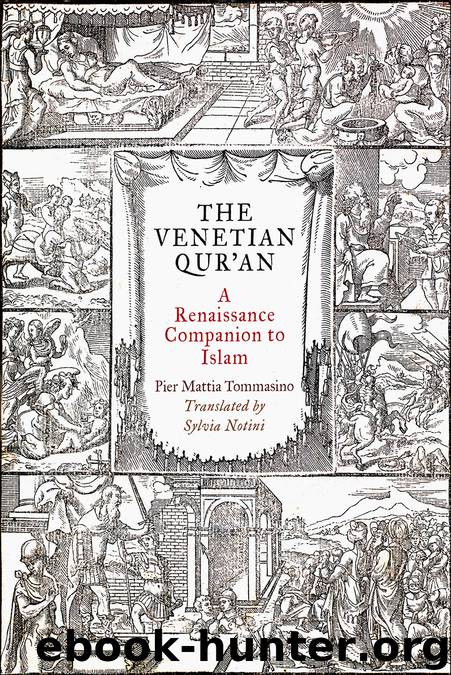
Author:Tommasino, Pier Mattia; Notini, Sylvia;
Language: eng
Format: epub
Publisher: University of Pennsylvania Press
Published: 2018-09-08T16:00:00+00:00
THE CAESARIZATION OF THE PROPHET
In the fifteenth century and early decades of the sixteenth century, a particular process was under way in historical writings. This process was rooted in the medieval chronicles, and it flourished in several directions after Machiavelli. I would call this process the “Caesarization” of the Prophet, and it would lead to Muhammad the legislator and the impostor of the eighteen-century French philosophers and European libertines, all the way to the Muhammad discussed by Raskol’nikov’s article in Dostoevskij’s Crime and Punishment. The rise of the Ottoman Empire, the new French and Spanish presence in Italy, the affirmation of the signori, and the deeds of the great captains during the Italian wars, as well as the diffusion of universal history and of the biographies of illustrious men, encouraged Italian intellectuals to recontextualize the life of the Prophet of Islam. Especially in historical writings there was a decisive shift in the life of Muhammad from the medieval antihagiography of the dirty pseudoprophet to the imperial biography of the legislator, of the conditor legis (the founder of religion). The biography of the Prophet Muhammad migrated from religious polemic and the paratext of Qur’anic translations to chronicles, universal histories, and then the lives of illustrious military captains. Frequently, Muhammad left the company of hideous heresiarchs and brutish pseudoprophets to join Roman generals and Ottoman rulers.
Muhammad was now given a new place among the Caesars. His antibiography could be read among the vitae Caesarum and it was an introduction to Ottoman genealogies. Muhammad was no longer just a man of religion; he was above all a man of arms, the founder of a new law and of an empire. He went from being anti-Christ to anti-Caesar. Indeed, the displacement of the life of Muhammad from religious polemic to historiography, to a certain extent already under way in late medieval historiography as indicated by Margaret Meserve—legitimized Muhammad as military leader and founder of a law that would lay the foundations for the Ottoman Empire. This occurred because of the great humanists of the time, and because of the polygraphs who translated and rewrote their works. See the well-known Muhammad of the Enneades by Marco Antonio Sabellico (1436–1506), and the less-known Muhammad of the Vitae Caesarum by Bernardino Corio (1459–1519), or that of the abridged lives, of “lucid brevity,” as their publisher Marcolini would put it, in the De Caesaribus by Giovanni Battista Egnatius (1478–1553). Let it be perfectly clear: the process under way among historians, and in the political orations of the humanists, did not uproot and replace religious controversy: it developed in parallel and often overlapped. And it certainly must not be described as a teleological and linear movement, but a bumpy one with leaps forward, and bristling with dead ends, twists and turns, and sudden diversions. The humanistic biographies of Muhammad are therefore characterized by the continuous reuse of materials taken from medieval polemical sources. This endless rewriting of the same stories and exotic wonders led scholars to underscore the continuity
Download
This site does not store any files on its server. We only index and link to content provided by other sites. Please contact the content providers to delete copyright contents if any and email us, we'll remove relevant links or contents immediately.
4 3 2 1: A Novel by Paul Auster(12554)
The handmaid's tale by Margaret Atwood(7871)
Giovanni's Room by James Baldwin(7477)
Asking the Right Questions: A Guide to Critical Thinking by M. Neil Browne & Stuart M. Keeley(5860)
Big Magic: Creative Living Beyond Fear by Elizabeth Gilbert(5859)
Ego Is the Enemy by Ryan Holiday(5576)
The Body: A Guide for Occupants by Bill Bryson(5219)
On Writing A Memoir of the Craft by Stephen King(5024)
Ken Follett - World without end by Ken Follett(4819)
Adulting by Kelly Williams Brown(4649)
Bluets by Maggie Nelson(4641)
Eat That Frog! by Brian Tracy(4633)
Guilty Pleasures by Laurell K Hamilton(4536)
The Poetry of Pablo Neruda by Pablo Neruda(4197)
Alive: The Story of the Andes Survivors by Piers Paul Read(4107)
Fingerprints of the Gods by Graham Hancock(4084)
The Book of Joy by Dalai Lama(4073)
White Noise - A Novel by Don DeLillo(4062)
The Bookshop by Penelope Fitzgerald(3914)
