The Suffragist Peace by Robert F. Trager;Joslyn N. Barnhart; & Joslyn N. Barnhart
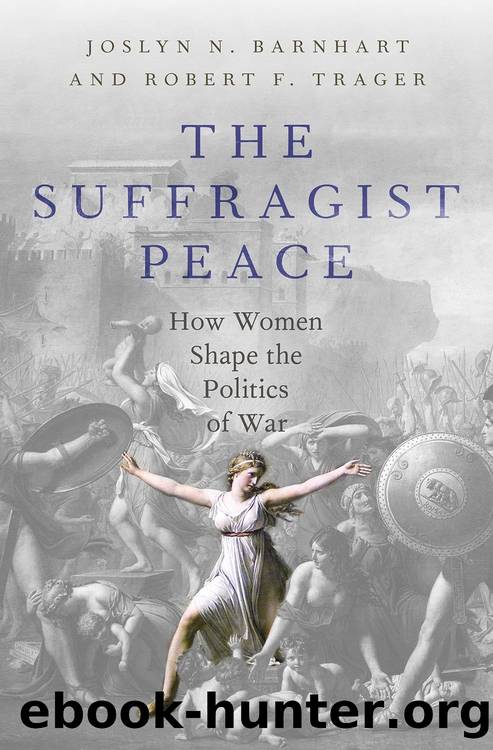
Author:Robert F. Trager;Joslyn N. Barnhart; & Joslyn N. Barnhart [Trager, Robert F. & Barnhart, Joslyn N.]
Language: eng
Format: epub
ISBN: 9780197629772
Publisher: Oxford University Press USA
Published: 2022-11-29T00:00:00+00:00
Kings and Queens
It turns out that determining whether men and women leaders behave differently on averageâand whyâis difficult. For starters, men and women may come to power in different contexts. Men may be more likely, for instance, to rise to power in dangerous times, making them appear more willing to go to war even though they are not.29 Women might be elevated to positions of power when things are going poorly for male leadersâa phenomenon known in business as âthe glass cliff.â In these contexts women are put into precarious positions with a far higher likelihood of failure, making it exceedingly difficult to assess performance. This was the case for prime Minister KatrÃn Jakobsdóttir, who was was appointed in 2017 to stabilize Iceland after three elections in the preceding four years, and British prime Minister Theresa May, who was given the extraordinary task of negotiating Britainâs exit from the European Union, a no-win political situation that made no one wholly happy with the outcome.
On the flip side, women may also come to power when more cooperative, stereotypically âfeminineâ attributes are required, like post-war reconciliation. This was the case in Germany, when Angela Merkel rose to power in a recently reunified Germany and in a post-war Liberia, where Ellen Johnson-Sirleaf took over with her âmotherly sensitivity.â Beyond these examples, there may be a thousand differences in context that influence both which genders come to power and whether states end up at war. These unknown elements of political contexts may be the true cause of apparent differences among leaders of different genders.
Anther reason that this question is so difficult to answer is that men and women leaders may be treated differently by both their militaries at home and their male colleagues abroad. Corazon, the former president of the Philippines, reported, for instance, that the Filipino military found it âextremely difficult to accept a woman commander-in-chief.â30 If female leaders are more likely to seek peace, it could be this very tendency that leads them to be attacked more often.31
Happily, one study largely overcomes these challenges by taking advantage of a randomization performed by nature herself: the sex of the first-born child. In European history, when kings and queens had children, the sex of the first-born child was a strong predictor of whether the next ruler would be male or female. This fact allows researchers to use a statistical technique known as âinstrumental variablesâ to parse out the effect of that rulerâs sex on war and peace.32 It is almost like running an experiment in which the gender of the ruler is randomly assigned, just as new drugs are randomly assigned to some participants in drug trials. But not quite because a first-born female may not be ableâor allowedâto take the throne.
These researchers use data on European kings and queens from 1480 to 1913. Incredibly, they find that queens are 39% more likely to fight a war in a year than kings. Queens also took more territory than kings over the course of their reigns.
Download
This site does not store any files on its server. We only index and link to content provided by other sites. Please contact the content providers to delete copyright contents if any and email us, we'll remove relevant links or contents immediately.
The Secret History by Donna Tartt(19105)
The Social Justice Warrior Handbook by Lisa De Pasquale(12197)
Thirteen Reasons Why by Jay Asher(8921)
This Is How You Lose Her by Junot Diaz(6894)
Weapons of Math Destruction by Cathy O'Neil(6285)
Zero to One by Peter Thiel(5808)
Beartown by Fredrik Backman(5769)
The Myth of the Strong Leader by Archie Brown(5513)
The Fire Next Time by James Baldwin(5454)
How Democracies Die by Steven Levitsky & Daniel Ziblatt(5225)
Promise Me, Dad by Joe Biden(5157)
Stone's Rules by Roger Stone(5091)
A Higher Loyalty: Truth, Lies, and Leadership by James Comey(4967)
100 Deadly Skills by Clint Emerson(4932)
Rise and Kill First by Ronen Bergman(4797)
Secrecy World by Jake Bernstein(4756)
The David Icke Guide to the Global Conspiracy (and how to end it) by David Icke(4724)
The Farm by Tom Rob Smith(4517)
The Doomsday Machine by Daniel Ellsberg(4493)
