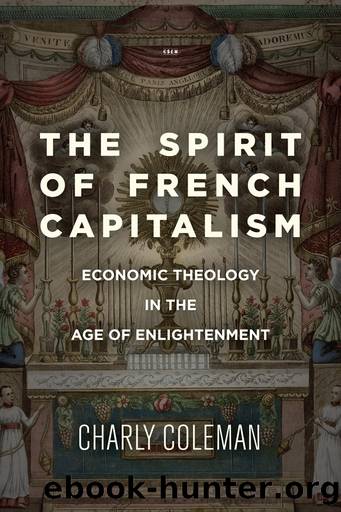
The Spirit of French Capitalism by Charly Coleman;
Author:Charly Coleman;
Language: eng
Format: epub
Publisher: Stanford University Press
Published: 2021-01-15T00:00:00+00:00
Theologians drew deeply on monetary metaphors to describe the workings of the spiritual economy. An eighteenth-century compendium of real indulgences stressed the supplemental, even superfluous, nature of the exchange. Pardons presumed a surfeit of sin, the temporal penalties for which could not be expiated in a single lifetime. God offered sinners the possibility of forgiving the original offense as well as the punishment it brought upon the soul. The compiler marveled at the âgenerous goodness of the Church, which procures for us so sure and so abundant a meansâ of salvation in the âdepository of an inexhaustible treasure.â He urged readers to seek fortunes so freely given: âLet us never lose an occasion to profit,â he wrote, from privileges that âkeep us in a spirit of fervor.â93 The analogies formulated between temporal and heavenly wealth transformed both registers of meaning. Economic references designated devotional objects as a means of conveying value without end. The economy in question was founded not on scarcity but abundance, with the rosary mediating between infinite indebtedness and infinite redemption.
As Pierre Forestier, canon on Avalon, observed, âthe sovereign pontiffs seem to have wanted to surpass each other in the liberality with which they enriched the Rosary with indulgences.â94 In 1686 Pope Innocent XI directed Antoine de Monroy, Master of the Dominican Order, to publish a compilation of grants issued during his predecessorsâ reigns. The quantities of indulgences varied widely: Sixtus IV (r. 1471â84) promised five years and five quarantines for saying the Rosary. As noted in the introduction to this chapter, his successor, Innocent VIII, increased the amount to a staggering sixty thousand years, provided one confessed before praying; the reward of five years was also retained, now merely for uttering the name of Jesus after each Ave Maria. Clement IX (r. 1667â69) guaranteed that Catholics in the Spanish Antilles enjoyed the same benefits as subjects residing in the metropole. Gregory XIII gave plenary indulgences to members who confessed and communed before participating in a procession with their rosaries; men and women too infirmed to participate could recite the prayers at home. Still further dispensations accrued for visiting the Chapel of the Holy Rosary in Rome or elsewhere, for giving alms, caring for ailing friends, attending services, and performing other pious actions.95
Several popes, including Innocent VIII, Pius V, Clement VIII (r. 1592â1605), and Clement X (r. 1670â76), offered to forgive all outstanding temporal penalties at the moment of death. This was an especially valuable asset, since it opened the possibility of avoiding purgatory altogether. For the most part, one needed only to have received last rites, or, less frequently, to have said the rosary either regularly during oneâs lifetime or in oneâs final hours. In drawing up the terms for gaining an indulgence, popes made allowances for the ill and indisposed, who often could recite prayers as a substitute for another good work.96 Clement X and Innocent XI also authorized petitions to bestow the advantages enjoyed by the confraternities on the âsouls of the faithful departed in union with God.
Download
This site does not store any files on its server. We only index and link to content provided by other sites. Please contact the content providers to delete copyright contents if any and email us, we'll remove relevant links or contents immediately.
| Arms Control | Diplomacy |
| Security | Trades & Tariffs |
| Treaties | African |
| Asian | Australian & Oceanian |
| Canadian | Caribbean & Latin American |
| European | Middle Eastern |
| Russian & Former Soviet Union |
The Secret History by Donna Tartt(19058)
The Social Justice Warrior Handbook by Lisa De Pasquale(12187)
Thirteen Reasons Why by Jay Asher(8894)
This Is How You Lose Her by Junot Diaz(6877)
Weapons of Math Destruction by Cathy O'Neil(6267)
Zero to One by Peter Thiel(5789)
Beartown by Fredrik Backman(5737)
The Myth of the Strong Leader by Archie Brown(5500)
The Fire Next Time by James Baldwin(5432)
How Democracies Die by Steven Levitsky & Daniel Ziblatt(5216)
Promise Me, Dad by Joe Biden(5144)
Stone's Rules by Roger Stone(5081)
A Higher Loyalty: Truth, Lies, and Leadership by James Comey(4954)
100 Deadly Skills by Clint Emerson(4921)
Rise and Kill First by Ronen Bergman(4780)
Secrecy World by Jake Bernstein(4742)
The David Icke Guide to the Global Conspiracy (and how to end it) by David Icke(4709)
The Farm by Tom Rob Smith(4502)
The Doomsday Machine by Daniel Ellsberg(4484)
