The Slow Burning Fuse by Quail John; Heath Nick; Bantman Constance
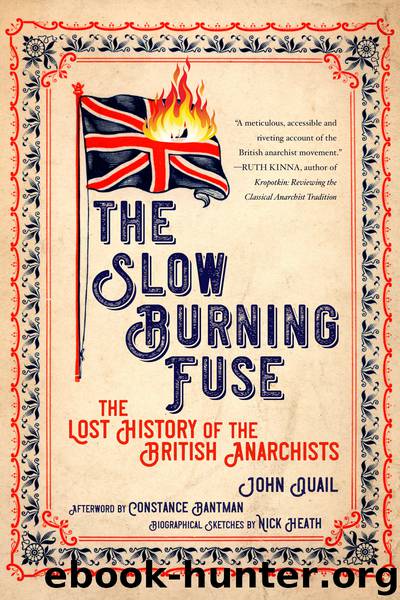
Author:Quail, John; Heath, Nick; Bantman, Constance
Language: eng
Format: epub
Publisher: PM Press
Published: 2019-05-19T04:00:00+00:00
Chapter 10
THE MOVEMENT IN 1894
In the years 1889–1891 there had been a positive orgy of trades union organising. There has been no satisfactory attempt to describe and analyse this phenomenon as a whole, much needed though it is. It is clear though that the ‘terms of trade’ had swung in favour of labour, which made such organisation very much more simple. The combativeness had obviously been stimulated by the unemployed agitation and socialists in the previous years. The gains of 1889–1890 began to be eroded by unemployment and the counter-attack of the employers. Unemployment rose seriously between 1891 and 1893. Yet the earlier gains were not given up without a struggle. Defensive strikes occurred in many places. Some were of a massive and riotous nature and mobilised many more people than were involved in the strikes themselves. In December 1892 a fund raising procession in Bristol in support of a strike was banned. It took place anyway, and the authorities were unable to enforce their ban until dragoons had made repeated charges involving the free use of lances and sabres on a crowd estimated to number some hundreds of thousands. In the Hull dock strike in May 1893, gunboats were moored in the Humber, there was arson in the docks and many confrontations took place between strikers and police. It was not only in connection with industrial disputes that the people demonstrated their readiness to take direct action. The August 1892 issue of Commonweal reported that 3,000 people had first pulled down the railings protecting a railway that had been run across common land at Leyton, near London. They then proceeded to wreck the railway itself. The spirit of the times also made itself manifest in more local eruptions: when broker’s men seized the goods of a widow in Clerkenwell, a quickly gathering crowd attacked the men, smashed the seized goods and used the bits, together with lumps of coal, potatoes and garbage, to attack police when these subsequently arrived.1
In fact this period after the ‘boom’ of organising, when the working class was in an embattled and bitter mood, proved a more responsive one for the anarchists. The period 1889–1890 had led to something of a scattering of the libertarian wing of the socialist movement. Insofar as there had been any anarchist organisation at all it had been based in London on the London Socialist League. Outside London, branches of the Socialist League in their various states of disintegration or transformation had provided temporary haven, particularly where socialist clubs had been formed. It was not until mid-1892 that a federation of anarchist groups was formed in London and not until a little later that specifically anarchist groups were formed in the provinces. The one exception was a group formed in Sheffield in early 1891. This group however was formed round the exceptional personality of Dr John Creaghe, and when he left Sheffield towards the end of that year it went into something of a decline. The anarchists at this point were not really able to sustain an organisation separately.
Download
This site does not store any files on its server. We only index and link to content provided by other sites. Please contact the content providers to delete copyright contents if any and email us, we'll remove relevant links or contents immediately.
| Anarchism | Communism & Socialism |
| Conservatism & Liberalism | Democracy |
| Fascism | Libertarianism |
| Nationalism | Radicalism |
| Utopian |
The Secret History by Donna Tartt(19035)
The Social Justice Warrior Handbook by Lisa De Pasquale(12183)
Thirteen Reasons Why by Jay Asher(8885)
This Is How You Lose Her by Junot Diaz(6873)
Weapons of Math Destruction by Cathy O'Neil(6261)
Zero to One by Peter Thiel(5784)
Beartown by Fredrik Backman(5734)
The Myth of the Strong Leader by Archie Brown(5495)
The Fire Next Time by James Baldwin(5428)
How Democracies Die by Steven Levitsky & Daniel Ziblatt(5211)
Promise Me, Dad by Joe Biden(5141)
Stone's Rules by Roger Stone(5080)
A Higher Loyalty: Truth, Lies, and Leadership by James Comey(4947)
100 Deadly Skills by Clint Emerson(4917)
Rise and Kill First by Ronen Bergman(4776)
Secrecy World by Jake Bernstein(4739)
The David Icke Guide to the Global Conspiracy (and how to end it) by David Icke(4697)
The Farm by Tom Rob Smith(4501)
The Doomsday Machine by Daniel Ellsberg(4482)
