The Shaming State by Sara Salman;
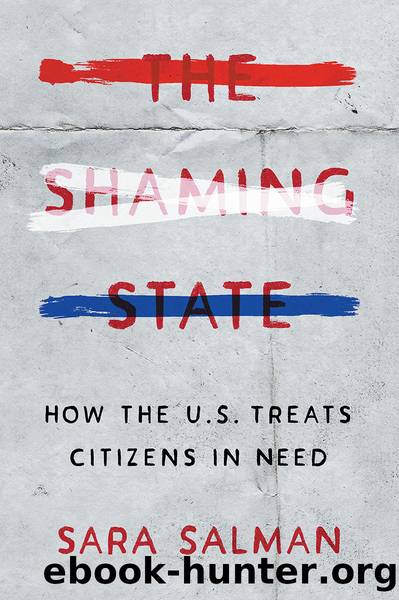
Author:Sara Salman;
Language: eng
Format: epub
Tags: POL042000 POLITICAL SCIENCE / Political Ideologies / General
Publisher: New York University Press
The Burden of Suspicion and the Cost of Fraud Prevention
The problems that plagued Build It Back are not simply problems caused by bad subcontractors. At the outset, New York City officials assumed that public money is scarce, and people tend toward fraud. The result was a program that treated recipients accordingly. Build It Back also revealed the faith public officials have in consultancy firms, which were not held accountable even as they raked in millions of public funds on jobs that were poorly done. The neighborhood residents came face to face with a convoluted bureaucratic post-disaster rebuilding program intended to combat fraud but which functioned to keep them out. Build It Back came to identify needing help with fraud, even if that was not the explicit intent of the program. As such, it came to resemble stigmatizing assistance given to the poor through programs like TANF. The familiesâ negative feelings of shame and humiliation were connected to how the process of Build It Back exhibited mistrust and contempt toward the families.
It may be difficult at first to draw comparisons to the experiences of Iraqi families at the DHHS offices, where their time was not valued and where they were expected to exhibit deference to their caseworkers. Build It Back is not the same as public assistance programs. It was introduced on the premise that people needed assistance to rebuild and repair after Hurricane Sandy. The program the city created was going to be simple and supportive. There was political consensus, with the exception of a small number of conservative congress members, that the hurricane was real in its effect and that victims who lost their belongings deserved help. The consensus on the nature of need in this instance is in stark contrast to the consensus that frames the poor relief programs described in part 1, where refugee families were lumped with poor American families suspected of defrauding the DHHS. Post-disaster long-term aid was presented sympathetically by federal, state, and local governments. But if we look closely at the experiences of the families with Build It Back, we come to observe high administrative burdens that are not so different from the ones carried by Iraqi families. If we return to Moynihan, Herd, and Harveyâs types of burdens, we find that Build It Back exhibited high compliance costs as well learning and psychological costs.29
Neighborhood residents like Janice had to learn about the Build It Back appeal process in order to contest the decision to deny her application. She relied on her knowledge of bureaucratic language from her professional experience in management and administration. She felt badly for her neighbors, knowing that they may not possess the same know-how: âNow, I picture all these steps as one of my neighbors who doesnât have a lot of skills in this stuff. And itâs like, they would have just folded and gone away.â Janice compared Build It Back to other public assistance programs, and was certain that likewise, it was âbuilt so people opt out.â
Download
This site does not store any files on its server. We only index and link to content provided by other sites. Please contact the content providers to delete copyright contents if any and email us, we'll remove relevant links or contents immediately.
| Anthropology | Archaeology |
| Philosophy | Politics & Government |
| Social Sciences | Sociology |
| Women's Studies |
The Secret History by Donna Tartt(19089)
The Social Justice Warrior Handbook by Lisa De Pasquale(12190)
Thirteen Reasons Why by Jay Asher(8910)
This Is How You Lose Her by Junot Diaz(6887)
Weapons of Math Destruction by Cathy O'Neil(6280)
Zero to One by Peter Thiel(5802)
Beartown by Fredrik Backman(5754)
The Myth of the Strong Leader by Archie Brown(5508)
The Fire Next Time by James Baldwin(5446)
How Democracies Die by Steven Levitsky & Daniel Ziblatt(5219)
Promise Me, Dad by Joe Biden(5153)
Stone's Rules by Roger Stone(5088)
A Higher Loyalty: Truth, Lies, and Leadership by James Comey(4964)
100 Deadly Skills by Clint Emerson(4925)
Rise and Kill First by Ronen Bergman(4789)
Secrecy World by Jake Bernstein(4753)
The David Icke Guide to the Global Conspiracy (and how to end it) by David Icke(4720)
The Farm by Tom Rob Smith(4513)
The Doomsday Machine by Daniel Ellsberg(4490)
